Sign In Start Free Trial
Account

Add to playlist

Create a Playlist

Modal Close icon
You need to login to use this feature.
  • Book Overview & Buying Full Stack FastAPI, React, and MongoDB
  • Table Of Contents Toc
  • Feedback & Rating feedback
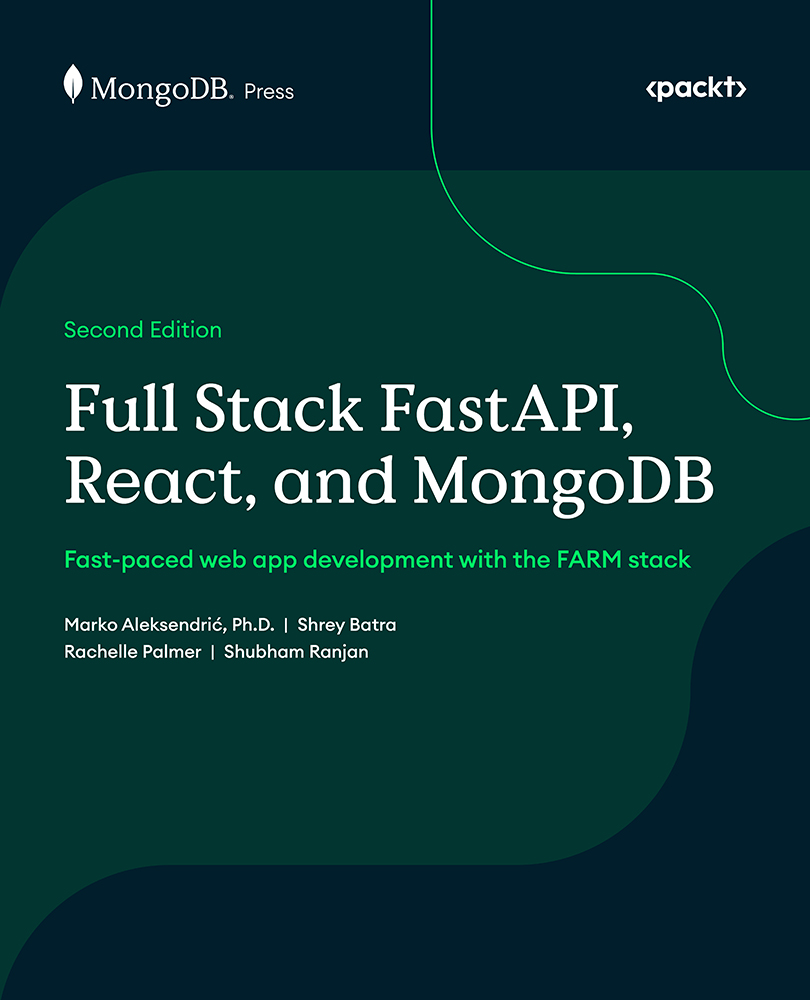
Full Stack FastAPI, React, and MongoDB

Full Stack FastAPI, React, and MongoDB - Second Edition

By : Marko Aleksendrić, Shrey Batra, Rachelle Palmer, Shubham Ranjan
5 (1)
close
close
Full Stack FastAPI, React, and MongoDB

Full Stack FastAPI, React, and MongoDB

5 (1)
By: Marko Aleksendrić, Shrey Batra, Rachelle Palmer, Shubham Ranjan

Overview of this book

Discover how to harness the power of the FARM stack—FastAPI, React, and MongoDB—to develop production-ready web applications of varying complexity. Written by a team of industry experts, including MongoDB champions and product leaders, this fast-paced, hands-on guide equips beginners with essential skills to build web applications efficiently. Introducing each element of the stack, the book demonstrates how to seamlessly integrate them to create a medium-sized web application. You'll set up MongoDB as a document store, construct a simple API with FastAPI, and build an application using React. The guide also covers enhancing application security through authentication and authorization with JSON Web Tokens. Beyond mastering the stack, you'll get to grips with integrating Large Language Models (like ChatGPT) for advanced functionality, such as automated email sending. Additionally, you'll learn how to make the most of Next.js 14, a robust full-stack framework offering improved developer experience. By the end of the book, you'll have created functional applications and gained the foundation to explore diverse and more specialized domains, expanding your development horizons.
Table of Contents (14 chapters)
close
close

Why use MongoDB?

MongoDB is a free, fast, and scalable database with a JSON format and simple syntax. It enables flexible schemas and, thus, iterative and rapid development. MongoDB is able to accommodate data structures of varying complexities. Additionally, its querying and aggregation methods make it an excellent choice for a flexible REST API framework such as FastAPI, coupled with an official Python driver such as Motor. It has a high level of adoption and maturity and is one of the pillars of the NoSQL data storage movement that took the web development world by storm a decade ago.

The following are some other features that will be detailed for use in this book:

  • Complex nested structures: MongoDB documents allow other documents and arrays of documents to be embedded, which naturally translates into the data flow of a modern data web app (for example, you can embed all comments into the blog post they respond to). Denormalization is encouraged.
  • Simple, intuitive syntax: The methods for performing basic create, read, update, delete (CRUD) operations, coupled with powerful aggregation frameworks and projections, allow you to achieve almost all data reads quite easily through the use of drivers. The commands should be intuitive for anyone with a bit of SQL experience.
  • Community and documentation: MongoDB is backed by a mature company and a strong community, and it offers various tools to facilitate the development and prototyping process. For instance, Compass is a desktop application that enables users to manage and administer databases. The framework of the serverless functions is constantly being updated and upgraded, and there are excellent drivers for virtually every programming language.

Of course, MongoDB is not a silver bullet, and some challenges are worth noticing upfront. On the one hand, the schema-less design and the ability to insert any type of data into your database might be a bit panic-inducing but translates to the need for stronger data integrity validation on the backend side. You will see how Pydantic—an excellent Python validation and type-enforcement library—can help you with stronger data integrity. The absence of complex joins, which are present in the SQL world, might be a dealbreaker for some types of applications.

Now that you understand what MongoDB brings to the table in terms of scalability and flexibility, with its schema-less approach, take a look at the REST API framework of choice, FastAPI, and learn how it can help you implement that schema-less approach and simplify your interactions with the data.

Visually different images
CONTINUE READING
83
Tech Concepts
36
Programming languages
73
Tech Tools
Icon Unlimited access to the largest independent learning library in tech of over 8,000 expert-authored tech books and videos.
Icon Innovative learning tools, including AI book assistants, code context explainers, and text-to-speech.
Icon 50+ new titles added per month and exclusive early access to books as they are being written.
Full Stack FastAPI, React, and MongoDB
notes
bookmark Notes and Bookmarks search Search in title playlist Add to playlist download Download options font-size Font size

Change the font size

margin-width Margin width

Change margin width

day-mode Day/Sepia/Night Modes

Change background colour

Close icon Search
Country selected

Close icon Your notes and bookmarks

Confirmation

Modal Close icon
claim successful

Buy this book with your credits?

Modal Close icon
Are you sure you want to buy this book with one of your credits?
Close
YES, BUY

Submit Your Feedback

Modal Close icon
Modal Close icon
Modal Close icon