Sign In Start Free Trial
Account

Add to playlist

Create a Playlist

Modal Close icon
You need to login to use this feature.
  • Book Overview & Buying Full Stack FastAPI, React, and MongoDB
  • Table Of Contents Toc
  • Feedback & Rating feedback
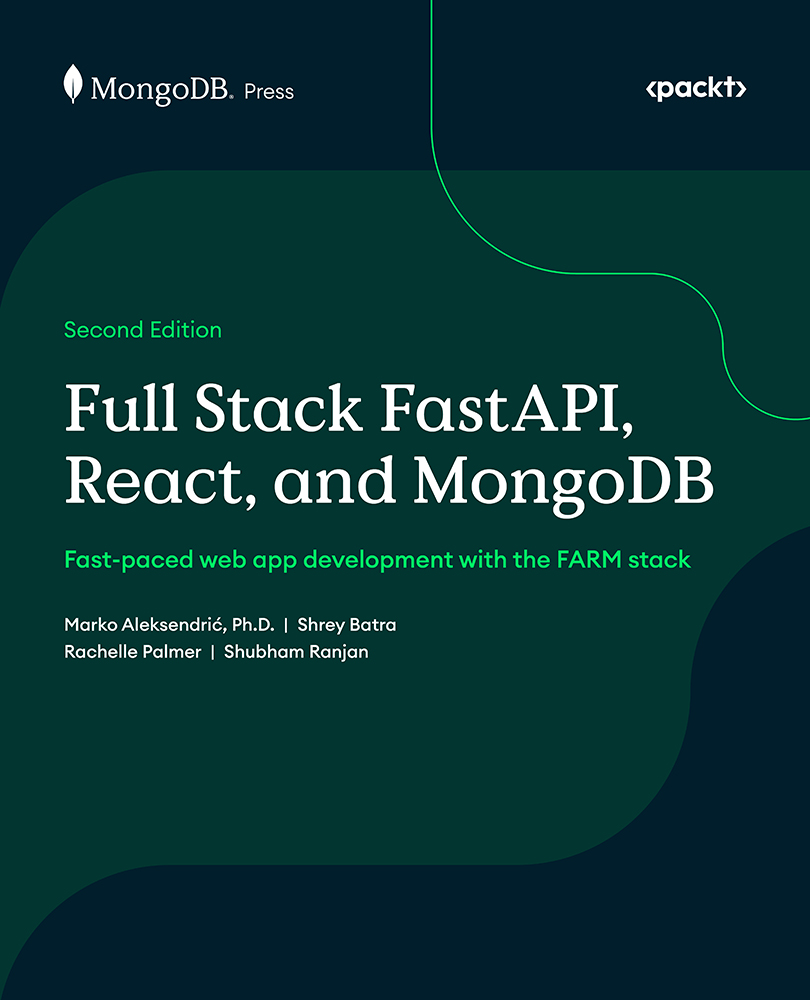
Full Stack FastAPI, React, and MongoDB

Full Stack FastAPI, React, and MongoDB - Second Edition

By : Marko Aleksendrić, Shrey Batra, Rachelle Palmer, Shubham Ranjan
5 (1)
close
close
Full Stack FastAPI, React, and MongoDB

Full Stack FastAPI, React, and MongoDB

5 (1)
By: Marko Aleksendrić, Shrey Batra, Rachelle Palmer, Shubham Ranjan

Overview of this book

Discover how to harness the power of the FARM stack—FastAPI, React, and MongoDB—to develop production-ready web applications of varying complexity. Written by a team of industry experts, including MongoDB champions and product leaders, this fast-paced, hands-on guide equips beginners with essential skills to build web applications efficiently. Introducing each element of the stack, the book demonstrates how to seamlessly integrate them to create a medium-sized web application. You'll set up MongoDB as a document store, construct a simple API with FastAPI, and build an application using React. The guide also covers enhancing application security through authentication and authorization with JSON Web Tokens. Beyond mastering the stack, you'll get to grips with integrating Large Language Models (like ChatGPT) for advanced functionality, such as automated email sending. Additionally, you'll learn how to make the most of Next.js 14, a robust full-stack framework offering improved developer experience. By the end of the book, you'll have created functional applications and gained the foundation to explore diverse and more specialized domains, expanding your development horizons.
Table of Contents (14 chapters)
close
close

Why use FastAPI?

FastAPI is a modern and performant web framework for building APIs. Built by Sebastian Ramirez, it uses the newest features of the Python programming language, such as type hinting and annotations, the async – await syntax, Pydantic models, web socket support, and more.

If you are not familiar with APIs, let’s get into it in more depth by understanding what an API is. An application programming interface (API) is used to enable some kind of interaction between different pieces of software, and they communicate using Hypertext Transfer Protocol (HTTP) through a cycle of requests and responses. Therefore, an API is, as its name suggests, an interface. Via this interface, humans or machines interact with an application or a service. Every API provider should have an interface that is well suited for the type of data that they provide; for instance, a weather forecasting station provides an API that lists the temperatures and humidity levels for a certain location. Sports sites provide statistical data about the games that are being played. A pizza delivery API will provide you with the selected ingredients, the price, and the estimated time of arrival.

APIs touch every aspect of your life, for example, transmitting medical data, enabling fast communications between applications, and even used in tractors in fields. APIs are what make today’s web run and, put simply, are the best form of information exchange.

This chapter will not go over the rigorous definitions of REST APIs, but just list some of their most important features:

  • Statelessness: REST APIs are said to be stateless, which means that neither the client nor the server stores any states in between. All the requests and responses are handled by the API server in isolation and without information about the session itself.
  • Layered structure: To keep the API scalable and understandable, a RESTful architecture implies a layered structure. The different layers form a hierarchy and communicate with each other but not with every component, thus improving overall security.
  • Client-server architecture: APIs should be able to connect different systems/pieces of software without limiting their own functionalities—the server and the client have to stay separate and independent from each other.

There are numerous reasons why MongoDB chose FastAPI for their REST API layer, even though it’s new compared to other Python frameworks. Here are some of the reasons:

  • High performance: FastAPI can achieve very high performance, especially compared to other Python-based solutions. By using Starlette under the hood, FastAPI’s performance reaches levels that are usually reserved for Node.js and Go.
  • Data validation and simplicity: Being heavily based on Python types and Pydantic brings numerous benefits. Since Pydantic structures are just instances of classes the developers define, you can use complex data validations, deeply nested JSON objects, and hierarchical models (using Python lists and dictionaries), and this relates very well with the nature of MongoDB.
  • Faster development: Development becomes more intuitive, with strong integrated development environment (IDE) support, which leads to faster development time and fewer bugs.
  • Standards compliance: FastAPI is standard-based and fully compatible with open standards for building APIs—such as OpenAPI and JSON schema.
  • Logical structuring of apps: The framework allows the structuring of APIs and apps into multiple routers and allows granular request and response customization, and easy access to every part of the HTTP cycle.
  • Async support: FastAPI uses an asynchronous server gateway interface (ASGI) and, with the use of an ASGI-compatible server, such as Uvicorn or Hypercorn, is able to provide a truly asynchronous workflow without actually having to import the asyncio module into Python.
  • Dependency injection: The dependency injection system in FastAPI is one of its biggest selling points. It enables the creation of complex functionalities that are easily reusable across your API. This is a pretty big deal and probably the feature that makes FastAPI ideal for hybrid web apps—it gives developers the opportunity to easily attach different functionalities to the REST endpoints.
  • Great documentation: The documentation of the framework itself is excellent and second to none. It is both easy to follow and extensive.
  • Automatic documentation: Being based on OpenAPI, FastAPI enables automatic documentation creation, which essentially means that you get your API documented for free with Swagger.

Also, getting started is relatively simple:

pip install fastapi

In order to get at least a basic idea of what coding with FastAPI looks like, let’s take a look at a minimal API:

# main.py
from fastapi import FastAPI
app = FastAPI()
@app.get(“/”)
async def root():
    return {“message”: “Hello World”}

The preceding few lines of code define a minimal API with a single endpoint (/) that responds to a GET request with the message Hello world. You can instantiate a FastAPI class and use decorators to tell the server which HTTP methods should trigger which function for a response.

Visually different images
CONTINUE READING
83
Tech Concepts
36
Programming languages
73
Tech Tools
Icon Unlimited access to the largest independent learning library in tech of over 8,000 expert-authored tech books and videos.
Icon Innovative learning tools, including AI book assistants, code context explainers, and text-to-speech.
Icon 50+ new titles added per month and exclusive early access to books as they are being written.
Full Stack FastAPI, React, and MongoDB
notes
bookmark Notes and Bookmarks search Search in title playlist Add to playlist download Download options font-size Font size

Change the font size

margin-width Margin width

Change margin width

day-mode Day/Sepia/Night Modes

Change background colour

Close icon Search
Country selected

Close icon Your notes and bookmarks

Confirmation

Modal Close icon
claim successful

Buy this book with your credits?

Modal Close icon
Are you sure you want to buy this book with one of your credits?
Close
YES, BUY

Submit Your Feedback

Modal Close icon
Modal Close icon
Modal Close icon