
Sign In Start Free Trial
Account

Add to playlist

Create a Playlist

Modal Close icon
You need to login to use this feature.
  • Book Overview & Buying Learn D3.js
  • Table Of Contents Toc
Learn D3.js

Learn D3.js

By : Helder da Rocha
4.3 (9)
close
close
Learn D3.js

Learn D3.js

4.3 (9)
By: Helder da Rocha

Overview of this book

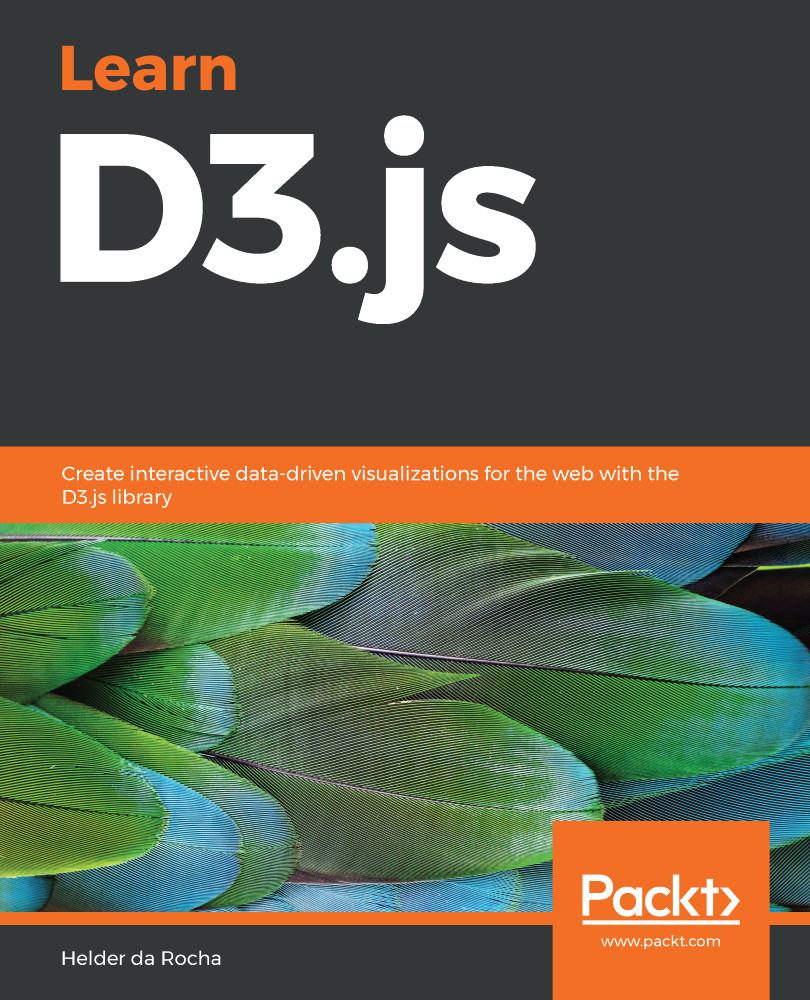
This book is a practical hands-on introduction to D3 (Data-driven Documents): the most popular open-source JavaScript library for creating interactive web-based data visualizations. Based entirely on open web standards, D3 provides an integrated collection of tools for efficiently binding data to graphical elements. If you have basic knowledge of HTML, CSS and JavaScript you can use D3.js to create beautiful interactive web-based data visualizations. D3 is not a charting library. It doesn’t contain any pre-defined chart types, but can be used to create whatever visual representations of data you can imagine. The goal of this book is to introduce D3 and provide a learning path so that you obtain a solid understanding of its fundamental concepts, learn to use most of its modules and functions, and gain enough experience to create your own D3 visualizations. You will learn how to create bar, line, pie and scatter charts, trees, dendograms, treemaps, circle packs, chord/ribbon diagrams, sankey diagrams, animated network diagrams, and maps using different geographical projections. Fundamental concepts are explained in each chapter and then applied to a larger example in step-by-step tutorials, complete with full code, from hundreds of examples you can download and run. This book covers D3 version 5 and is based on ES2015 JavaScript.
Table of Contents (13 chapters)
close
close

Creating a scatterplot

In this final section, you will use the features that you learned about in this chapter to create a scatterplot and compared the Gross Domestic Product (GDP) per capital and the Human Development Index (HDI) of several countries. This is a step-by-step tutorial. We will start with a simple chart and add axes, labels, and interactive features. You can code as you go or download the files that are available from the StepByStep/ folder, in the GitHub repository for this chapter.

The CSV data file that's used for this visualization (Data/un_regions_gdp.csv) contains data that was obtained from several sources, such as the United Nations and the World Bank. Both the HDI and GDP are from 2017, so they can be compared. The following is a fragment of this file, showing the headers and some rows of data:

Country,Continent,Area_km2,Pop_2016,HDI_2017,Code,GDP_2017...
Visually different images
CONTINUE READING
83
Tech Concepts
36
Programming languages
73
Tech Tools
Icon Unlimited access to the largest independent learning library in tech of over 8,000 expert-authored tech books and videos.
Icon Innovative learning tools, including AI book assistants, code context explainers, and text-to-speech.
Icon 50+ new titles added per month and exclusive early access to books as they are being written.
Learn D3.js
notes
bookmark Notes and Bookmarks search Search in title playlist Add to playlist download Download options font-size Font size

Change the font size

margin-width Margin width

Change margin width

day-mode Day/Sepia/Night Modes

Change background colour

Close icon Search
Country selected

Close icon Your notes and bookmarks

Confirmation

Modal Close icon
claim successful

Buy this book with your credits?

Modal Close icon
Are you sure you want to buy this book with one of your credits?
Close
YES, BUY

Submit Your Feedback

Modal Close icon
Modal Close icon
Modal Close icon