Sign In Start Free Trial
Account

Add to playlist

Create a Playlist

Modal Close icon
You need to login to use this feature.
  • Book Overview & Buying Learning PHP Data Objects
  • Table Of Contents Toc
  • Feedback & Rating feedback
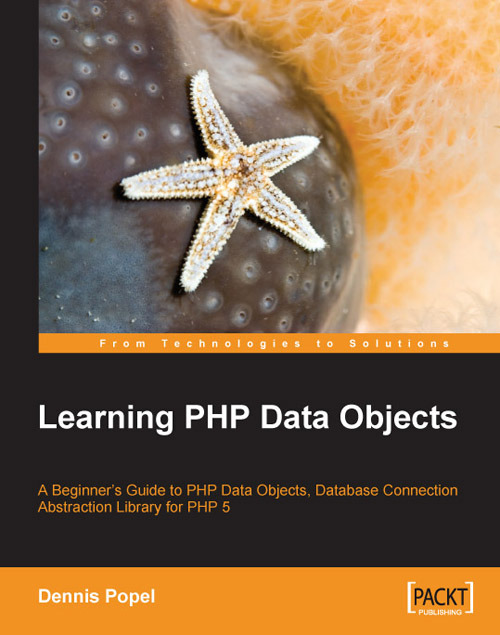
Learning PHP Data Objects

Learning PHP Data Objects

By : Dennis Popel
4.2 (10)
close
close
Learning PHP Data Objects

Learning PHP Data Objects

4.2 (10)
By: Dennis Popel

Overview of this book

PDO is lighter, faster, and more powerful than existing PHP data abstraction interfaces. PDO is a common interface to different databases that must be used with a database-specific PDO driver to access a particular database server: the PDO extension does not provide a database abstraction by itself; it doesn't rewrite SQL, emulate missing database features, or perform any database functions using by itself. It performs the same role as other classic database abstraction layers such as ODBC and JDBC: it's a query abstraction layer that abstracts the mechanism for accessing a database and manipulating the returned records; each database driver that implements the PDO interface can also expose database-specific features as regular extension functions. ¬ PDO ships with PHP 5.1, and is available as an extension for PHP 5.0; it requires the new object-oriented features of PHP 5, and cannot run with earlier versions of PHP.This book will teach you how to use the PDO, including its advanced features. Readers need to be aware of the basics of data abstraction and should be familiar with PHP.
Table of Contents (13 chapters)
close
close

Chapter 5. Handling Rowsets

Real life dynamic, data-driven web applications are very different from each other, as their complexity is dictated by the purposes that they serve. However, almost all of them have some common characteristics. One of these characteristics is the ability to paginate long result lists for ease of use and faster page loading times.

Correct pagination requires the calculation of the number of total rows returned from the database, the page size (which is a configurable option), and the number of current page. Based on this data, it is easy to calculate the starting offset into the result set to display only a subset of rows.

In this chapter, we will examine:

  • How to retrieve the number of rows in the result sets returned by PDO

  • How to fetch results starting at a specified row number

Retrieving the Number of Rows in a Result Set

As we have already discussed in Chapter 2, the PDOStatement::rowCount() method does not return the correct number of rows in a query. (It returns...

Visually different images
CONTINUE READING
83
Tech Concepts
36
Programming languages
73
Tech Tools
Icon Unlimited access to the largest independent learning library in tech of over 8,000 expert-authored tech books and videos.
Icon Innovative learning tools, including AI book assistants, code context explainers, and text-to-speech.
Icon 50+ new titles added per month and exclusive early access to books as they are being written.
Learning PHP Data Objects
notes
bookmark Notes and Bookmarks search Search in title playlist Add to playlist font-size Font size

Change the font size

margin-width Margin width

Change margin width

day-mode Day/Sepia/Night Modes

Change background colour

Close icon Search
Country selected

Close icon Your notes and bookmarks

Confirmation

Modal Close icon
claim successful

Buy this book with your credits?

Modal Close icon
Are you sure you want to buy this book with one of your credits?
Close
YES, BUY

Submit Your Feedback

Modal Close icon
Modal Close icon
Modal Close icon