Sign In Start Free Trial
Account

Add to playlist

Create a Playlist

Modal Close icon
You need to login to use this feature.
  • Book Overview & Buying Data Wrangling with Python
  • Table Of Contents Toc
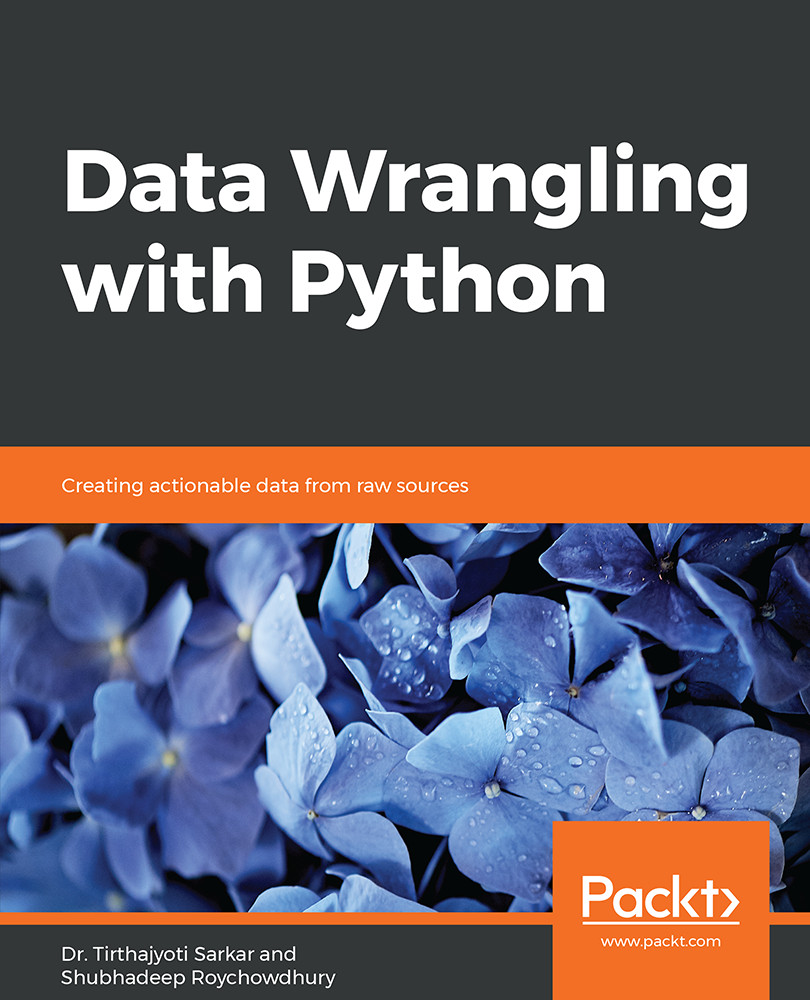
Data Wrangling with Python

Data Wrangling with Python

By : Dr. Tirthajyoti Sarkar, Shubhadeep Roychowdhury
3.7 (32)
close
close
Data Wrangling with Python

Data Wrangling with Python

3.7 (32)
By: Dr. Tirthajyoti Sarkar, Shubhadeep Roychowdhury

Overview of this book

For data to be useful and meaningful, it must be curated and refined. Data Wrangling with Python teaches you the core ideas behind these processes and equips you with knowledge of the most popular tools and techniques in the domain. The book starts with the absolute basics of Python, focusing mainly on data structures. It then delves into the fundamental tools of data wrangling like NumPy and Pandas libraries. You'll explore useful insights into why you should stay away from traditional ways of data cleaning, as done in other languages, and take advantage of the specialized pre-built routines in Python. This combination of Python tips and tricks will also demonstrate how to use the same Python backend and extract/transform data from an array of sources including the Internet, large database vaults, and Excel financial tables. To help you prepare for more challenging scenarios, you'll cover how to handle missing or wrong data, and reformat it based on the requirements from the downstream analytics tool. The book will further help you grasp concepts through real-world examples and datasets. By the end of this book, you will be confident in using a diverse array of sources to extract, clean, transform, and format your data efficiently.
Table of Contents (12 chapters)
close
close
Data Wrangling with Python
Preface
1
Appendix

Refresher of RDBMS and SQL


An RDBMS is a piece of software that manages data (represented for the end user in a tabular form) on physical hard disks and is built using the Codd's relational model. Most of the databases that we encounter today are RDBMS. In recent years, there has been a huge industry shift toward a newer kind of database management system, called NoSQL (MongoDB, CouchDB, Riak, and so on). These systems, although in some aspects they follow some of the rules of RDBMS, in most cases reject or modify them.

How is an RDBMS Structured?

The RDBMS structure consists of three main elements, namely the storage engine, query engine, and log management. Here is a diagram that shows the structure of a RDBMS:

Figure 8.2 RDBMS structure

The following are the main concepts of any RDBMS structure:

  • Storage engine: This is the part of the RDBMS that is responsible for storing the data in an efficient way and also to give it back when asked for, in an efficient way. As an end user of the RDBMS...

CONTINUE READING
83
Tech Concepts
36
Programming languages
73
Tech Tools
Icon Unlimited access to the largest independent learning library in tech of over 8,000 expert-authored tech books and videos.
Icon Innovative learning tools, including AI book assistants, code context explainers, and text-to-speech.
Icon 50+ new titles added per month and exclusive early access to books as they are being written.
Data Wrangling with Python
notes
bookmark Notes and Bookmarks search Search in title playlist Add to playlist font-size Font size

Change the font size

margin-width Margin width

Change margin width

day-mode Day/Sepia/Night Modes

Change background colour

Close icon Search
Country selected

Close icon Your notes and bookmarks

Confirmation

Modal Close icon
claim successful

Buy this book with your credits?

Modal Close icon
Are you sure you want to buy this book with one of your credits?
Close
YES, BUY

Submit Your Feedback

Modal Close icon
Modal Close icon
Modal Close icon