


-
Book Overview & Buying
-
Table Of Contents

An iOS Developer's Guide to SwiftUI
By :


An iOS Developer's Guide to SwiftUI
By:
Overview of this book
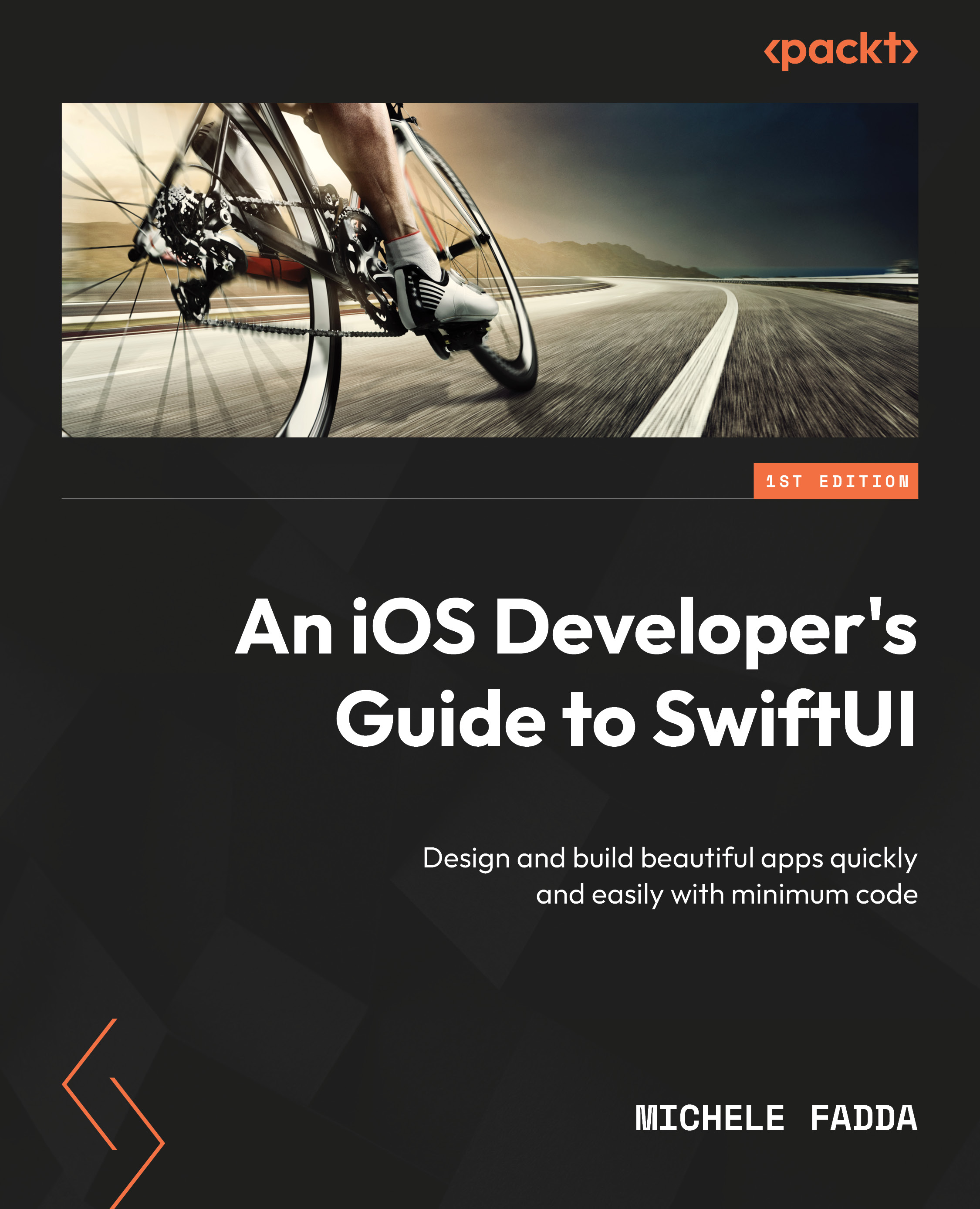
– SwiftUI transforms Apple Platform app development with intuitive Swift code for seamless UI design.
– Explore SwiftUI's declarative programming: define what the app should look like and do, while the OS handles the heavy lifting.
– Hands-on approach covers SwiftUI fundamentals and often-omitted parts in introductory guides.
– Progress from creating views and modifiers to intricate, responsive UIs and advanced techniques for complex apps.
– Focus on new features in asynchronous programming and architecture patterns for efficient, modern app design.
– Learn UIKit and SwiftUI integration, plus how to run tests for SwiftUI applications.
– Gain confidence to harness SwiftUI's full potential for building professional-grade apps across Apple devices.
Table of Contents (25 chapters)
Preface


Chapter 1: Exploring the Environment – Xcode, Playgrounds, and SwiftUI
Chapter 2: Adding Basic UI Elements and Designing Layouts
Chapter 3: Adding Interactivity to a SwiftUI View
Part 2: Scrollable Views
Chapter 4: Iterating Views, Scroll Views, FocusState, Lists, and Scroll View Reader
Chapter 5: The Art of Displaying Grids
Part 3: SwiftUI Navigation
Chapter 6: Tab Bars and Modal View Presentation
Chapter 7: All About Navigation
Part 4: Graphics and Animation
Chapter 8: Creating Custom Graphics
Chapter 9: An Introduction to Animations in SwiftUI
Part 5: App Architecture
Chapter 10: App Architecture and SwiftUI Part I: Practical Tools
Chapter 11: App Architecture and SwiftUI Part II – the Theory
Part 6: Beyond Basics
Chapter 12: Persistence with Core Data
Chapter 13: Modern Structured Concurrency

Chapter 14: An Introduction to SwiftData
Chapter 15: Consuming REST Services in SwiftUI
Chapter 16: Exploring the Apple Vision Pro
Index


