Sign In Start Free Trial
Account

Add to playlist

Create a Playlist

Modal Close icon
You need to login to use this feature.
  • Book Overview & Buying Windows Server 2016 Cookbook
  • Table Of Contents Toc
  • Feedback & Rating feedback
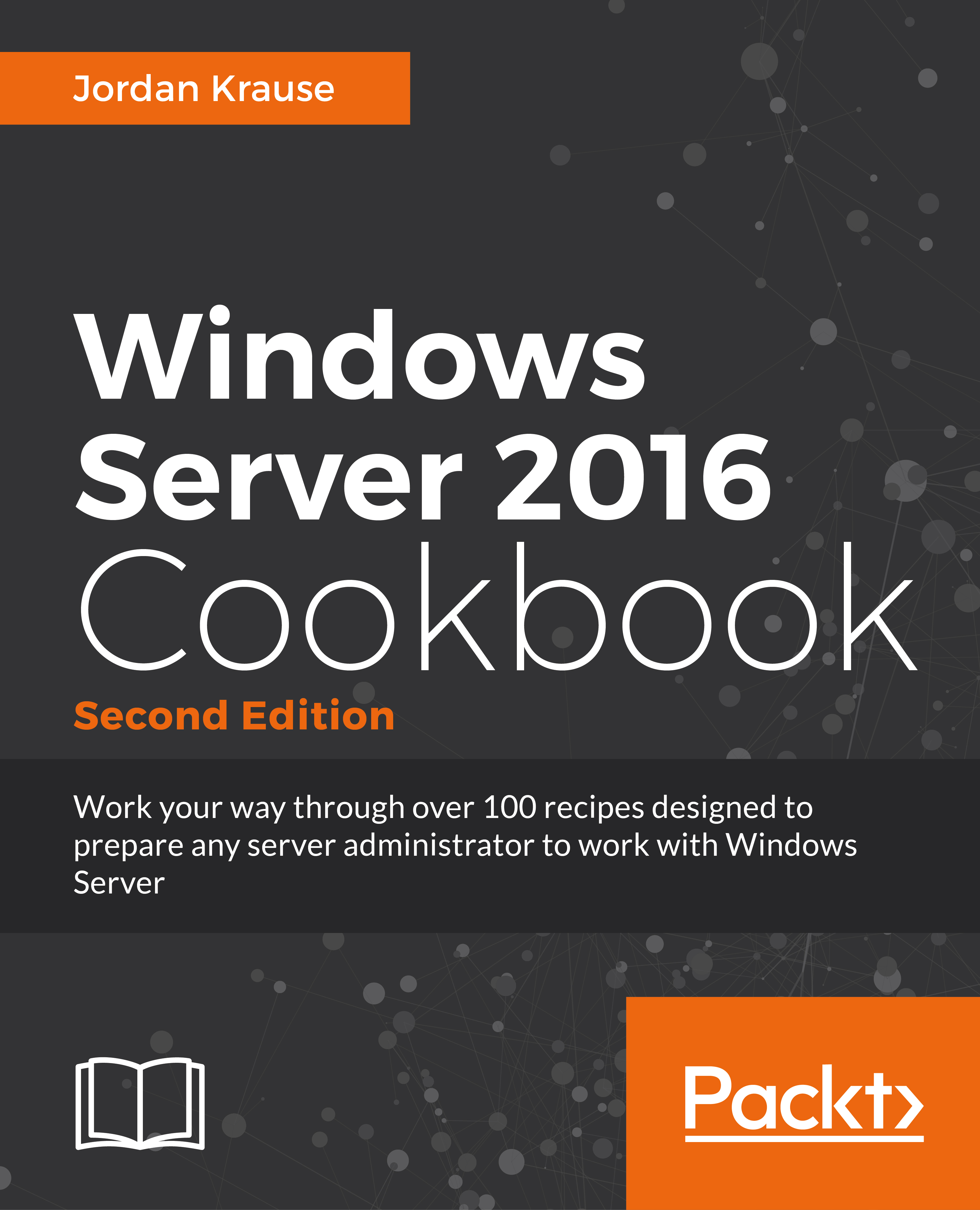
Windows Server 2016 Cookbook

Windows Server 2016 Cookbook

By : Jordan Krause
3.5 (2)
close
close
Windows Server 2016 Cookbook

Windows Server 2016 Cookbook

3.5 (2)
By: Jordan Krause

Overview of this book

This hands-on Cookbook is stuffed full of practical recipes that will help you handle the essential administrative tasks in Windows Server 2016. You’ll start by familiarizing yourself with the look and feel of Windows Server 2016, and will then learn how to navigate through some daily tasks using the graphical interface. You will see how to compose optimal Group Policies and facilitate task automation with PowerShell 5.0 scripting. We will also take a look at the functions available to provide remote network access to your traveling users, and explore the much anticipated Nano Server and Hyper-V built-in integration support that is brand new in Windows Server 2016. By the end of this book, you will know how to take your Windows Server 2016-powered server and turn it into any common infrastructure role that might be required in your company.
Table of Contents (13 chapters)
close
close

Using PowerShell to accomplish any function in Windows Server

An incredibly powerful tool in Windows Server 2016 is PowerShell. Think of PowerShell like a Command Prompt on steroids. It is a command-line interface from which you can manipulate almost anything inside Windows that you may care to. Better yet, any task that you may wish to accomplish can be scripted out in PowerShell and saved off as a .ps1 script file, so that you can automate large tasks and schedule them for later, or at regular intervals. In this recipe, let's open up PowerShell and run some sample commands and tasks just to get a quick feel for the interface. In a later chapter of the book, we will do some more specific tasks with PowerShell to go even deeper into the technology.

Getting ready

To start using PowerShell, all you need is a server with Windows Server 2016 installed. PowerShell is installed and enabled by default.

How to do it…

To get a feel of using PowerShell, perform the following steps:

  1. PowerShell used to exist in the taskbar by default, which was smart because we really should be pushing people to use it rather than Command Prompt, right? Unfortunately, PowerShell is not in the taskbar by default in Server 2016, but the Windows Store is...? Explain that one to me some day. So our first step to working in PowerShell is finding it. Thankfully, we know how to search for applications now, so I'll just press my WinKey and type PowerShell. Once my search result is displayed, I am going to right-click on Windows PowerShell and choose to Run as administrator.

    How to do it…

  2. Test out some commands that you are familiar with from using the Command Prompt, such as dir and cls. Since you are able to make use of these familiar commands, PowerShell can really be your one and only command-line interface if you choose.
  3. Now let's try some of the PowerShell secret sauce, one of its cmdlets. These are special commands that are built into Windows and allow us to do all kinds of information gathering, as well as manipulation of server components. Let's start by pulling some data. Maybe take a look at what IP addresses are on the system with Get-NetIPAddress.

    How to do it…
  4. The previous command probably gave you a lot more information than you needed, since most companies don't make use of IPv6 inside their network yet. Let's whittle this information down to the IPv4-specific info that you are most likely interested in. Enter Get-NetIPAddress -AddressFamily IPv4 to attain it.

    How to do it…

How it works…

PowerShell has so many commands and cmdlets, we just wanted to get a feel for launching the program and pulling some data with this particular recipe. There are countless Get commands to query information from the server, and as you have seen those cmdlets have various parameters that can be appended to the cmdlets to pull more specific data to meet your needs. To make things even better, there are not only Get cmdlets, but also Set cmdlets, which will allow us to make use of the PowerShell prompt to configure many aspects of the configuration on our server, as well as remote servers. We will dive further into PowerShell in a later chapter.

Visually different images
CONTINUE READING
83
Tech Concepts
36
Programming languages
73
Tech Tools
Icon Unlimited access to the largest independent learning library in tech of over 8,000 expert-authored tech books and videos.
Icon Innovative learning tools, including AI book assistants, code context explainers, and text-to-speech.
Icon 50+ new titles added per month and exclusive early access to books as they are being written.
Windows Server 2016 Cookbook
notes
bookmark Notes and Bookmarks search Search in title playlist Add to playlist font-size Font size

Change the font size

margin-width Margin width

Change margin width

day-mode Day/Sepia/Night Modes

Change background colour

Close icon Search
Country selected

Close icon Your notes and bookmarks

Confirmation

Modal Close icon
claim successful

Buy this book with your credits?

Modal Close icon
Are you sure you want to buy this book with one of your credits?
Close
YES, BUY

Submit Your Feedback

Modal Close icon
Modal Close icon
Modal Close icon