Sign In Start Free Trial
Account

Add to playlist

Create a Playlist

Modal Close icon
You need to login to use this feature.
  • Book Overview & Buying Windows Server 2016 Cookbook
  • Table Of Contents Toc
  • Feedback & Rating feedback
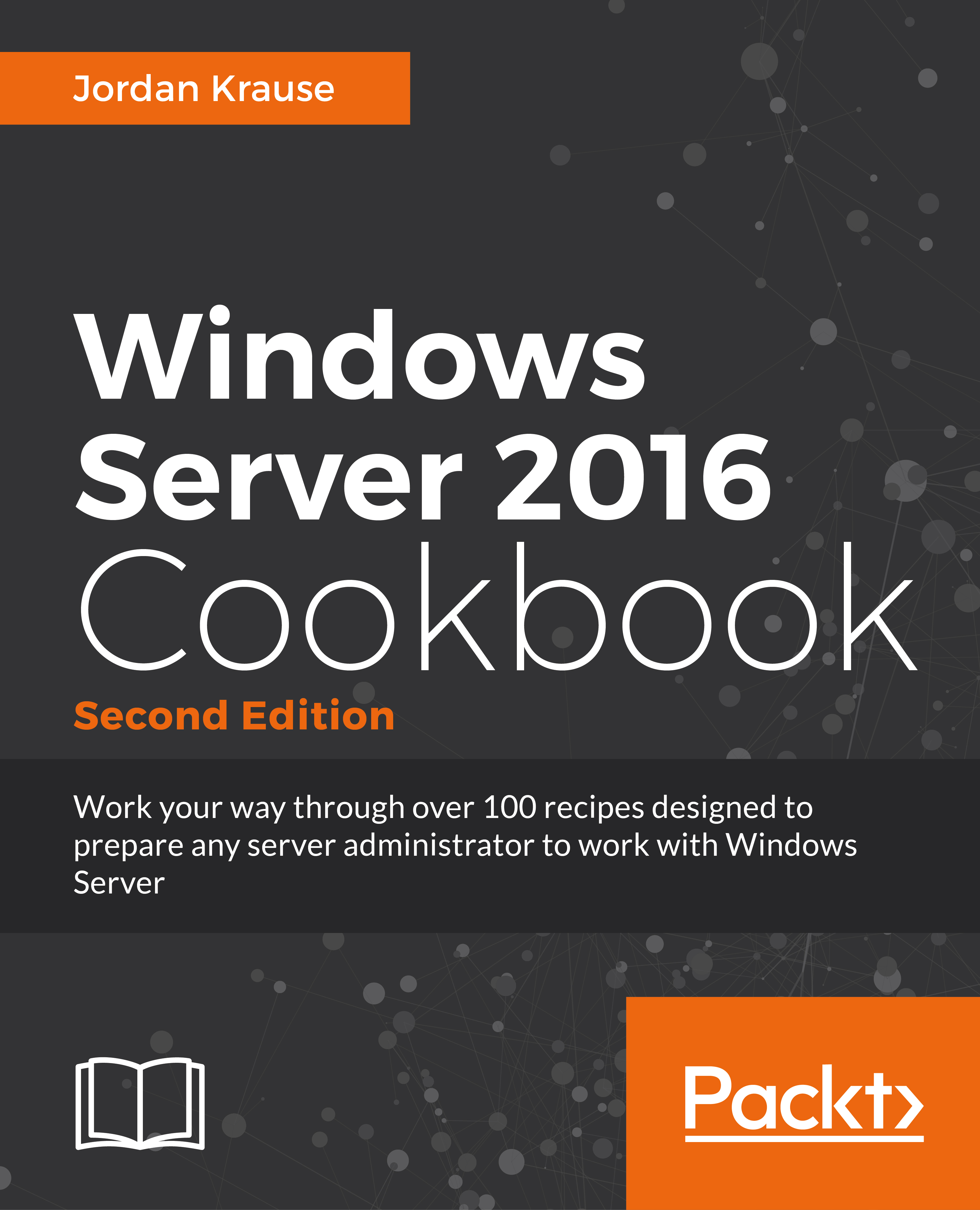
Windows Server 2016 Cookbook

Windows Server 2016 Cookbook

By : Jordan Krause
3.5 (2)
close
close
Windows Server 2016 Cookbook

Windows Server 2016 Cookbook

3.5 (2)
By: Jordan Krause

Overview of this book

This hands-on Cookbook is stuffed full of practical recipes that will help you handle the essential administrative tasks in Windows Server 2016. You’ll start by familiarizing yourself with the look and feel of Windows Server 2016, and will then learn how to navigate through some daily tasks using the graphical interface. You will see how to compose optimal Group Policies and facilitate task automation with PowerShell 5.0 scripting. We will also take a look at the functions available to provide remote network access to your traveling users, and explore the much anticipated Nano Server and Hyper-V built-in integration support that is brand new in Windows Server 2016. By the end of this book, you will know how to take your Windows Server 2016-powered server and turn it into any common infrastructure role that might be required in your company.
Table of Contents (13 chapters)
close
close

Enabling Distributed File System and creating a Namespace

Distributed File System (DFS) is a technology included with Windows Server 2016 that enables multiple file servers to share a single Namespace, enabling end users to access files and folders from a single network name. Those accessing the files don't have to worry about which physical server they are currently in contact with; they simply utilize the namespace of the DFS environment and let the servers do all the grunt work in making sure that all files and folders are available to the users, no matter where those files happen to be physically sitting. Another way to think of it as a collection of network shares, all stuck together under the same umbrella that is the DFS Namespace. Users access folders and files via the Namespace, and have access to everything in one place. It helps to think of DFS Namespaces sort of like CNAME records in DNS. They essentially allow us to virtualize the file resources.

Let's work together...

Visually different images
CONTINUE READING
83
Tech Concepts
36
Programming languages
73
Tech Tools
Icon Unlimited access to the largest independent learning library in tech of over 8,000 expert-authored tech books and videos.
Icon Innovative learning tools, including AI book assistants, code context explainers, and text-to-speech.
Icon 50+ new titles added per month and exclusive early access to books as they are being written.
Windows Server 2016 Cookbook
notes
bookmark Notes and Bookmarks search Search in title playlist Add to playlist font-size Font size

Change the font size

margin-width Margin width

Change margin width

day-mode Day/Sepia/Night Modes

Change background colour

Close icon Search
Country selected

Close icon Your notes and bookmarks

Confirmation

Modal Close icon
claim successful

Buy this book with your credits?

Modal Close icon
Are you sure you want to buy this book with one of your credits?
Close
YES, BUY

Submit Your Feedback

Modal Close icon
Modal Close icon
Modal Close icon