Sign In Start Free Trial
Account

Add to playlist

Create a Playlist

Modal Close icon
You need to login to use this feature.
  • Book Overview & Buying The Docker Workshop
  • Table Of Contents Toc
The Docker Workshop

The Docker Workshop

By : Vincent Sesto, Onur Yılmaz , Sathsara Sarathchandra , Aric Renzo, Engy Fouda , Ankit Mishra, Fiodar Sazanavets, Craig Newton, Earl Waud
5 (9)
close
close
The Docker Workshop

The Docker Workshop

5 (9)
By: Vincent Sesto, Onur Yılmaz , Sathsara Sarathchandra , Aric Renzo, Engy Fouda , Ankit Mishra, Fiodar Sazanavets, Craig Newton, Earl Waud

Overview of this book

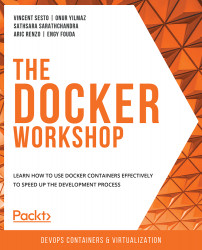
No doubt Docker Containers are the future of highly-scalable software systems and have cost and runtime efficient supporting infrastructure. But learning it might look complex as it comes with many technicalities. This is where The Docker Workshop will help you. Through this workshop, you’ll quickly learn how to work with containers and Docker with the help of practical activities.? The workshop starts with Docker containers, enabling you to understand how it works. You’ll run third party Docker images and also create your own images using Dockerfiles and multi-stage Dockerfiles. Next, you’ll create environments for Docker images, and expedite your deployment and testing process with Continuous Integration. Moving ahead, you’ll tap into interesting topics and learn how to implement production-ready environments using Docker Swarm. You’ll also apply best practices to secure Docker images and to ensure that production environments are running at maximum capacity. Towards the end, you’ll gather skills to successfully move Docker from development to testing, and then into production. While doing so, you’ll learn how to troubleshoot issues, clear up resource bottlenecks and optimize the performance of services. By the end of this workshop, you’ll be able to utilize Docker containers in real-world use cases.
Table of Contents (17 chapters)
close
close
Preface

Signing and Verifying Docker Images

Just as we can make sure that the applications we purchase and install on our systems are from a trusted source, we can do the same with the Docker images we use. Running an untrusted Docker image could become a huge risk and could cause major issues in our system. This is why we should look to have specific proof of the images we are using. An untrusted source could potentially add code to the running image, which could expose your entire network to the attacker.

Fortunately, Docker has a way of digitally signing our images to ensure we're using images from a verified vendor or provider. This will also ensure the image has not been changed or corrupted since it was originally signed, ensuring some authenticity. It shouldn't be the only way we trust our images. As you'll see later in this chapter, once we have our image, we can then scan it to ensure we avoid installing an image that may have security issues.

The way that Docker...

CONTINUE READING
83
Tech Concepts
36
Programming languages
73
Tech Tools
Icon Unlimited access to the largest independent learning library in tech of over 8,000 expert-authored tech books and videos.
Icon Innovative learning tools, including AI book assistants, code context explainers, and text-to-speech.
Icon 50+ new titles added per month and exclusive early access to books as they are being written.
The Docker Workshop
notes
bookmark Notes and Bookmarks search Search in title playlist Add to playlist download Download options font-size Font size

Change the font size

margin-width Margin width

Change margin width

day-mode Day/Sepia/Night Modes

Change background colour

Close icon Search
Country selected

Close icon Your notes and bookmarks

Confirmation

Modal Close icon
claim successful

Buy this book with your credits?

Modal Close icon
Are you sure you want to buy this book with one of your credits?
Close
YES, BUY

Submit Your Feedback

Modal Close icon
Modal Close icon
Modal Close icon