Sign In Start Free Trial
Account

Add to playlist

Create a Playlist

Modal Close icon
You need to login to use this feature.
  • Book Overview & Buying Turning Text into Gold: Taxonomies and Textual Analytics
  • Table Of Contents Toc
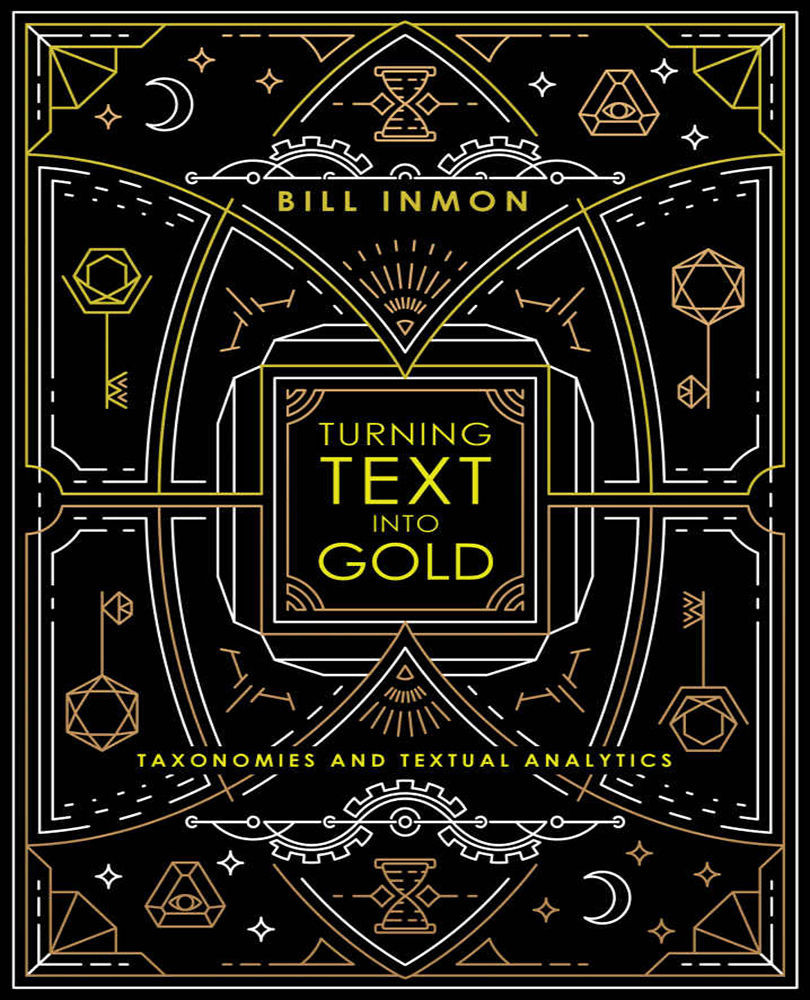
Turning Text into Gold: Taxonomies and Textual Analytics

Turning Text into Gold: Taxonomies and Textual Analytics

By : Bill Inmon
4.3 (4)
close
close
Turning Text into Gold: Taxonomies and Textual Analytics

Turning Text into Gold: Taxonomies and Textual Analytics

4.3 (4)
By: Bill Inmon

Overview of this book

With businesses operating round the clock, a large amount of data gets generated. This data can be efficiently converted into useful knowledge that can take your business to a higher level. This book introduces you to the concept of taxonomies and how they are used to simplify and understand the text. You'll explore how to use taxonomies for textual analytics. It begins with a quick history of taxonomies and their earliest usage. You’ll learn about the different types of taxonomies (recursive, networked, hierarchical, and so on). You'll also learn about ontologies and understand how the ontology becomes a bridge between the worlds of technology and business and commerce. The later chapters of the book show how to find the taxonomies that you need for successful textual analytics, update your taxonomies to include the constantly-changing language, and extract meaningful information from raw text using different tools, such as textual disambiguation, document fracturing, and so on. By the end of this book, you’ll be able to utilize the various aspects of taxonomies for efficient textual analysis.
Table of Contents (20 chapters)
close
close
Lock Free Chapter
1
Introduction
chevron up
5
4: Ontologies
7
6: Changing Taxonomies
9
8: Taxonomies and Data Models
10
9: Types of Textual Data
17
16: Airline Analytics
18
Glossary
19
References
20
Index

Introduction

Multiple millennia ago, mankind set out to create wealth by turning everyday substances into gold. This was early alchemy, and ultimately it did not work. Despite the best minds and the best efforts, no one succeeded to transform other substances into gold because gold is an element. You can discover gold, you can dig for gold, and you can pan for gold, but you cannot create gold.

But the world has changed. Today we have a type of “modern alchemy” that really can create gold.

Text is the common fabric of society. Business is transacted in text, arguments are made in text, court cases are conducted in text, conversations between best friends transpire through text. In short, text is the medium of exchange between people living on earth.

Since the beginning of computing, text has defied the computer. Text is simply the original square peg in the round hole. Computer processes focus on structured transactions (not text).

For most of its early history, the computer was not much help in dealing with text. That was a shame, as some of the most important information was in the form of text.

But today, there exist advancements in technology that allow the computer to read, store and analyze text. And in doing so, a whole world of informed decision-making is possible. Unlike the alchemists of yore, if you know what you are doing, you really can turn text into gold.

As more and more applications were built, computer scientists realized that in order to manage those applications, an abstraction was needed. Enter the data model: an abstraction of computer applications. Furthermore, someone eventually observed that there was a lot of valuable data found in the text. In order to capture and use that text, the technology known as textual disambiguation was developed. Finally, at the intersection of data models and textual disambiguation, it dawned on computer scientists that an abstraction of text was needed.

Enter taxonomies.

Taxonomies have been around for a long time – long before the first computer was built or even conceived. But it is in the world of computation, where users must come to grips with text, that taxonomies have found a truly novel and important use.

Speech is complex. We are taught speech by our parents at a young age, and mimic it even before then. Adult brains process speech in a largely automated manner. But the automatic processing that occurs in our brain masks the complexity of speech.

Taxonomies (classifications) are critical to the processing of text. If we wish to get computers to process data like the brain does, then we need taxonomies. Sure, there is more to processing text than resolving text using taxonomies. But for most text, taxonomical resolution is the first step to making text useful.

This book will introduce you to the concept of taxonomies and how they are used to simplify and understand text.

This book is a practical book. Very little theory is discussed. Instead, the emphasis is on the practical aspects and usages of taxonomies, and the subsequent usage of taxonomies as a basis for textual analytics.

This book is for students of computer science, managers who have to deal with text, programmers who need to understand taxonomies, systems analysts who need to understand how to get business value out of a body of text, and especially those who are struggling to decode data lakes. Hopefully for those individuals (and many more), this book will serve as both an introduction to taxonomies and a guide to how taxonomies can be used to bring text into the realm of corporate decision-making.

WHI, Castle Rock, Co 1/1/2017

CONTINUE READING
83
Tech Concepts
36
Programming languages
73
Tech Tools
Icon Unlimited access to the largest independent learning library in tech of over 8,000 expert-authored tech books and videos.
Icon Innovative learning tools, including AI book assistants, code context explainers, and text-to-speech.
Icon 50+ new titles added per month and exclusive early access to books as they are being written.
Turning Text into Gold: Taxonomies and Textual Analytics
notes
bookmark Notes and Bookmarks search Search in title playlist Add to playlist font-size Font size

Change the font size

margin-width Margin width

Change margin width

day-mode Day/Sepia/Night Modes

Change background colour

Close icon Search
Country selected

Close icon Your notes and bookmarks

Confirmation

Modal Close icon
claim successful

Buy this book with your credits?

Modal Close icon
Are you sure you want to buy this book with one of your credits?
Close
YES, BUY

Submit Your Feedback

Modal Close icon
Modal Close icon
Modal Close icon