Sign In Start Free Trial
Account

Add to playlist

Create a Playlist

Modal Close icon
You need to login to use this feature.
  • Book Overview & Buying Turning Text into Gold: Taxonomies and Textual Analytics
  • Table Of Contents Toc
Turning Text into Gold: Taxonomies and Textual Analytics

Turning Text into Gold: Taxonomies and Textual Analytics

By : Bill Inmon
4.3 (4)
close
close
Turning Text into Gold: Taxonomies and Textual Analytics

Turning Text into Gold: Taxonomies and Textual Analytics

4.3 (4)
By: Bill Inmon

Overview of this book

With businesses operating round the clock, a large amount of data gets generated. This data can be efficiently converted into useful knowledge that can take your business to a higher level. This book introduces you to the concept of taxonomies and how they are used to simplify and understand the text. You'll explore how to use taxonomies for textual analytics. It begins with a quick history of taxonomies and their earliest usage. You’ll learn about the different types of taxonomies (recursive, networked, hierarchical, and so on). You'll also learn about ontologies and understand how the ontology becomes a bridge between the worlds of technology and business and commerce. The later chapters of the book show how to find the taxonomies that you need for successful textual analytics, update your taxonomies to include the constantly-changing language, and extract meaningful information from raw text using different tools, such as textual disambiguation, document fracturing, and so on. By the end of this book, you’ll be able to utilize the various aspects of taxonomies for efficient textual analysis.
Table of Contents (20 chapters)
close
close
Lock Free Chapter
1
Introduction
5
4: Ontologies
7
6: Changing Taxonomies
9
8: Taxonomies and Data Models
10
9: Types of Textual Data
17
16: Airline Analytics
18
Glossary
19
References
20
Index

Stop Word Processing

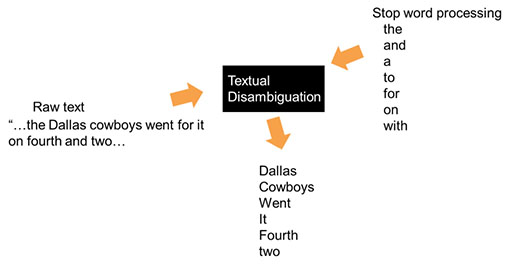
Stop word processing removes all designated “stop” words. The English language is full of words that are extraneous. We need these words for proper communication, but they really don’t have much (if any) bearing on what is being discussed. For that reason, these stop words are excised from the raw text. Here is an example of stop word processing:

Image317679.jpg

In the example, we see that the system has examined the text and has removed all the words that are on the stop word list. One reason to use stop word processing is to remove unnecessary words from the output database. This “paring down” of the text has many benefits. The largest benefit is to remove words that do not have any real value. By “paring down” the text, the remaining processing is streamlined.

CONTINUE READING
83
Tech Concepts
36
Programming languages
73
Tech Tools
Icon Unlimited access to the largest independent learning library in tech of over 8,000 expert-authored tech books and videos.
Icon Innovative learning tools, including AI book assistants, code context explainers, and text-to-speech.
Icon 50+ new titles added per month and exclusive early access to books as they are being written.
Turning Text into Gold: Taxonomies and Textual Analytics
notes
bookmark Notes and Bookmarks search Search in title playlist Add to playlist font-size Font size

Change the font size

margin-width Margin width

Change margin width

day-mode Day/Sepia/Night Modes

Change background colour

Close icon Search
Country selected

Close icon Your notes and bookmarks

Confirmation

Modal Close icon
claim successful

Buy this book with your credits?

Modal Close icon
Are you sure you want to buy this book with one of your credits?
Close
YES, BUY

Submit Your Feedback

Modal Close icon
Modal Close icon
Modal Close icon