Sign In Start Free Trial
Account

Add to playlist

Create a Playlist

Modal Close icon
You need to login to use this feature.
  • Book Overview & Buying Learning Predictive Analytics with Python
  • Table Of Contents Toc
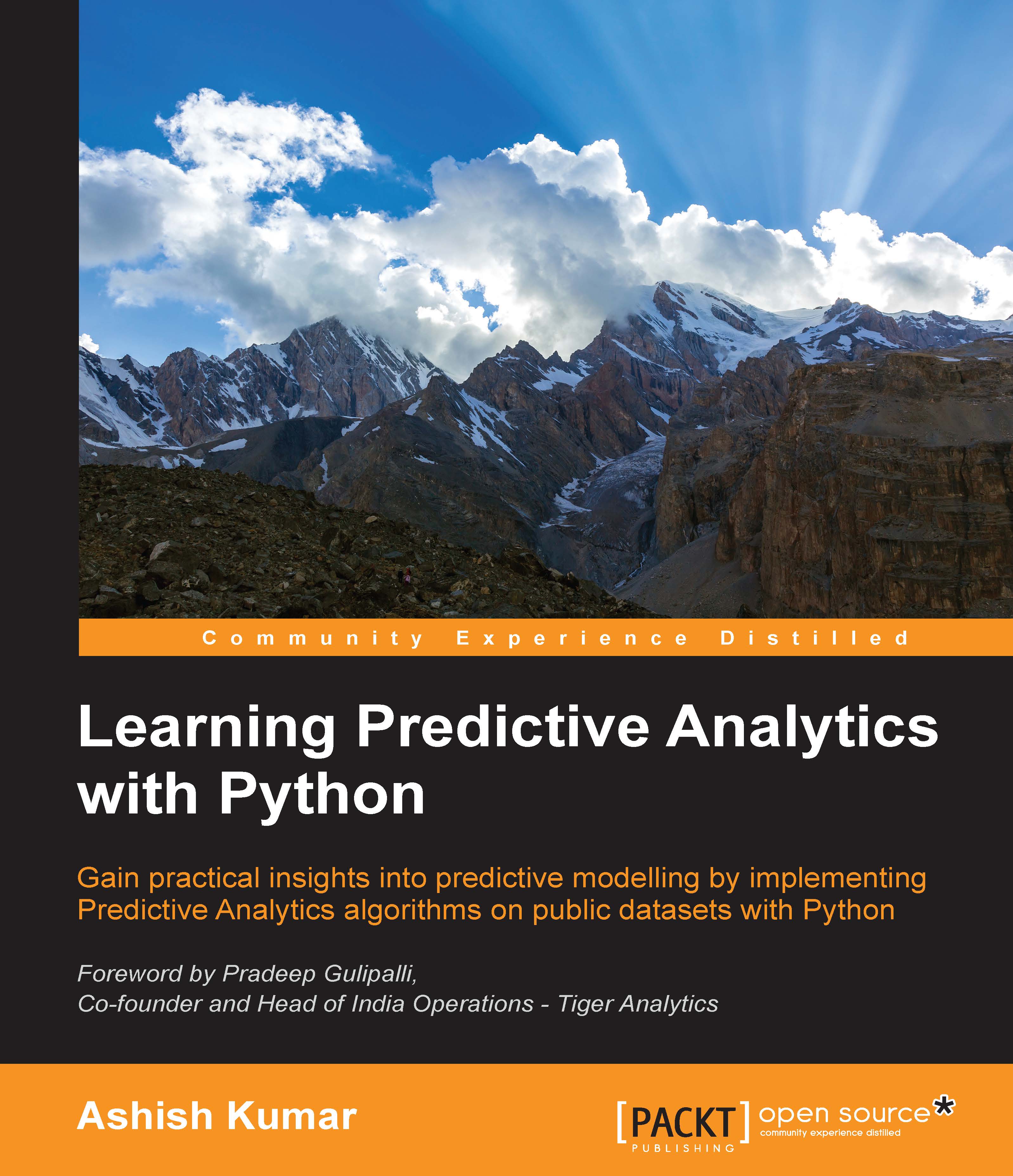
Learning Predictive Analytics with Python

Learning Predictive Analytics with Python

By : Kumar, Gary Dougan
3.4 (11)
close
close
Learning Predictive Analytics with Python

Learning Predictive Analytics with Python

3.4 (11)
By: Kumar, Gary Dougan

Overview of this book

Social Media and the Internet of Things have resulted in an avalanche of data. Data is powerful but not in its raw form - It needs to be processed and modeled, and Python is one of the most robust tools out there to do so. It has an array of packages for predictive modeling and a suite of IDEs to choose from. Learning to predict who would win, lose, buy, lie, or die with Python is an indispensable skill set to have in this data age. This book is your guide to getting started with Predictive Analytics using Python. You will see how to process data and make predictive models from it. We balance both statistical and mathematical concepts, and implement them in Python using libraries such as pandas, scikit-learn, and numpy. You’ll start by getting an understanding of the basics of predictive modeling, then you will see how to cleanse your data of impurities and get it ready it for predictive modeling. You will also learn more about the best predictive modeling algorithms such as Linear Regression, Decision Trees, and Logistic Regression. Finally, you will see the best practices in predictive modeling, as well as the different applications of predictive modeling in the modern world.
Table of Contents (12 chapters)
close
close
10
A. A List of Links
11
Index

Summary


A logistic regression is a versatile technique used widely in the cases where the variable to be predicted is a binary (or categorical) variable. This chapter dives deep into the math behind the logistics regression and the process to implement it using the scikit-learn and statsmodel api modules. It is important to understand the math behind the algorithm so that the model is not used as a black box without knowing what is going on behind the hood. To recap, the following are the main takeaways from the chapter:

  • Linear regression wouldn't be an appropriate model to predict binary variables as the predictor variables can range from -infinity to +infinity, while the binary variable would be 0 or 1.

  • The odds of a certain event happening is the probability of that event happening divided by the probability of that event not happening. The higher the odds, the higher are the chances of the event happening. The odds can range from 0 to infinity.

  • The final equation for the logistic regression...

Visually different images
CONTINUE READING
83
Tech Concepts
36
Programming languages
73
Tech Tools
Icon Unlimited access to the largest independent learning library in tech of over 8,000 expert-authored tech books and videos.
Icon Innovative learning tools, including AI book assistants, code context explainers, and text-to-speech.
Icon 50+ new titles added per month and exclusive early access to books as they are being written.
Learning Predictive Analytics with Python
notes
bookmark Notes and Bookmarks search Search in title playlist Add to playlist font-size Font size

Change the font size

margin-width Margin width

Change margin width

day-mode Day/Sepia/Night Modes

Change background colour

Close icon Search
Country selected

Close icon Your notes and bookmarks

Confirmation

Modal Close icon
claim successful

Buy this book with your credits?

Modal Close icon
Are you sure you want to buy this book with one of your credits?
Close
YES, BUY

Submit Your Feedback

Modal Close icon
Modal Close icon
Modal Close icon