Sign In Start Free Trial
Account

Add to playlist

Create a Playlist

Modal Close icon
You need to login to use this feature.
  • Book Overview & Buying F# for Machine Learning Essentials
  • Table Of Contents Toc
  • Feedback & Rating feedback
F# for Machine Learning Essentials

F# for Machine Learning Essentials

By : Sudipta Mukherjee
2 (1)
close
close
F# for Machine Learning Essentials

F# for Machine Learning Essentials

2 (1)
By: Sudipta Mukherjee

Overview of this book

The F# functional programming language enables developers to write simple code to solve complex problems. With F#, developers create consistent and predictable programs that are easier to test and reuse, simpler to parallelize, and are less prone to bugs. If you want to learn how to use F# to build machine learning systems, then this is the book you want. Starting with an introduction to the several categories on machine learning, you will quickly learn to implement time-tested, supervised learning algorithms. You will gradually move on to solving problems on predicting housing pricing using Regression Analysis. You will then learn to use Accord.NET to implement SVM techniques and clustering. You will also learn to build a recommender system for your e-commerce site from scratch. Finally, you will dive into advanced topics such as implementing neural network algorithms while performing sentiment analysis on your data.
Table of Contents (9 chapters)
close
close
8
Index

Multiple linear regression


Sometimes it makes more sense to include more predictors (that is, the independent variables) to find the value of the dependent variable (that is, the predicted variable). For example, predicting the price of a house based only on the total area is probably not a good idea. Maybe the price also depends on the number of bathrooms and the distance from several required facilities, such as schools, grocery stores, and so on.

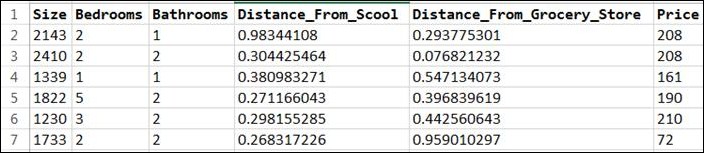
So we might have a dataset as shown next, and the problem we pose for our linear regression model is to predict the price of a new house given all the other parameters:

In this case, the model can be represented as a linear combination of all the predictors, as follows:

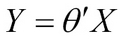
Here, the theta values represent the parameters we must select to fit the model. In vectorized form, this can be written as:

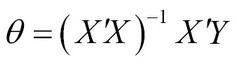
Theta can be calculated by the following formula:

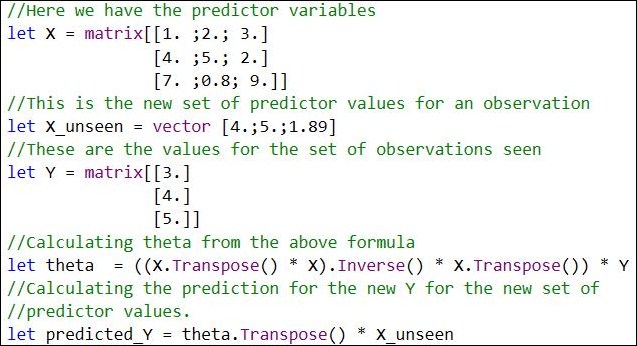
So using the MathNet.Fsharp package, this can be calculated as follows:

Previously, in Chapter 1, Introduction...

Visually different images
CONTINUE READING
83
Tech Concepts
36
Programming languages
73
Tech Tools
Icon Unlimited access to the largest independent learning library in tech of over 8,000 expert-authored tech books and videos.
Icon Innovative learning tools, including AI book assistants, code context explainers, and text-to-speech.
Icon 50+ new titles added per month and exclusive early access to books as they are being written.
F# for Machine Learning Essentials
notes
bookmark Notes and Bookmarks search Search in title playlist Add to playlist font-size Font size

Change the font size

margin-width Margin width

Change margin width

day-mode Day/Sepia/Night Modes

Change background colour

Close icon Search
Country selected

Close icon Your notes and bookmarks

Confirmation

Modal Close icon
claim successful

Buy this book with your credits?

Modal Close icon
Are you sure you want to buy this book with one of your credits?
Close
YES, BUY

Submit Your Feedback

Modal Close icon
Modal Close icon
Modal Close icon