Sign In Start Free Trial
Account

Add to playlist

Create a Playlist

Modal Close icon
You need to login to use this feature.
  • Book Overview & Buying F# for Machine Learning Essentials
  • Table Of Contents Toc
F# for Machine Learning Essentials

F# for Machine Learning Essentials

By : Sudipta Mukherjee
2 (1)
close
close
F# for Machine Learning Essentials

F# for Machine Learning Essentials

2 (1)
By: Sudipta Mukherjee

Overview of this book

The F# functional programming language enables developers to write simple code to solve complex problems. With F#, developers create consistent and predictable programs that are easier to test and reuse, simpler to parallelize, and are less prone to bugs. If you want to learn how to use F# to build machine learning systems, then this is the book you want. Starting with an introduction to the several categories on machine learning, you will quickly learn to implement time-tested, supervised learning algorithms. You will gradually move on to solving problems on predicting housing pricing using Regression Analysis. You will then learn to use Accord.NET to implement SVM techniques and clustering. You will also learn to build a recommender system for your e-commerce site from scratch. Finally, you will dive into advanced topics such as implementing neural network algorithms while performing sentiment analysis on your data.
Table of Contents (9 chapters)
close
close
8
Index

Preface

Machine learning (ML) is more prevalent now than ever before. Every day a lot of data is being generated. Machine learning algorithms perform heavy duty number crunching to improve our lives every day. The following image captures the major tasks that machine learning algorithms perform. These are the classes or types of problems that ML algorithms solve.

Preface

Our lives are more and more driven by the output of these ML algorithms than we care to admit. Let me walk you through the image once:

  • Computers everywhere: Now your smartphone can beat a vintage supercomputer, and computer are everywhere: in your phone, camera, car, microwave, and so on.
  • Clustering: Clustering is the task of identifying groups of items from a given list that seem to be similar to the others in the group. Clustering has many diverse uses. However, it is heavily used in market segment analysis to identify different categories of customers.
  • Classification: This is the ML algorithm that works hard to keep your spam e-mails away from your priority inbox. The same algorithm can be used to identify objects from images or videos and surprisingly, the same algorithm can be used to predict whether a patient has cancer or not. Generally, a lot of data is provided to the algorithm, from which it learns. That's why this set of algorithms is sometime referred to as supervised learning algorithms, and this constitutes the vast majority of machine learning algorithms.
  • Predictions: There are several ML algorithms that perform predictions for several situations that are important in life. For example, there are predictors that predict fuel price in the near future. This family of algorithms is known as regressions.
  • Anomaly detection: Anomaly, as the name suggests, relates to items that have attributes that are not similar to normal ones. Anomaly detection algorithms use statistical methods to find out the anomalous items from a given list automatically. This is an example of unsupervised learning. Anomaly detection has several diverse uses, such as finding faulty items in factories to finding intruders on a video stream coming from a surveillance camera, and so on.
  • Recommendations: Every time you visit Amazon and rate a product, the site recommends some items to you. Under the hood is a clever machine learning algorithm in action called collaborative filtering, which takes cues from other users purchasing similar items as you are. Recommender systems are a very active research topic now and several other algorithms are being considered.
  • Sentiment analysis: Whenever a product hits the market, the company that brought it into the market wants to know how the market is reacting towards it. Is it positive or negative? Sentiment analysis techniques help to identify these reactions. Also, in review websites, people post several comments, and the website might be interested in publishing a generalized positive or negative rating for the item under review. Here, sentiment analysis techniques can be quite helpful.
  • Information retrieval: Whenever you hit the search button on your favorite search engine, a plethora of information retrieval algorithms are used under the hood. These algorithms are also used in the content-based filtering that is used in recommender systems.

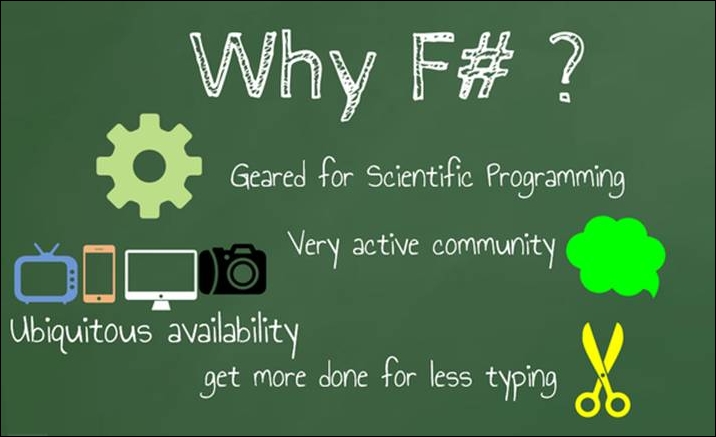
Now that you have a top-level idea of what ML algorithms can do for you, let's see why F# is the perfect fit for the implementations. Here are my reasons for using F# to implement machine learning algorithms:

Preface
CONTINUE READING
83
Tech Concepts
36
Programming languages
73
Tech Tools
Icon Unlimited access to the largest independent learning library in tech of over 8,000 expert-authored tech books and videos.
Icon Innovative learning tools, including AI book assistants, code context explainers, and text-to-speech.
Icon 50+ new titles added per month and exclusive early access to books as they are being written.
F# for Machine Learning Essentials
notes
bookmark Notes and Bookmarks search Search in title playlist Add to playlist font-size Font size

Change the font size

margin-width Margin width

Change margin width

day-mode Day/Sepia/Night Modes

Change background colour

Close icon Search
Country selected

Close icon Your notes and bookmarks

Confirmation

Modal Close icon
claim successful

Buy this book with your credits?

Modal Close icon
Are you sure you want to buy this book with one of your credits?
Close
YES, BUY

Submit Your Feedback

Modal Close icon
Modal Close icon
Modal Close icon