Sign In Start Free Trial
Account

Add to playlist

Create a Playlist

Modal Close icon
You need to login to use this feature.
  • Book Overview & Buying Deep Learning with Theano
  • Table Of Contents Toc
Deep Learning with Theano

Deep Learning with Theano

By : Christopher Bourez
3.7 (3)
close
close
Deep Learning with Theano

Deep Learning with Theano

3.7 (3)
By: Christopher Bourez

Overview of this book

This book offers a complete overview of Deep Learning with Theano, a Python-based library that makes optimizing numerical expressions and deep learning models easy on CPU or GPU. The book provides some practical code examples that help the beginner understand how easy it is to build complex neural networks, while more experimented data scientists will appreciate the reach of the book, addressing supervised and unsupervised learning, generative models, reinforcement learning in the fields of image recognition, natural language processing, or game strategy. The book also discusses image recognition tasks that range from simple digit recognition, image classification, object localization, image segmentation, to image captioning. Natural language processing examples include text generation, chatbots, machine translation, and question answering. The last example deals with generating random data that looks real and solving games such as in the Open-AI gym. At the end, this book sums up the best -performing nets for each task. While early research results were based on deep stacks of neural layers, in particular, convolutional layers, the book presents the principles that improved the efficiency of these architectures, in order to help the reader build new custom nets.
Table of Contents (15 chapters)
close
close
14
Index

Functions and automatic differentiation

The previous section introduced the function instruction to compile the expression. In this section, we develop some of the following arguments in its signature:

def theano.function(inputs, 
	outputs=None, updates=None, givens=None,
 allow_input_downcast=None, mode=None, profile=None,
  	)

We've already used the allow_input_downcast feature to convert data from float64 to float32, int64 to int32 and so on. The mode and profile features are also displayed because they'll be presented in the optimization and debugging section.

Input variables of a Theano function should be contained in a list, even when there is a single input.

For outputs, it is possible to use a list in the case of multiple outputs to be computed in parallel:

>>> a = T.matrix()

>>> ex = theano.function([a],[T.exp(a),T.log(a),a**2])

>>> ex(numpy.random.randn(3,3).astype(theano.config.floatX))
[array([[ 2.33447003,  0.30287042,  0.63557744],
       [ 0.18511547,  1.34327984,  0.42203984],
       [ 0.87083125,  5.01169062,  6.88732481]], dtype=float32),
array([[-0.16512829,         nan,         nan],
       [        nan, -1.2203927 ,         nan],
       [        nan,  0.47733498,  0.65735561]], dtype=float32),
array([[ 0.71873927,  1.42671108,  0.20540957],
       [ 2.84521151,  0.08709242,  0.74417454],
       [ 0.01912885,  2.59781313,  3.72367549]], dtype=float32)]

The second useful attribute is the updates attribute, used to set new values to shared variables once the expression has been evaluated:

>>> w = shared(1.0)

>>> x = T.scalar('x')

>>> mul = theano.function([x],updates=[(w,w*x)])

>>> mul(4)
[]

>>> w.get_value()
array(4.0)

Such a mechanism can be used as an internal state. The shared variable w has been defined outside the function.

With the givens parameter, it is possible to change the value of any symbolic variable in the graph, without changing the graph. The new value will then be used by all the other expressions that were pointing to it.

The last and most important feature in Theano is the automatic differentiation, which means that Theano computes the derivatives of all previous tensor operators. Such a differentiation is performed via the theano.grad operator:

>>> a = T.scalar()

>>> pow = a ** 2

>>> g = theano.grad(pow,a)

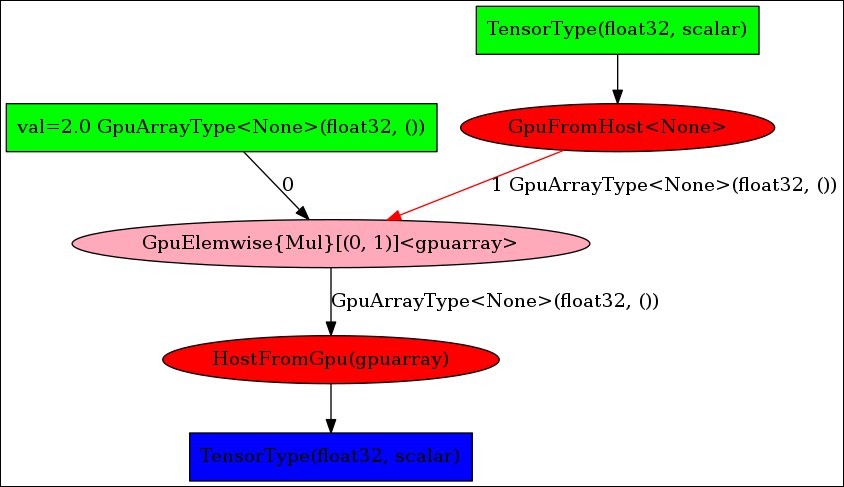
>>> theano.printing.pydotprint(g)

>>> theano.printing.pydotprint(theano.function([a],g))
Functions and automatic differentiation

In the optimization graph, theano.grad has computed the gradient of Functions and automatic differentiation with respect to a, which is a symbolic expression equivalent to 2 * a.

Note that it is only possible to take the gradient of a scalar, but the wrt variables can be arbitrary tensors.

CONTINUE READING
83
Tech Concepts
36
Programming languages
73
Tech Tools
Icon Unlimited access to the largest independent learning library in tech of over 8,000 expert-authored tech books and videos.
Icon Innovative learning tools, including AI book assistants, code context explainers, and text-to-speech.
Icon 50+ new titles added per month and exclusive early access to books as they are being written.
Deep Learning with Theano
notes
bookmark Notes and Bookmarks search Search in title playlist Add to playlist download Download options font-size Font size

Change the font size

margin-width Margin width

Change margin width

day-mode Day/Sepia/Night Modes

Change background colour

Close icon Search
Country selected

Close icon Your notes and bookmarks

Confirmation

Modal Close icon
claim successful

Buy this book with your credits?

Modal Close icon
Are you sure you want to buy this book with one of your credits?
Close
YES, BUY

Submit Your Feedback

Modal Close icon
Modal Close icon
Modal Close icon