


-
Book Overview & Buying
-
Table Of Contents

Deep Learning with Theano
By :


Deep Learning with Theano
By:
Overview of this book
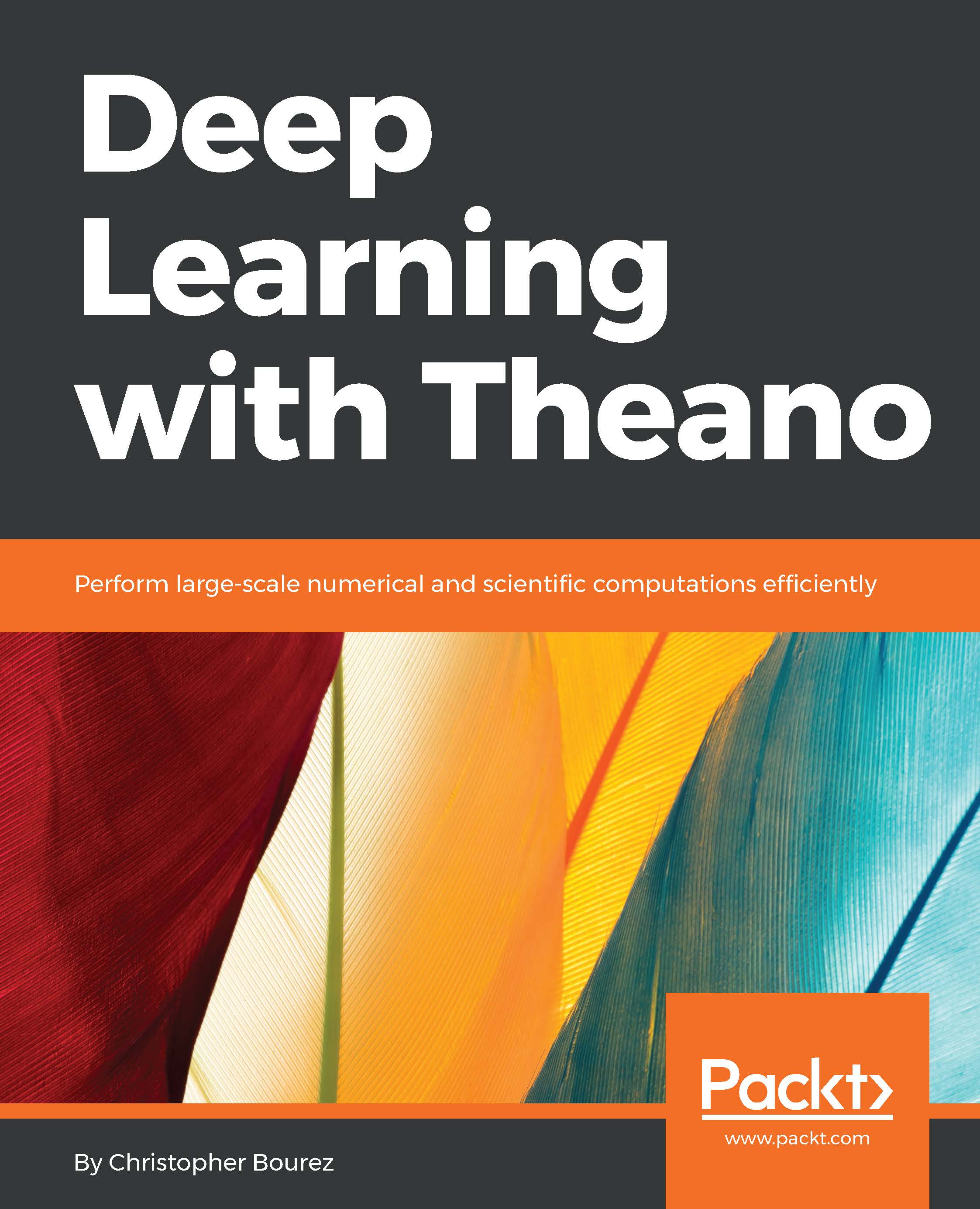
This book offers a complete overview of Deep Learning with Theano, a Python-based library that makes optimizing numerical expressions and deep learning models easy on CPU or GPU.
The book provides some practical code examples that help the beginner understand how easy it is to build complex neural networks, while more experimented data scientists will appreciate the reach of the book, addressing supervised and unsupervised learning, generative models, reinforcement learning in the fields of image recognition, natural language processing, or game strategy.
The book also discusses image recognition tasks that range from simple digit recognition, image classification, object localization, image segmentation, to image captioning. Natural language processing examples include text generation, chatbots, machine translation, and question answering. The last example deals with generating random data that looks real and solving games such as in the Open-AI gym.
At the end, this book sums up the best -performing nets for each task. While early research results were based on deep stacks of neural layers, in particular, convolutional layers, the book presents the principles that improved the efficiency of these architectures, in order to help the reader build new custom nets.
Table of Contents (15 chapters)
Preface


 Free Chapter
1. Theano Basics
2. Classifying Handwritten Digits with a Feedforward Network

3. Encoding Word into Vector
4. Generating Text with a Recurrent Neural Net
5. Analyzing Sentiment with a Bidirectional LSTM
6. Locating with Spatial Transformer Networks
7. Classifying Images with Residual Networks
8. Translating and Explaining with Encoding – decoding Networks
9. Selecting Relevant Inputs or Memories with the Mechanism of Attention
10. Predicting Times Sequences with Advanced RNN
11. Learning from the Environment with Reinforcement
12. Learning Features with Unsupervised Generative Networks
13. Extending Deep Learning with Theano
Index


