
While voice input is undoubtedly a useful feature, we all well know how the actual meaning of the sentence can be opposite to the literal one, depending on the speaker's intonation, facial expression, and context. Try this simple sentence: Oh, really? Depending on the conditions, this can mean: I doubt, I didn't know, I'm impressed, I don't care, This is obvious, and so on. The problem is that speech is not the only mode of conversation for human beings, and that's why much research is focused these days on teaching computers to understand (and also simulate) gestures, facial expressions, sentiments in a text, eye movements, sarcasm, and other affect manifestations. An interdisciplinary field that emerges around the question of emotional and compassionate AI is known as affective computing. It integrates knowledge from the computer and cognitive sciences, as well as psychology and robotics. The aim is the creation of computer systems that will adapt themselves...
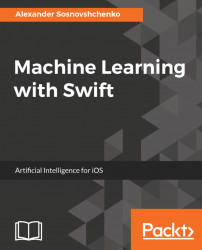
Machine Learning with Swift
By :
Machine Learning with Swift
By:
Overview of this book
Machine learning as a field promises to bring increased intelligence to the software by helping us learn and analyse information efficiently and discover certain patterns that humans cannot. This book will be your guide as you embark on an exciting journey in machine learning using the popular Swift language.
We’ll start with machine learning basics in the first part of the book to develop a lasting intuition about fundamental machine learning concepts. We explore various supervised and unsupervised statistical learning techniques and how to implement them in Swift, while the third section walks you through deep learning techniques with the help of typical real-world cases. In the last section, we will dive into some hard core topics such as model compression, GPU acceleration and provide some recommendations to avoid common mistakes during machine learning application development.
By the end of the book, you'll be able to develop intelligent applications written in Swift that can learn for themselves.
Related Content you might be interested in
Current Title:
Machine Learning with Swift
Table of Contents (18 chapters)
Title Page

Packt Upsell

Contributors
Preface
 Free Chapter
Getting Started with Machine Learning
Classification – Decision Tree Learning
K-Nearest Neighbors Classifier
K-Means Clustering
Association Rule Learning
Linear Regression and Gradient Descent
Linear Classifier and Logistic Regression
Neural Networks
Convolutional Neural Networks
Natural Language Processing
Machine Learning Libraries
Optimizing Neural Networks for Mobile Devices
Best Practices
Index
Customer Reviews