Sign In Start Free Trial
Account

Add to playlist

Create a Playlist

Modal Close icon
You need to login to use this feature.
  • Book Overview & Buying Python Data Analysis, Second Edition
  • Table Of Contents Toc
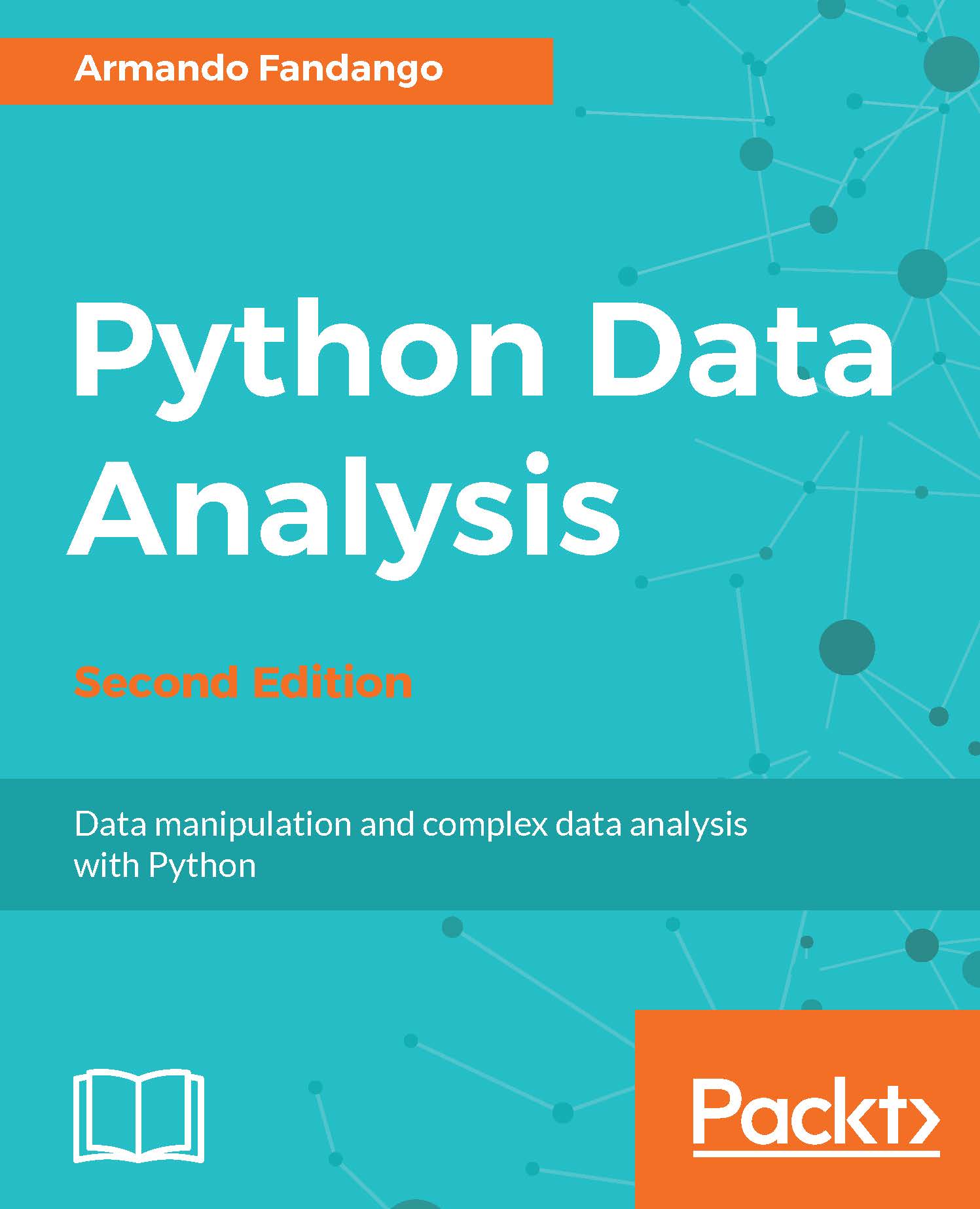
Python Data Analysis, Second Edition

Python Data Analysis, Second Edition - Second Edition

By : Armando Fandango
4 (4)
close
close
Python Data Analysis, Second Edition

Python Data Analysis, Second Edition

4 (4)
By: Armando Fandango

Overview of this book

Data analysis techniques generate useful insights from small and large volumes of data. Python, with its strong set of libraries, has become a popular platform to conduct various data analysis and predictive modeling tasks. With this book, you will learn how to process and manipulate data with Python for complex analysis and modeling. We learn data manipulations such as aggregating, concatenating, appending, cleaning, and handling missing values, with NumPy and Pandas. The book covers how to store and retrieve data from various data sources such as SQL and NoSQL, CSV fies, and HDF5. We learn how to visualize data using visualization libraries, along with advanced topics such as signal processing, time series, textual data analysis, machine learning, and social media analysis. The book covers a plethora of Python modules, such as matplotlib, statsmodels, scikit-learn, and NLTK. It also covers using Python with external environments such as R, Fortran, C/C++, and Boost libraries.
Table of Contents (16 chapters)
close
close
13
A. Key Concepts
15
C. Online Resources

Genetic algorithms

This is the most controversial section in the book so far. Genetic algorithms are based on the biological theory of evolution (see http://en.wikipedia.org/wiki/Evolutionary_algorithm). This type of algorithm is useful for searching and optimization. For instance, we can use it to find the optimal parameters for a regression or classification problem.

Humans and other life forms on Earth carry genetic information in chromosomes. Chromosomes are frequently modeled as strings. A similar representation is used in genetic algorithms. The first step is to initialize the population with random individuals and related representations of genetic information. We can also initialize with already-known candidate solutions for the problem. After that, we go through many iterations, called generations. During each generation, individuals are selected for mating based on a predefined fitness function. The fitness function evaluates how close an individual is to the desired solution.

Two...

CONTINUE READING
83
Tech Concepts
36
Programming languages
73
Tech Tools
Icon Unlimited access to the largest independent learning library in tech of over 8,000 expert-authored tech books and videos.
Icon Innovative learning tools, including AI book assistants, code context explainers, and text-to-speech.
Icon 50+ new titles added per month and exclusive early access to books as they are being written.
Python Data Analysis, Second Edition
notes
bookmark Notes and Bookmarks search Search in title playlist Add to playlist download Download options font-size Font size

Change the font size

margin-width Margin width

Change margin width

day-mode Day/Sepia/Night Modes

Change background colour

Close icon Search
Country selected

Close icon Your notes and bookmarks

Confirmation

Modal Close icon
claim successful

Buy this book with your credits?

Modal Close icon
Are you sure you want to buy this book with one of your credits?
Close
YES, BUY

Submit Your Feedback

Modal Close icon
Modal Close icon
Modal Close icon