Sign In Start Free Trial
Account

Add to playlist

Create a Playlist

Modal Close icon
You need to login to use this feature.
  • Book Overview & Buying Python Data Analysis, Second Edition
  • Table Of Contents Toc
Python Data Analysis, Second Edition

Python Data Analysis, Second Edition - Second Edition

By : Armando Fandango
4 (4)
close
close
Python Data Analysis, Second Edition

Python Data Analysis, Second Edition

4 (4)
By: Armando Fandango

Overview of this book

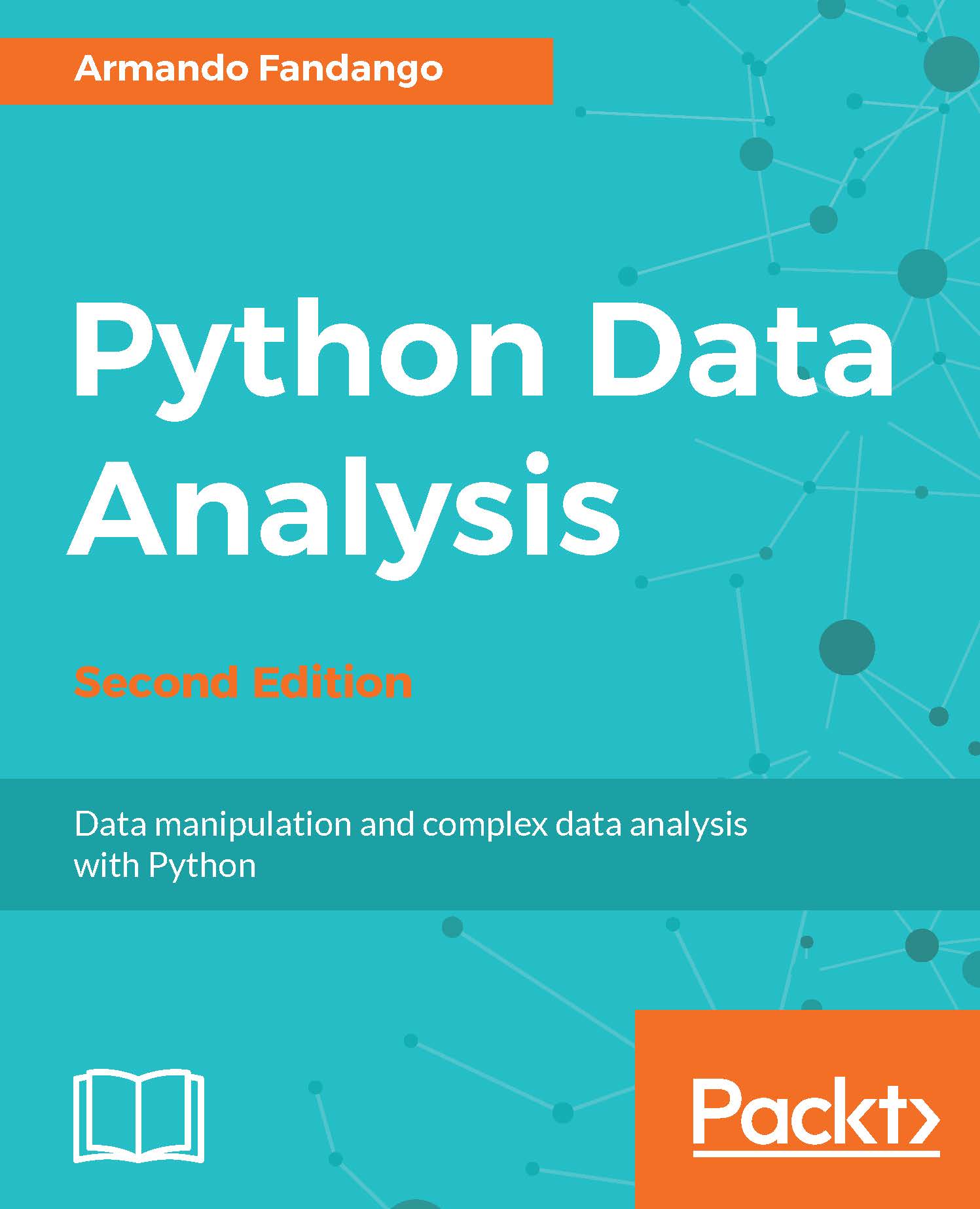
Data analysis techniques generate useful insights from small and large volumes of data. Python, with its strong set of libraries, has become a popular platform to conduct various data analysis and predictive modeling tasks. With this book, you will learn how to process and manipulate data with Python for complex analysis and modeling. We learn data manipulations such as aggregating, concatenating, appending, cleaning, and handling missing values, with NumPy and Pandas. The book covers how to store and retrieve data from various data sources such as SQL and NoSQL, CSV fies, and HDF5. We learn how to visualize data using visualization libraries, along with advanced topics such as signal processing, time series, textual data analysis, machine learning, and social media analysis. The book covers a plethora of Python modules, such as matplotlib, statsmodels, scikit-learn, and NLTK. It also covers using Python with external environments such as R, Fortran, C/C++, and Boost libraries.
Table of Contents (16 chapters)
close
close
13
A. Key Concepts
15
C. Online Resources

Integrating Boost and Python

Boost is a C++ library that can interface with Python. Download it from http://www.boost.org/users/download/. The Boost version at the time of writing is 1.63.0. The easiest, but also slowest, installation method involves the following commands:

$ ./bootstrap.sh --prefix=/path/to/boost
$ ./b2 install

The prefix argument specifies the installation directory. In this example, we will assume that Boost was installed under the user's home directory in a directory called Boost (such as ~/Boost). In this directory, a lib and include directory will be created. For Unix and Linux, you should run the following command:

export LD_LIBRARY_PATH=$HOME/Boost/lib:${LD_LIBRARY_PATH}

On Mac OS X, set the following environment variable:

export DYLD_LIBRARY_PATH=$HOME/Boost/lib

In our case, we set this variable as follows:

export DYLD_LIBRARY_PATH=/usr/local/Cellar/boost/1.63.0/lib

Redefine a rain summation function as given in the boost_rain.cpp file in this book's code...

CONTINUE READING
83
Tech Concepts
36
Programming languages
73
Tech Tools
Icon Unlimited access to the largest independent learning library in tech of over 8,000 expert-authored tech books and videos.
Icon Innovative learning tools, including AI book assistants, code context explainers, and text-to-speech.
Icon 50+ new titles added per month and exclusive early access to books as they are being written.
Python Data Analysis, Second Edition
notes
bookmark Notes and Bookmarks search Search in title playlist Add to playlist download Download options font-size Font size

Change the font size

margin-width Margin width

Change margin width

day-mode Day/Sepia/Night Modes

Change background colour

Close icon Search
Country selected

Close icon Your notes and bookmarks

Confirmation

Modal Close icon
claim successful

Buy this book with your credits?

Modal Close icon
Are you sure you want to buy this book with one of your credits?
Close
YES, BUY

Submit Your Feedback

Modal Close icon
Modal Close icon
Modal Close icon