Sign In Start Free Trial
Account

Add to playlist

Create a Playlist

Modal Close icon
You need to login to use this feature.
  • Book Overview & Buying Machine Learning Solutions
  • Table Of Contents Toc
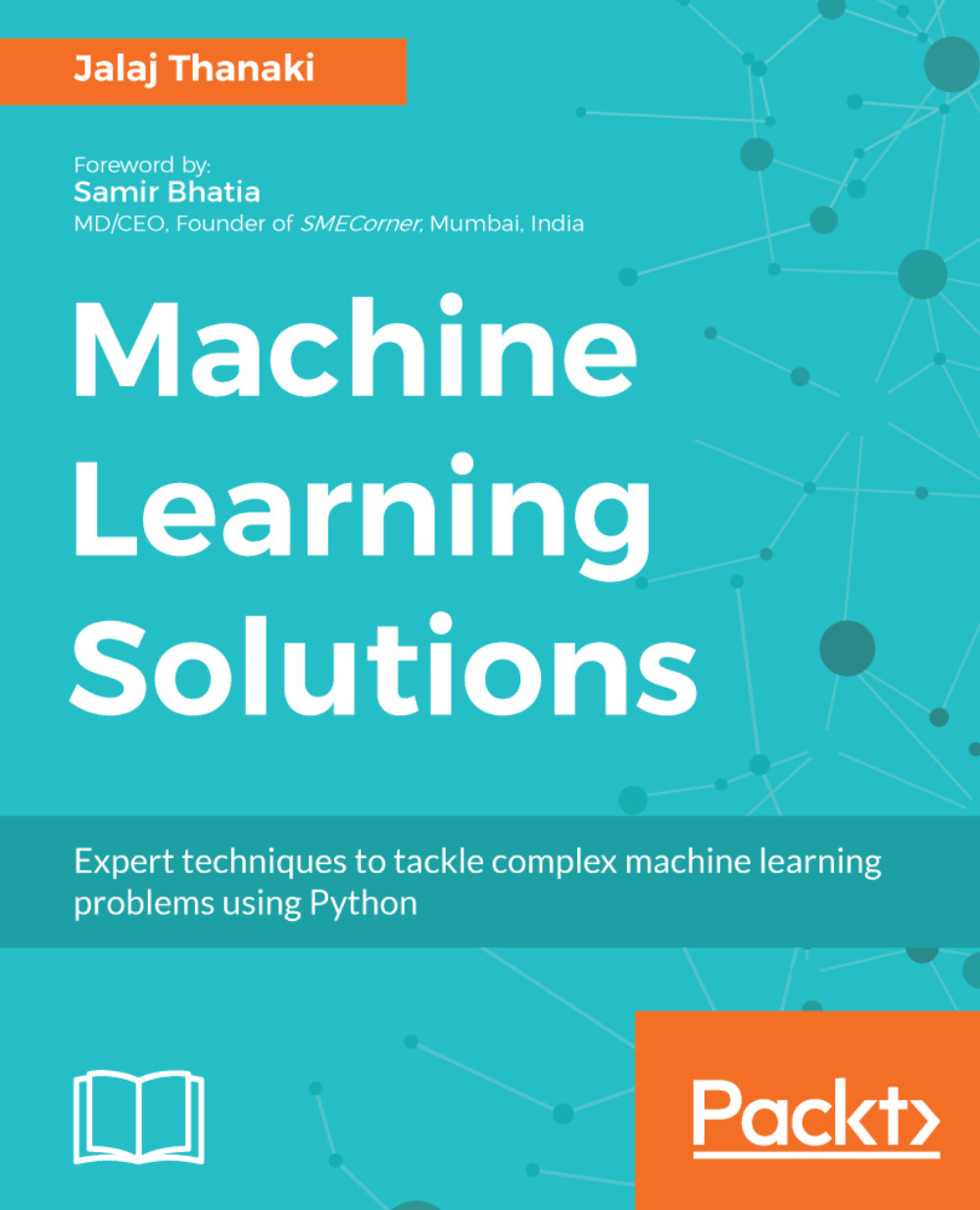
Machine Learning Solutions

Machine Learning Solutions

By : Jalaj Thanaki
4.6 (5)
close
close
Machine Learning Solutions

Machine Learning Solutions

4.6 (5)
By: Jalaj Thanaki

Overview of this book

Machine learning (ML) helps you find hidden insights from your data without the need for explicit programming. This book is your key to solving any kind of ML problem you might come across in your job. You’ll encounter a set of simple to complex problems while building ML models, and you'll not only resolve these problems, but you’ll also learn how to build projects based on each problem, with a practical approach and easy-to-follow examples. The book includes a wide range of applications: from analytics and NLP, to computer vision domains. Some of the applications you will be working on include stock price prediction, a recommendation engine, building a chat-bot, a facial expression recognition system, and many more. The problem examples we cover include identifying the right algorithm for your dataset and use cases, creating and labeling datasets, getting enough clean data to carry out processing, identifying outliers, overftting datasets, hyperparameter tuning, and more. Here, you'll also learn to make more timely and accurate predictions. In addition, you'll deal with more advanced use cases, such as building a gaming bot, building an extractive summarization tool for medical documents, and you'll also tackle the problems faced while building an ML model. By the end of this book, you'll be able to fine-tune your models as per your needs to deliver maximum productivity.
Table of Contents (19 chapters)
close
close
Machine Learning Solutions
Foreword
Contributors
Preface
1
List of Cheat Sheets
3
Index

Introducing the problem statement


First of all, let's try to understand the application that we want to develop or the problem that we are trying to solve. Once we understand the problem statement and it's use case, it will be much easier for us to develop the application. So let's begin!

Here, we want to help financial companies, such as banks, NBFS, lenders, and so on. We will make an algorithm that can predict to whom financial institutes should give loans or credit. Now you may ask what is the significance of this algorithm? Let me explain that in detail. When a financial institute lends money to a customer, they are taking some kind of risk. So, before lending, financial institutes check whether or not the borrower will have enough money in the future to pay back their loan. Based on the customer's current income and expenditure, many financial institutes perform some kind of analysis that helps them decide whether the borrower will be a good customer for that bank or not. This kind of analysis is manual and time-consuming. So, it needs some kind of automation. If we develop an algorithm, that will help financial institutes gauge their customers efficiently and effectively.Your next question may be what is the output of our algorithm? Our algorithm will generate probability. This probability value will indicate the chances of borrowers defaulting. Defaulting means borrowers cannot repay their loan in a certain amount of time. Here, probability indicates the chances of a customer not paying their loan EMI on time, resulting in default. So, a higher probability value indicates that the customer would be a bad or inappropriate borrower (customer) for the financial institution, as they may default in the next 2 years. A lower probability value indicates that the customer will be a good or appropriate borrower (customer) for the financial institution and will not default in the next 2 years.

Here, I have given you information regarding the problem statement and its output, but there is an important aspect of this algorithm: its input. So, let's discuss what our input will be!

CONTINUE READING
83
Tech Concepts
36
Programming languages
73
Tech Tools
Icon Unlimited access to the largest independent learning library in tech of over 8,000 expert-authored tech books and videos.
Icon Innovative learning tools, including AI book assistants, code context explainers, and text-to-speech.
Icon 50+ new titles added per month and exclusive early access to books as they are being written.
Machine Learning Solutions
notes
bookmark Notes and Bookmarks search Search in title playlist Add to playlist download Download options font-size Font size

Change the font size

margin-width Margin width

Change margin width

day-mode Day/Sepia/Night Modes

Change background colour

Close icon Search
Country selected

Close icon Your notes and bookmarks

Confirmation

Modal Close icon
claim successful

Buy this book with your credits?

Modal Close icon
Are you sure you want to buy this book with one of your credits?
Close
YES, BUY

Submit Your Feedback

Modal Close icon
Modal Close icon
Modal Close icon