


Computer Vision is a broad topic comprising a lot of different areas. If you want to start using Computer Vision algorithms in your projects, it may be ambiguous where the entry point is. Even if you're an experienced Computer Vision engineer, undoubtedly there are some technologies that you would want to explore in depth or get familiar with. In both cases, a practical approach works best. Only through applying methods to real problems, tuning existing methods to meet your requirements, and playing with samples can you fully understand the possibilities and limitations of any Computer Vision algorithm. This book is specifically designed to get your hands dirty with solving real computer vision tasks. Recipes in this book use OpenCV—the most popular, functionally rich, and widely used open source Computer Vision library. This book progresses from the simplest samples to the most complicated ones, so you will be able to find some useful and information which is easy to understand.
-
Book Overview & Buying
-
Table Of Contents

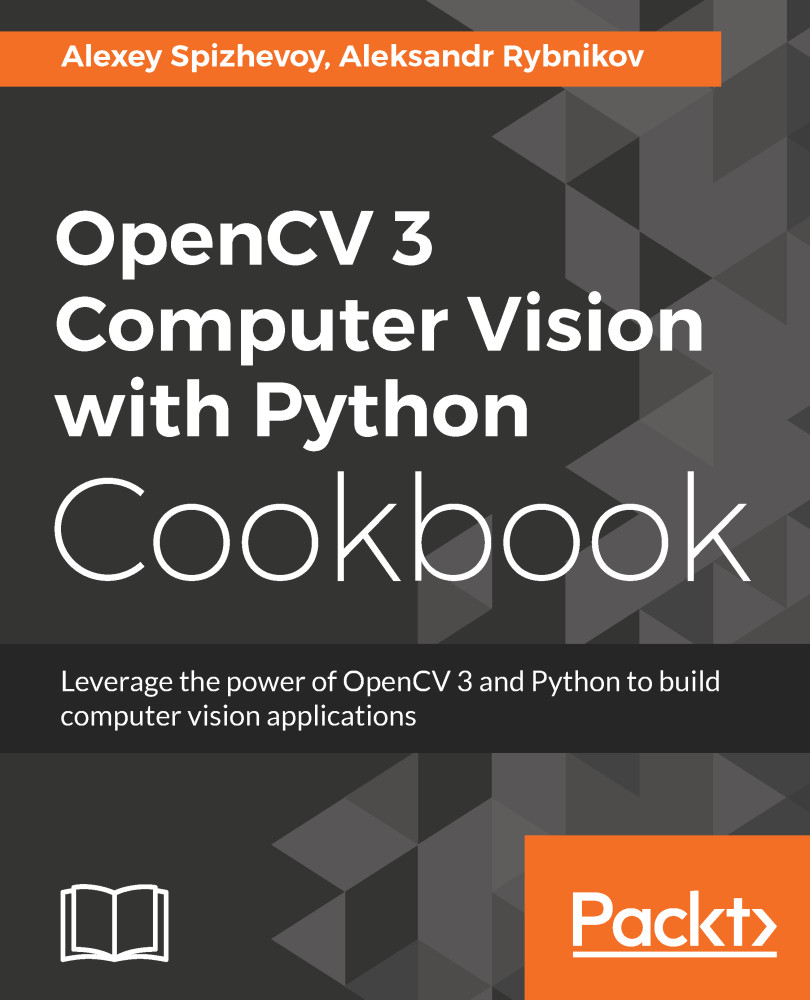
OpenCV 3 Computer Vision with Python Cookbook
By :


OpenCV 3 Computer Vision with Python Cookbook
By:
Overview of this book
OpenCV 3 is a native cross-platform library for computer vision, machine learning, and image processing. OpenCV's convenient high-level APIs hide very powerful internals designed for computational efficiency that can take advantage of multicore and GPU processing. This book will help you tackle increasingly challenging computer vision problems by providing a number of recipes that you can use to improve your applications.
In this book, you will learn how to process an image by manipulating pixels and analyze an image using histograms. Then, we'll show you how to apply image filters to enhance image content and exploit the image geometry in order to relay different views of a pictured scene. We’ll explore techniques to achieve camera calibration and perform a multiple-view analysis.
Later, you’ll work on reconstructing a 3D scene from images, converting low-level pixel information to high-level concepts for applications such as object detection and recognition. You’ll also discover how to process video from files or cameras and how to detect and track moving objects. Finally, you'll get acquainted with recent approaches in deep learning and neural networks.
By the end of the book, you’ll be able to apply your skills in OpenCV to create computer vision applications in various domains.
Table of Contents (11 chapters)
Preface

 Free Chapter
I/O and GUI

Matrices, Colors, and Filters
Contours and Segmentation
Object Detection and Machine Learning
Deep Learning
Linear Algebra
Detectors and Descriptors
Image and Video Processing
Multiple View Geometry
Other Books You May Enjoy


