
Sign In Start Free Trial
Account

Add to playlist

Create a Playlist

Modal Close icon
You need to login to use this feature.
  • Book Overview & Buying Hands-On Artificial Intelligence for Beginners
  • Table Of Contents Toc
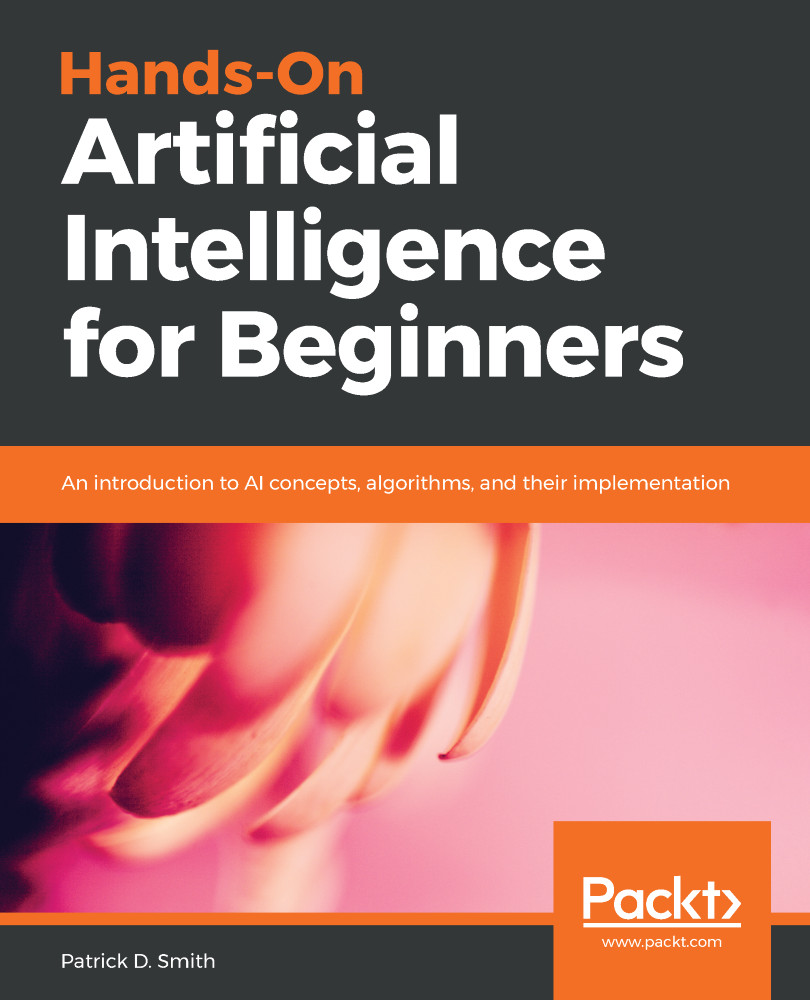
Hands-On Artificial Intelligence for Beginners

Hands-On Artificial Intelligence for Beginners

By : Dindi, Patrick D. Smith
close
close
Hands-On Artificial Intelligence for Beginners

Hands-On Artificial Intelligence for Beginners

By: Dindi, Patrick D. Smith

Overview of this book

Virtual Assistants, such as Alexa and Siri, process our requests, Google's cars have started to read addresses, and Amazon's prices and Netflix's recommended videos are decided by AI. Artificial Intelligence is one of the most exciting technologies and is becoming increasingly significant in the modern world. Hands-On Artificial Intelligence for Beginners will teach you what Artificial Intelligence is and how to design and build intelligent applications. This book will teach you to harness packages such as TensorFlow in order to create powerful AI systems. You will begin with reviewing the recent changes in AI and learning how artificial neural networks (ANNs) have enabled more intelligent AI. You'll explore feedforward, recurrent, convolutional, and generative neural networks (FFNNs, RNNs, CNNs, and GNNs), as well as reinforcement learning methods. In the concluding chapters, you'll learn how to implement these methods for a variety of tasks, such as generating text for chatbots, and playing board and video games. By the end of this book, you will be able to understand exactly what you need to consider when optimizing ANNs and how to deploy and maintain AI applications.
Table of Contents (15 chapters)
close
close

Constructing a basic agent

The simplest way to construct an artificial assistant with TensorFlow is to use a sequence-to-sequence (Seq2Seq) model, which we learned in the chapter on RNNs.

While originally developed for neural machine translation, we can adjust this model to act as an intelligent chatbot for our own purposes. We'll create the brain behind our assistant as a Python class called IntelligentAssistant. Then, we'll create the training and chatting functions for our assistant:

  1. First, let's start with our standard imports and initialize our variables. Take special note of the mask variable here; masks are placeholders that allow us to handle variable-length inputs in our network:
import numpy as np
import tensorflow as tf

class IntelligentAssistant:
''' The "Brain" behind our assistant '''

def __init__(self, forwardPass...
CONTINUE READING
83
Tech Concepts
36
Programming languages
73
Tech Tools
Icon Unlimited access to the largest independent learning library in tech of over 8,000 expert-authored tech books and videos.
Icon Innovative learning tools, including AI book assistants, code context explainers, and text-to-speech.
Icon 50+ new titles added per month and exclusive early access to books as they are being written.
Hands-On Artificial Intelligence for Beginners
notes
bookmark Notes and Bookmarks search Search in title playlist Add to playlist download Download options font-size Font size

Change the font size

margin-width Margin width

Change margin width

day-mode Day/Sepia/Night Modes

Change background colour

Close icon Search
Country selected

Close icon Your notes and bookmarks

Confirmation

Modal Close icon
claim successful

Buy this book with your credits?

Modal Close icon
Are you sure you want to buy this book with one of your credits?
Close
YES, BUY

Submit Your Feedback

Modal Close icon
Modal Close icon
Modal Close icon