Sign In Start Free Trial
Account

Add to playlist

Create a Playlist

Modal Close icon
You need to login to use this feature.
  • Book Overview & Buying Applied Unsupervised Learning with Python
  • Table Of Contents Toc
Applied Unsupervised Learning with Python

Applied Unsupervised Learning with Python

By : Benjamin Johnston , Aaron Jones , Christopher Kruger
3 (2)
close
close
Applied Unsupervised Learning with Python

Applied Unsupervised Learning with Python

3 (2)
By: Benjamin Johnston , Aaron Jones , Christopher Kruger

Overview of this book

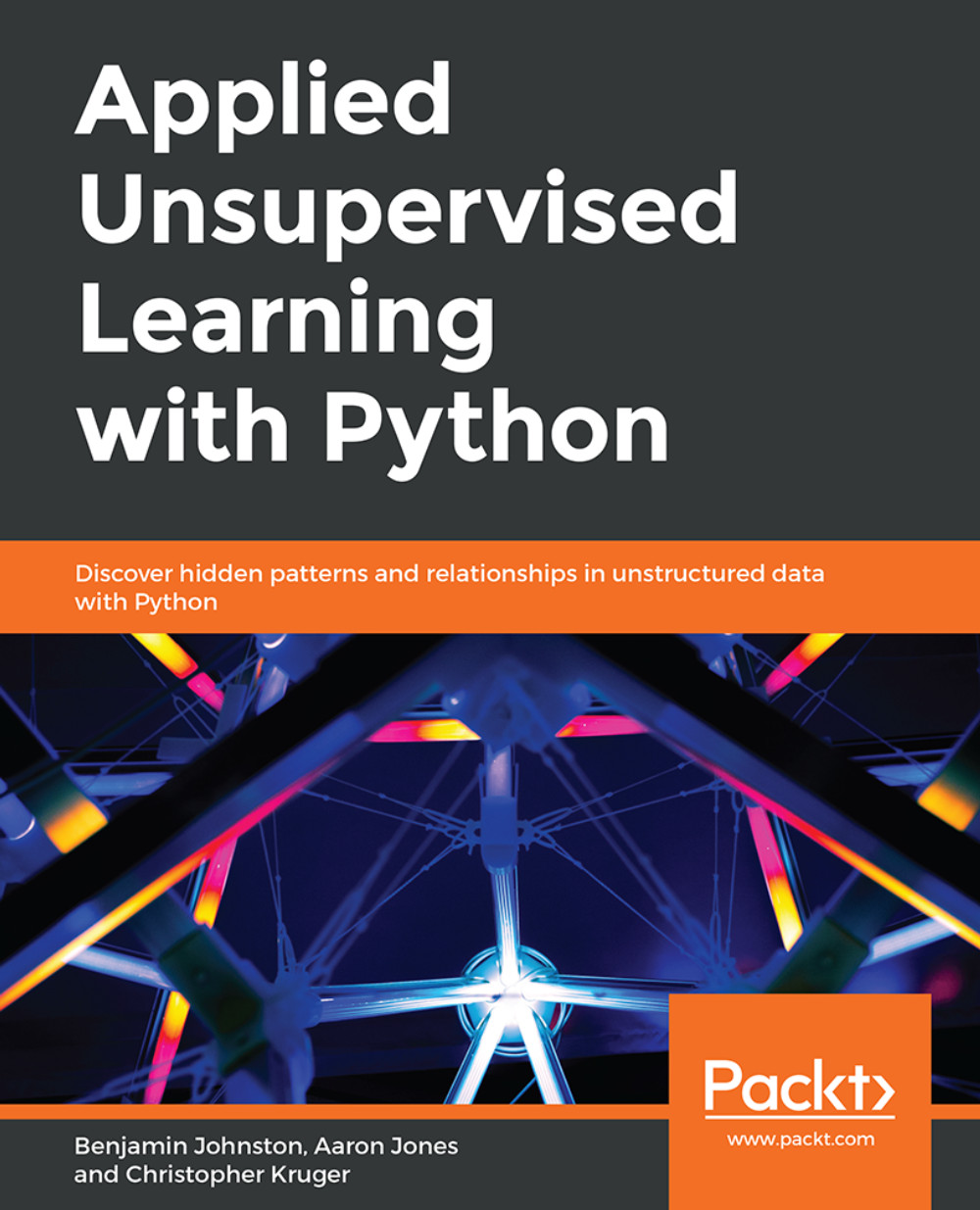
Unsupervised learning is a useful and practical solution in situations where labeled data is not available. Applied Unsupervised Learning with Python guides you in learning the best practices for using unsupervised learning techniques in tandem with Python libraries and extracting meaningful information from unstructured data. The book begins by explaining how basic clustering works to find similar data points in a set. Once you are well-versed with the k-means algorithm and how it operates, you’ll learn what dimensionality reduction is and where to apply it. As you progress, you’ll learn various neural network techniques and how they can improve your model. While studying the applications of unsupervised learning, you will also understand how to mine topics that are trending on Twitter and Facebook and build a news recommendation engine for users. Finally, you will be able to put your knowledge to work through interesting activities such as performing a Market Basket Analysis and identifying relationships between different products. By the end of this book, you will have the skills you need to confidently build your own models using Python.
Table of Contents (12 chapters)
close
close
Applied Unsupervised Learning with Python
Preface

Introduction


This chapter is the final installment in the micro-series on dimensionality reduction techniques and transformations. Our previous chapters in this series have described a number of different methods for reducing the dimensionality of a dataset as a means of either cleaning the data, reducing its size for computational efficiency, or for extracting the most important information available within the dataset. While we have demonstrated many methods for reducing high-dimensional datasets, in many cases, we are unable to reduce the number of dimensions to a size that can be visualized, that is, two or three dimensions, without excessively degrading the quality of the data. Consider the MNIST dataset that we used in Chapter 5, Autoencoders, which is a collection of digitized handwritten digits of the numbers 0 through 9. Each image is 28 x 28 pixels in size, providing 784 individual dimensions or features. If we were to reduce these 784 dimensions down to 2 or 3 for visualization...

CONTINUE READING
83
Tech Concepts
36
Programming languages
73
Tech Tools
Icon Unlimited access to the largest independent learning library in tech of over 8,000 expert-authored tech books and videos.
Icon Innovative learning tools, including AI book assistants, code context explainers, and text-to-speech.
Icon 50+ new titles added per month and exclusive early access to books as they are being written.
Applied Unsupervised Learning with Python
notes
bookmark Notes and Bookmarks search Search in title playlist Add to playlist font-size Font size

Change the font size

margin-width Margin width

Change margin width

day-mode Day/Sepia/Night Modes

Change background colour

Close icon Search
Country selected

Close icon Your notes and bookmarks

Confirmation

Modal Close icon
claim successful

Buy this book with your credits?

Modal Close icon
Are you sure you want to buy this book with one of your credits?
Close
YES, BUY

Submit Your Feedback

Modal Close icon
Modal Close icon
Modal Close icon