Sign In Start Free Trial
Account

Add to playlist

Create a Playlist

Modal Close icon
You need to login to use this feature.
  • Book Overview & Buying Applied Unsupervised Learning with R
  • Table Of Contents Toc
Applied Unsupervised Learning with R

Applied Unsupervised Learning with R

By : Alok Malik, Bradford Tuckfield
4.8 (10)
close
close
Applied Unsupervised Learning with R

Applied Unsupervised Learning with R

4.8 (10)
By: Alok Malik, Bradford Tuckfield

Overview of this book

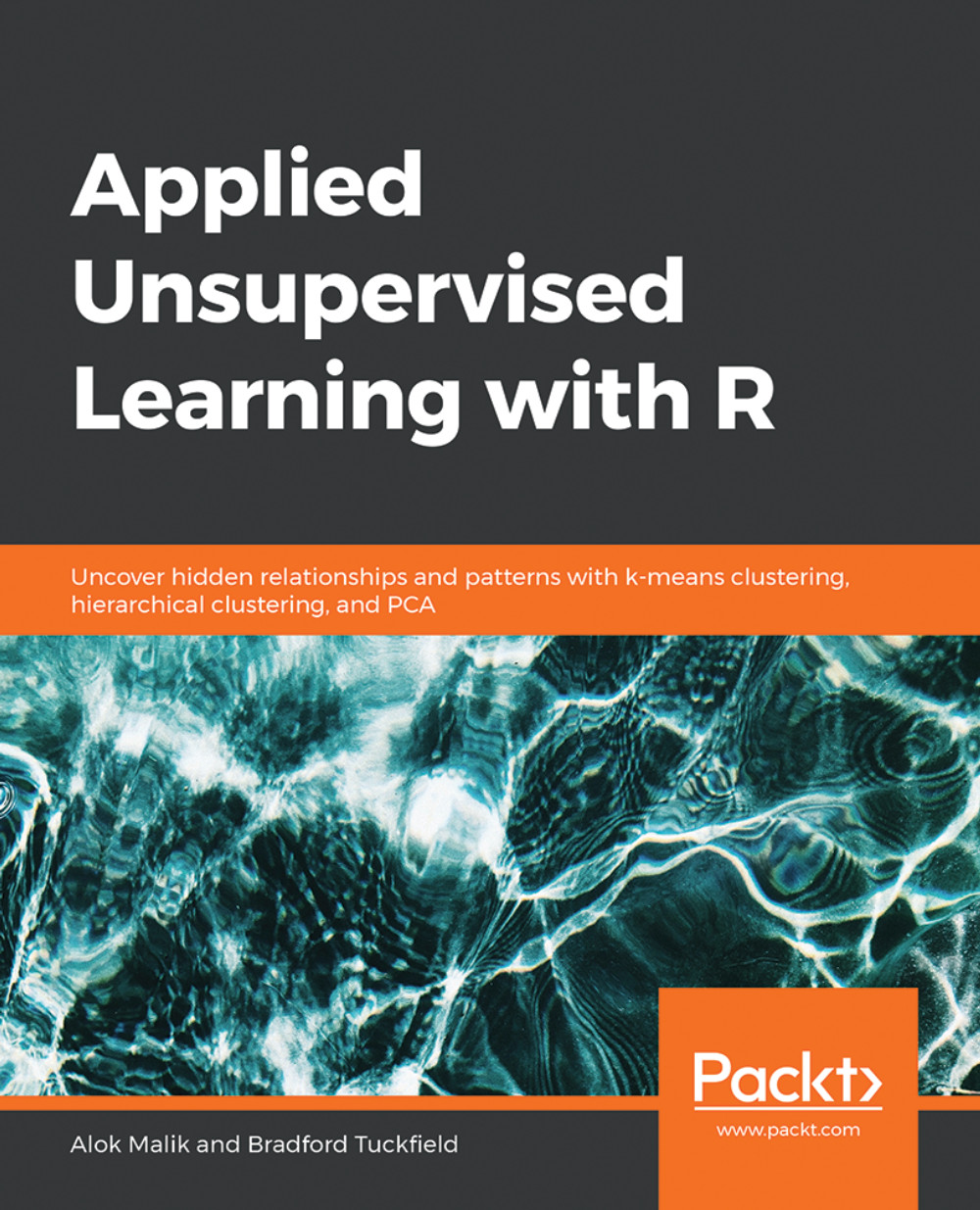
Starting with the basics, Applied Unsupervised Learning with R explains clustering methods, distribution analysis, data encoders, and features of R that enable you to understand your data better and get answers to your most pressing business questions. This book begins with the most important and commonly used method for unsupervised learning - clustering - and explains the three main clustering algorithms - k-means, divisive, and agglomerative. Following this, you'll study market basket analysis, kernel density estimation, principal component analysis, and anomaly detection. You'll be introduced to these methods using code written in R, with further instructions on how to work with, edit, and improve R code. To help you gain a practical understanding, the book also features useful tips on applying these methods to real business problems, including market segmentation and fraud detection. By working through interesting activities, you'll explore data encoders and latent variable models. By the end of this book, you will have a better understanding of different anomaly detection methods, such as outlier detection, Mahalanobis distances, and contextual and collective anomaly detection.
Table of Contents (9 chapters)
close
close

Kernel Density


To conclude the chapter, we will discuss using kernel density estimates to perform outlier detection on a set of blood samples. Kernel density estimation provides a natural way to test whether a particular set of blood results are anomalous, even without having specialized knowledge of the particular blood test being used or even of medicine in general.

Suppose that you are working at a doctor's office and your boss asks you to do a new type of blood test on patients. Your boss wants to know if any of the patients have anomalous test results. However, you are not familiar with this new blood test and you do not know what normal and anomalous results are supposed to look like. All you have is a record of previous blood tests that your boss assures you are from normal patients. Suppose that these tests had the following results:

normal_results<-c(100,95,106,92,109,190,210,201,198)

Now suppose that your boss wants you to find anomalies (if any) in the following new blood test...

CONTINUE READING
83
Tech Concepts
36
Programming languages
73
Tech Tools
Icon Unlimited access to the largest independent learning library in tech of over 8,000 expert-authored tech books and videos.
Icon Innovative learning tools, including AI book assistants, code context explainers, and text-to-speech.
Icon 50+ new titles added per month and exclusive early access to books as they are being written.
Applied Unsupervised Learning with R
notes
bookmark Notes and Bookmarks search Search in title playlist Add to playlist font-size Font size

Change the font size

margin-width Margin width

Change margin width

day-mode Day/Sepia/Night Modes

Change background colour

Close icon Search
Country selected

Close icon Your notes and bookmarks

Confirmation

Modal Close icon
claim successful

Buy this book with your credits?

Modal Close icon
Are you sure you want to buy this book with one of your credits?
Close
YES, BUY

Submit Your Feedback

Modal Close icon
Modal Close icon
Modal Close icon