Sign In Start Free Trial
Account

Add to playlist

Create a Playlist

Modal Close icon
You need to login to use this feature.
  • Book Overview & Buying The TensorFlow Workshop
  • Table Of Contents Toc
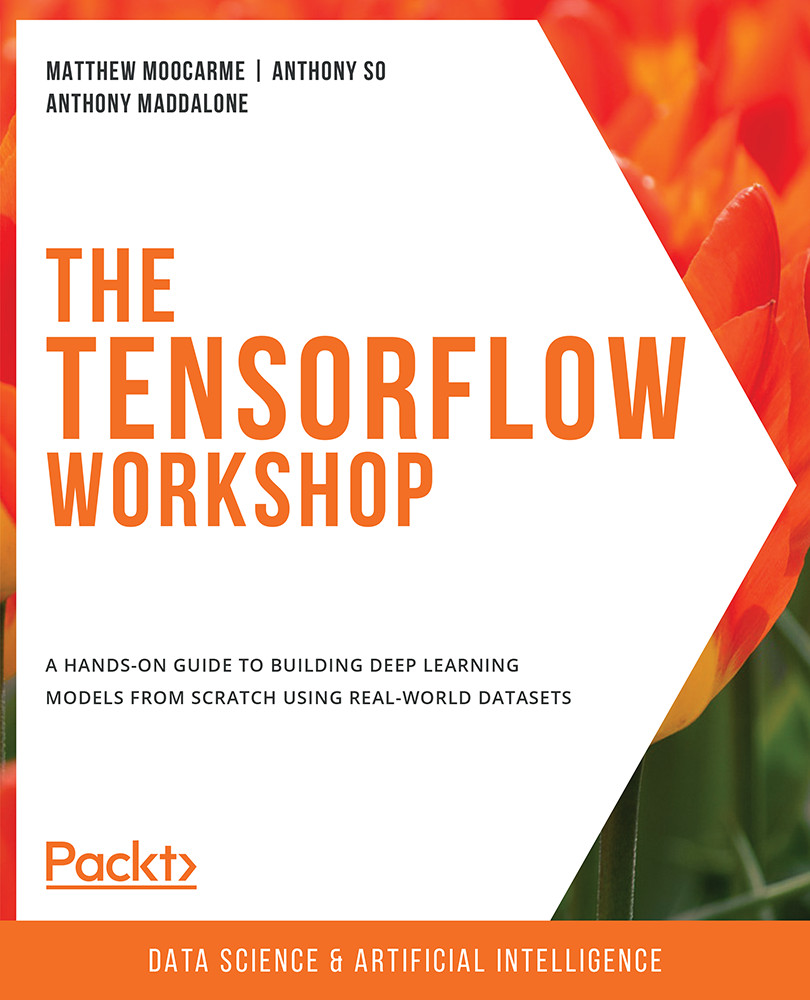
The TensorFlow Workshop

The TensorFlow Workshop

By : Matthew Moocarme, Abhranshu Bagchi, Anthony So , Anthony Maddalone
4.6 (25)
close
close
The TensorFlow Workshop

The TensorFlow Workshop

4.6 (25)
By: Matthew Moocarme, Abhranshu Bagchi, Anthony So , Anthony Maddalone

Overview of this book

Getting to grips with tensors, deep learning, and neural networks can be intimidating and confusing for anyone, no matter their experience level. The breadth of information out there, often written at a very high level and aimed at advanced practitioners, can make getting started even more challenging. If this sounds familiar to you, The TensorFlow Workshop is here to help. Combining clear explanations, realistic examples, and plenty of hands-on practice, it’ll quickly get you up and running. You’ll start off with the basics – learning how to load data into TensorFlow, perform tensor operations, and utilize common optimizers and activation functions. As you progress, you’ll experiment with different TensorFlow development tools, including TensorBoard, TensorFlow Hub, and Google Colab, before moving on to solve regression and classification problems with sequential models. Building on this solid foundation, you’ll learn how to tune models and work with different types of neural network, getting hands-on with real-world deep learning applications such as text encoding, temperature forecasting, image augmentation, and audio processing. By the end of this deep learning book, you’ll have the skills, knowledge, and confidence to tackle your own ambitious deep learning projects with TensorFlow.
Table of Contents (13 chapters)
close
close
Preface

Pooling Layer

Pooling is an operation that is commonly added to a CNN to reduce the dimensionality of an image by reducing the number of pixels in the output from the convolutional layer it follows. Pooling layers shrink the input image to increase computational efficiency and reduce the number of parameters to limit the risk of overfitting.

A pooling layer immediately follows a convolution layer and is considered another important part of the CNN structure. This section will focus on two types of pooling:

  • Max pooling
  • Average pooling

Max Pooling

With max pooling, a filter or kernel only retains the largest pixel value from an input matrix. To get a clearer idea of what is happening, consider the following example. Say you have a 4x4 input. This first step in max pooling would be to divide the 4x4 matrix into four quadrants. Each quadrant will be of the size 2x2. Apply a filter of size 2. This means that your filter will look exactly like a 2x2 matrix.

...
CONTINUE READING
83
Tech Concepts
36
Programming languages
73
Tech Tools
Icon Unlimited access to the largest independent learning library in tech of over 8,000 expert-authored tech books and videos.
Icon Innovative learning tools, including AI book assistants, code context explainers, and text-to-speech.
Icon 50+ new titles added per month and exclusive early access to books as they are being written.
The TensorFlow Workshop
notes
bookmark Notes and Bookmarks search Search in title playlist Add to playlist download Download options font-size Font size

Change the font size

margin-width Margin width

Change margin width

day-mode Day/Sepia/Night Modes

Change background colour

Close icon Search
Country selected

Close icon Your notes and bookmarks

Confirmation

Modal Close icon
claim successful

Buy this book with your credits?

Modal Close icon
Are you sure you want to buy this book with one of your credits?
Close
YES, BUY

Submit Your Feedback

Modal Close icon
Modal Close icon
Modal Close icon