


-
Book Overview & Buying
-
Table Of Contents

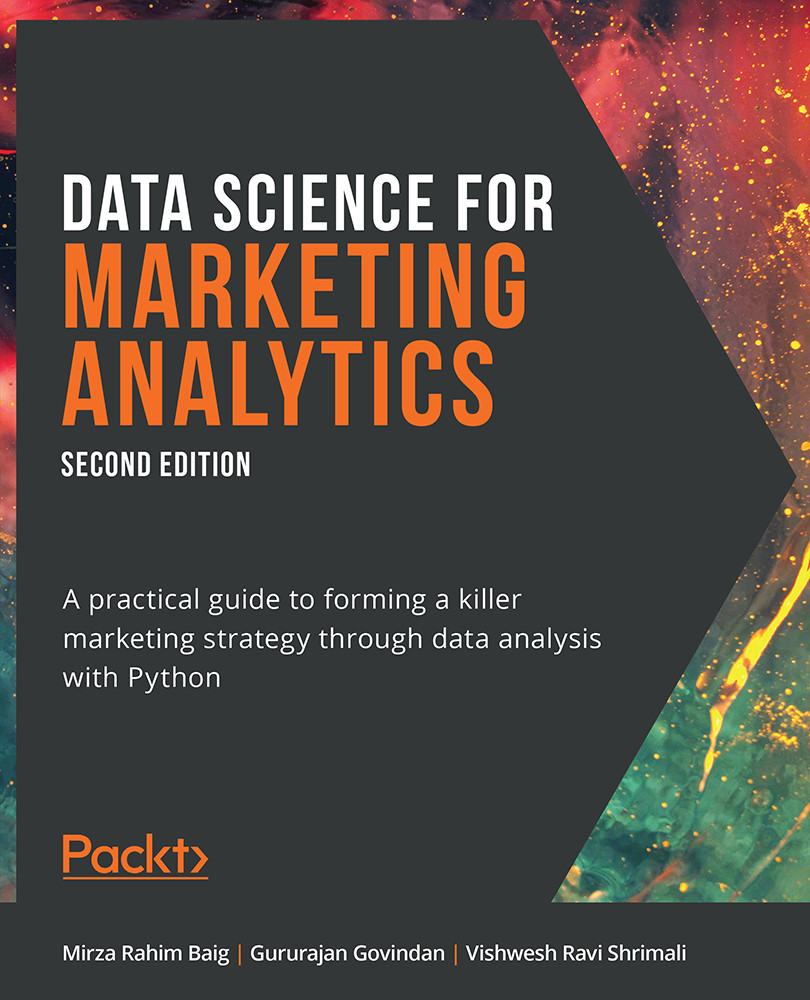
Data Science for Marketing Analytics - Second Edition
By :


Data Science for Marketing Analytics
By:
Overview of this book
Unleash the power of data to reach your marketing goals with this practical guide to data science for business.
This book will help you get started on your journey to becoming a master of marketing analytics with Python. You'll work with relevant datasets and build your practical skills by tackling engaging exercises and activities that simulate real-world market analysis projects.
You'll learn to think like a data scientist, build your problem-solving skills, and discover how to look at data in new ways to deliver business insights and make intelligent data-driven decisions.
As well as learning how to clean, explore, and visualize data, you'll implement machine learning algorithms and build models to make predictions. As you work through the book, you'll use Python tools to analyze sales, visualize advertising data, predict revenue, address customer churn, and implement customer segmentation to understand behavior.
By the end of this book, you'll have the knowledge, skills, and confidence to implement data science and machine learning techniques to better understand your marketing data and improve your decision-making.
Table of Contents (11 chapters)
Preface


1. Data Preparation and Cleaning

 Free Chapter
2. Data Exploration and Visualization
3. Unsupervised Learning and Customer Segmentation
4. Evaluating and Choosing the Best Segmentation Approach
5. Predicting Customer Revenue Using Linear Regression
6. More Tools and Techniques for Evaluating Regression Models
7. Supervised Learning: Predicting Customer Churn
8. Fine-Tuning Classification Algorithms
9. Multiclass Classification Algorithms
Appendix


