Sign In Start Free Trial
Account

Add to playlist

Create a Playlist

Modal Close icon
You need to login to use this feature.
  • Book Overview & Buying Exploratory Data Analysis with Python Cookbook
  • Table Of Contents Toc
Exploratory Data Analysis with Python Cookbook

Exploratory Data Analysis with Python Cookbook

By : Ayodele Oluleye
4.8 (5)
close
close
Exploratory Data Analysis with Python Cookbook

Exploratory Data Analysis with Python Cookbook

4.8 (5)
By: Ayodele Oluleye

Overview of this book

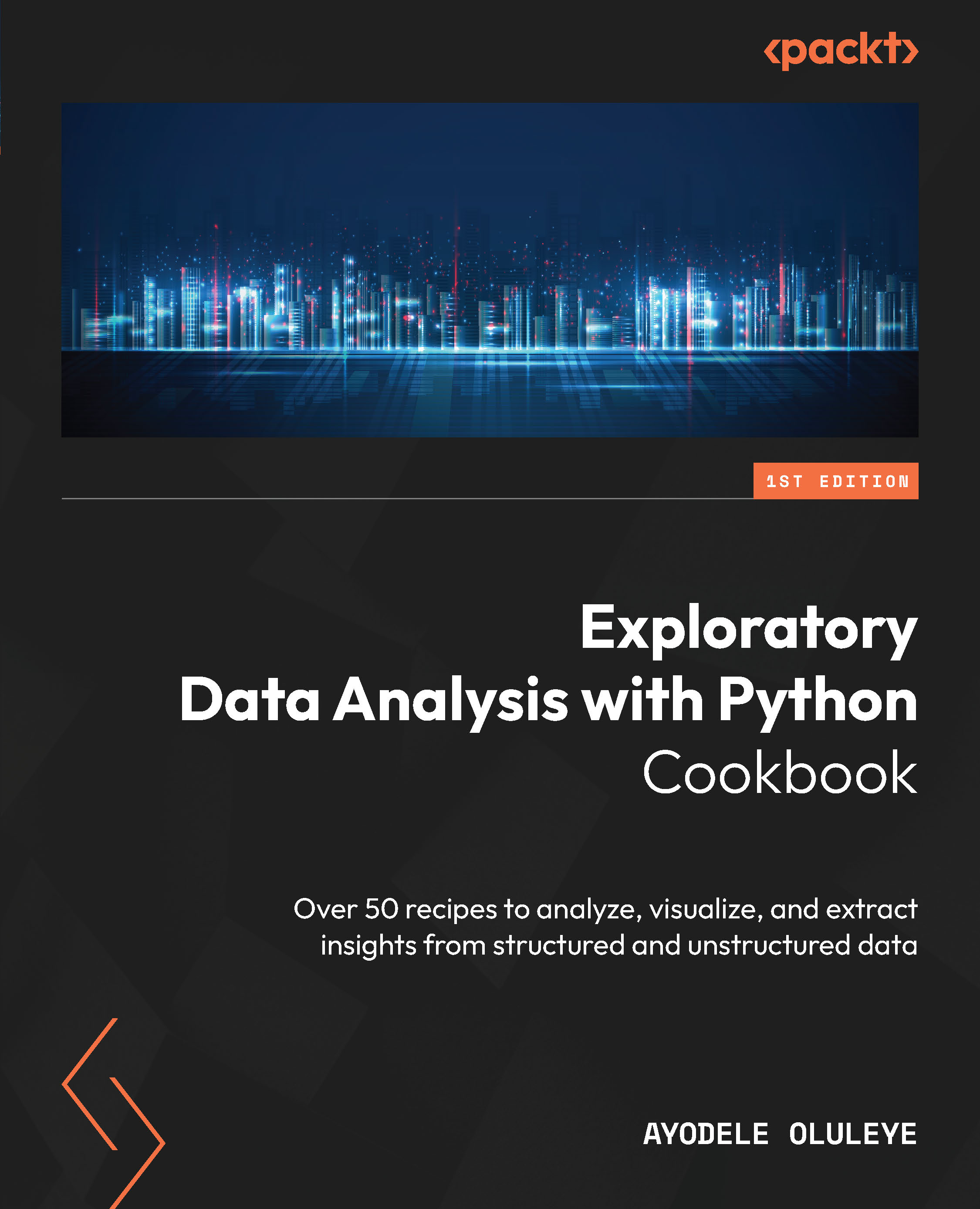
In today's data-centric world, the ability to extract meaningful insights from vast amounts of data has become a valuable skill across industries. Exploratory Data Analysis (EDA) lies at the heart of this process, enabling us to comprehend, visualize, and derive valuable insights from various forms of data. This book is a comprehensive guide to Exploratory Data Analysis using the Python programming language. It provides practical steps needed to effectively explore, analyze, and visualize structured and unstructured data. It offers hands-on guidance and code for concepts such as generating summary statistics, analyzing single and multiple variables, visualizing data, analyzing text data, handling outliers, handling missing values and automating the EDA process. It is suited for data scientists, data analysts, researchers or curious learners looking to gain essential knowledge and practical steps for analyzing vast amounts of data to uncover insights. Python is an open-source general purpose programming language which is used widely for data science and data analysis given its simplicity and versatility. It offers several libraries which can be used to clean, analyze, and visualize data. In this book, we will explore popular Python libraries such as Pandas, Matplotlib, and Seaborn and provide workable code for analyzing data in Python using these libraries. By the end of this book, you will have gained comprehensive knowledge about EDA and mastered the powerful set of EDA techniques and tools required for analyzing both structured and unstructured data to derive valuable insights.
Table of Contents (13 chapters)
close
close

Dropping data rows and columns

When working with tabular data, we may have reason to drop some rows or columns within our dataset. Sometimes, we may need to drop columns or rows either because they are erroneous or irrelevant. In pandas, we have the flexibility to drop a single row/column or multiple rows/columns. We can use the drop method to achieve this.

Getting ready

We will work with the full Marketing Campaign data for this recipe.

How to do it…

We will drop rows and columns using the pandas library:

  1. Import the pandas library:
    import pandas as pd
  2. Load the .csv file into a dataframe using read_csv. Then, subset the dataframe to include only relevant columns:
    marketing_data = pd.read_csv("data/marketing_campaign.csv")
    marketing_data = marketing_data[['ID', 'Year_Birth', 'Kidhome', 'Teenhome']]
  3. Inspect the data. Check the first few rows. Check the number of columns and rows:
    marketing_data.head()
        ID    Year_Birth    Education    Marital_Status
    0    5524    1957    Graduation    Single
    1    2174    1954    Graduation    Single
    2    4141    1965    Graduation    Together
    3    6182    1984    Graduation    Together
    4    5324    1981    PhD    Married
    marketing_data.shape
    (5, 4)
  4. Delete a specified row at index value 1:
    marketing_data.drop(labels=[1], axis=0)
        ID    Year_Birth    Education    Marital_Status
    0    5524    1957    Graduation    Single
    2    4141    1965    Graduation    Together
    3    6182    1984    Graduation    Together
    4    5324    1981    PhD    Married
  5. Delete a single column:
    marketing_data.drop(labels=['Year_Birth'], axis=1)
        ID    Education    Marital_Status
    0    5524    Graduation    Single
    1    2174    Graduation    Single
    2    4141    Graduation    Together
    3    6182    Graduation    Together
    4    5324    PhD    Married

Good job! We have dropped rows and columns from our dataset.

How it works...

We refer to pandas as pd in step 1. In step 2, we use read_csv to load the .csv file into a pandas dataframe and call it marketing_data. We also subset the dataframe to include only four relevant columns. In step 3, we inspect the dataset using head() to see the first five rows in the dataset. Using the shape method, we get a sense of the number of rows and columns from the tuple respectively.

In step 4, we use the drop method to delete a specified row at index value 1 and view the result, which shows the row at index 1 has been removed. The drop method takes a list of indices as the first argument and an axis value as the second. The axis value determines whether the drop operation will be performed on a row or column. A value of 0 is used for rows while 1 is used for columns.

In step 5, we use the drop method to delete a specified column and view the result, which shows the specific column has been removed. To drop columns, we need to specify the name of the column and provide the axis value of 1.

There’s more...

We can drop multiple rows or columns using the drop method. To achieve this, we need to specify all the row indices or column names in a list and provide the respective axis value of 0 or 1 for rows and columns respectively.

CONTINUE READING
83
Tech Concepts
36
Programming languages
73
Tech Tools
Icon Unlimited access to the largest independent learning library in tech of over 8,000 expert-authored tech books and videos.
Icon Innovative learning tools, including AI book assistants, code context explainers, and text-to-speech.
Icon 50+ new titles added per month and exclusive early access to books as they are being written.
Exploratory Data Analysis with Python Cookbook
notes
bookmark Notes and Bookmarks search Search in title playlist Add to playlist download Download options font-size Font size

Change the font size

margin-width Margin width

Change margin width

day-mode Day/Sepia/Night Modes

Change background colour

Close icon Search
Country selected

Close icon Your notes and bookmarks

Confirmation

Modal Close icon
claim successful

Buy this book with your credits?

Modal Close icon
Are you sure you want to buy this book with one of your credits?
Close
YES, BUY

Submit Your Feedback

Modal Close icon
Modal Close icon
Modal Close icon