


-
Book Overview & Buying
-
Table Of Contents

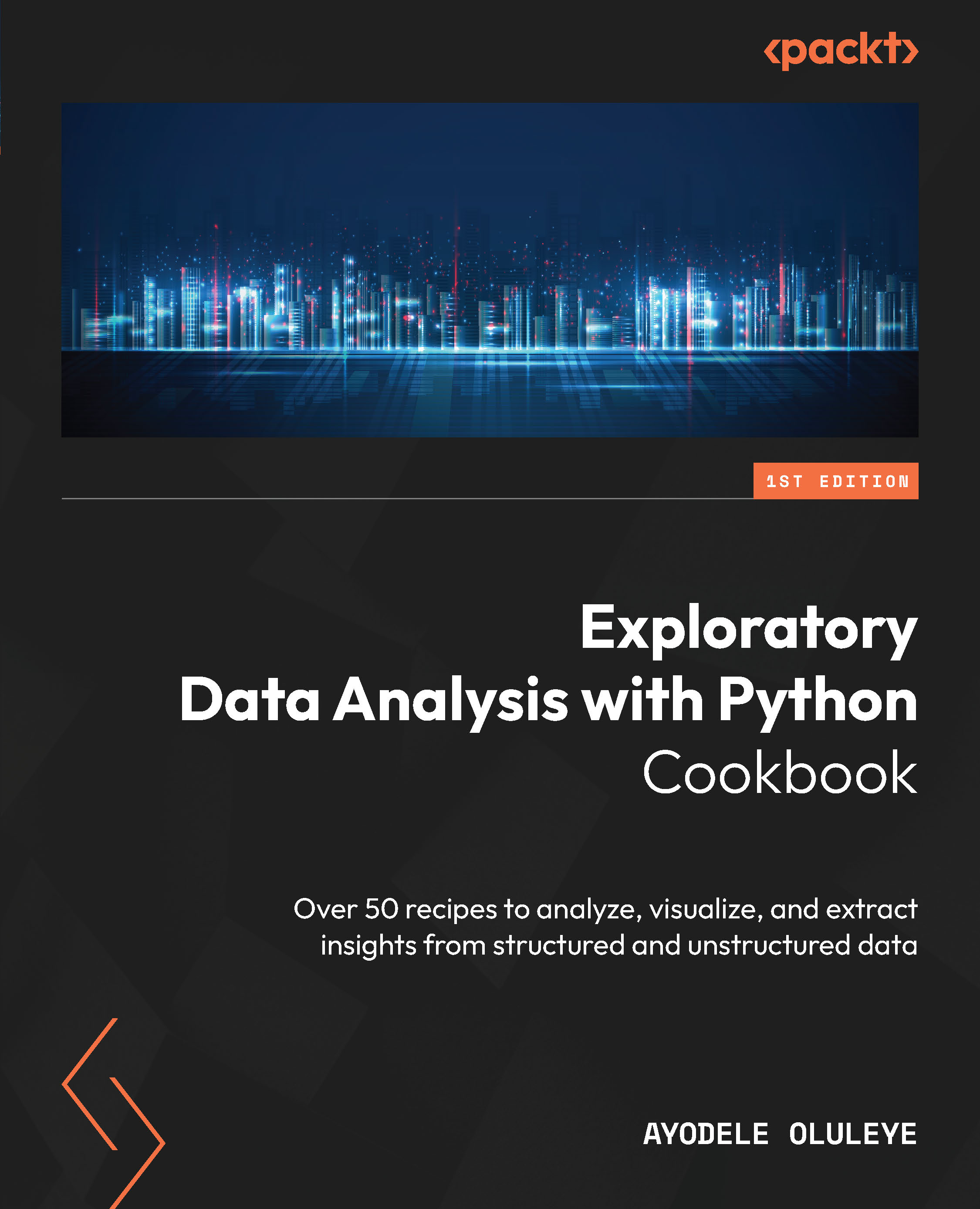
Exploratory Data Analysis with Python Cookbook
By :


Exploratory Data Analysis with Python Cookbook
By:
Overview of this book
In today's data-centric world, the ability to extract meaningful insights from vast amounts of data has become a valuable skill across industries. Exploratory Data Analysis (EDA) lies at the heart of this process, enabling us to comprehend, visualize, and derive valuable insights from various forms of data.
This book is a comprehensive guide to Exploratory Data Analysis using the Python programming language. It provides practical steps needed to effectively explore, analyze, and visualize structured and unstructured data. It offers hands-on guidance and code for concepts such as generating summary statistics, analyzing single and multiple variables, visualizing data, analyzing text data, handling outliers, handling missing values and automating the EDA process. It is suited for data scientists, data analysts, researchers or curious learners looking to gain essential knowledge and practical steps for analyzing vast amounts of data to uncover insights.
Python is an open-source general purpose programming language which is used widely for data science and data analysis given its simplicity and versatility. It offers several libraries which can be used to clean, analyze, and visualize data. In this book, we will explore popular Python libraries such as Pandas, Matplotlib, and Seaborn and provide workable code for analyzing data in Python using these libraries.
By the end of this book, you will have gained comprehensive knowledge about EDA and mastered the powerful set of EDA techniques and tools required for analyzing both structured and unstructured data to derive valuable insights.
Table of Contents (13 chapters)
Preface


Chapter 1: Generating Summary Statistics
 Free Chapter
Chapter 2: Preparing Data for EDA

Chapter 3: Visualizing Data in Python
Chapter 4: Performing Univariate Analysis in Python
Chapter 5: Performing Bivariate Analysis in Python
Chapter 6: Performing Multivariate Analysis in Python
Chapter 7: Analyzing Time Series Data in Python
Chapter 8: Analysing Text Data in Python
Chapter 9: Dealing with Outliers and Missing Values
Chapter 10: Performing Automated Exploratory Data Analysis in Python
Index


