


-
Book Overview & Buying
-
Table Of Contents

RAG from First Principles
By :


RAG from First Principles
By:
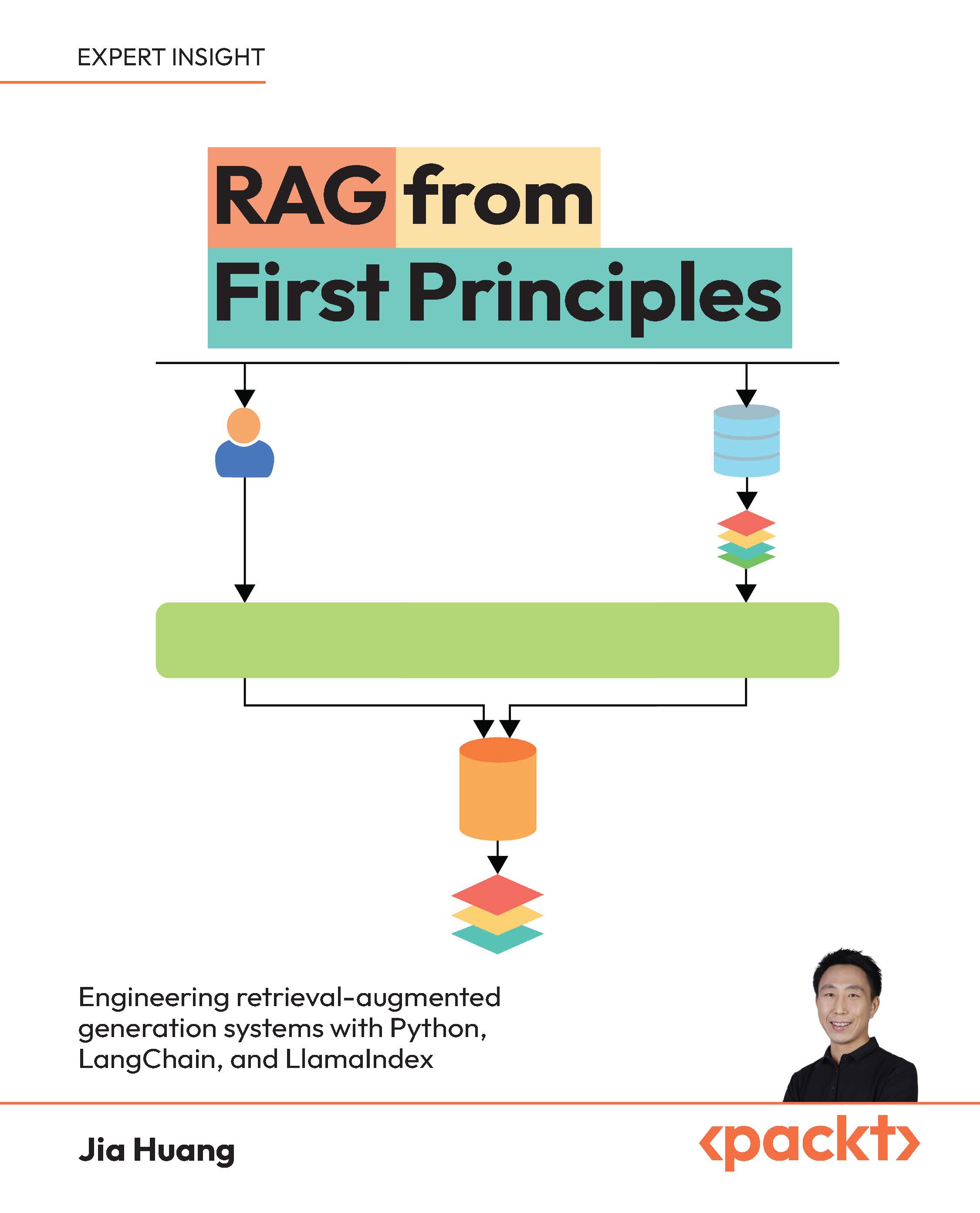
Overview of this book
Most developers can spin up a RAG pipeline in an afternoon using LangChain or LlamaIndex. Far fewer understand why retrieval fails or how to fix it. This book is for those who want to go deeper.
RAG From First Principles dismantles the retrieval-augmented generation stack layer by layer, explaining how documents are ingested and parsed, why chunking strategy directly impacts answer quality, how embedding models encode meaning, what happens inside a vector database, and how sparse and dense retrieval interact in a hybrid system. Written by Jia Huang, a research engineer and bestselling AI author, it brings both research depth and production experience to one of AI's most critical engineering disciplines.
Structured as a progressive dialogue between a seasoned engineer and two students, the book surfaces the questions practitioners actually ask. Each chapter builds on the last, covering topics from data import and chunking to embedding selection, index design, hybrid search, and post-retrieval processing, before moving on to response generation, evaluation, and advanced paradigms including GraphRAG, Agentic RAG, and Modular RAG.
By the end, you'll have the architectural understanding to optimize, debug, and extend your RAG systems with confidence.
*Email sign-up and proof of purchase required
Table of Contents (14 chapters)
Preface


 Free Chapter
Data Import

Text Chunking
Information Embedding
Vector Storage
Pre-Retrieval Processing
Index Optimization
Retrieval Post-Processing
Response Generation
System Evaluation
Complex RAG Paradigms
Unlock Your Exclusive Benefits
Other Books You May Enjoy
Index


