
Sign In Start Free Trial
Account

Add to playlist

Create a Playlist

Modal Close icon
You need to login to use this feature.
  • Book Overview & Buying Artificial Intelligence for IoT Cookbook
  • Table Of Contents Toc
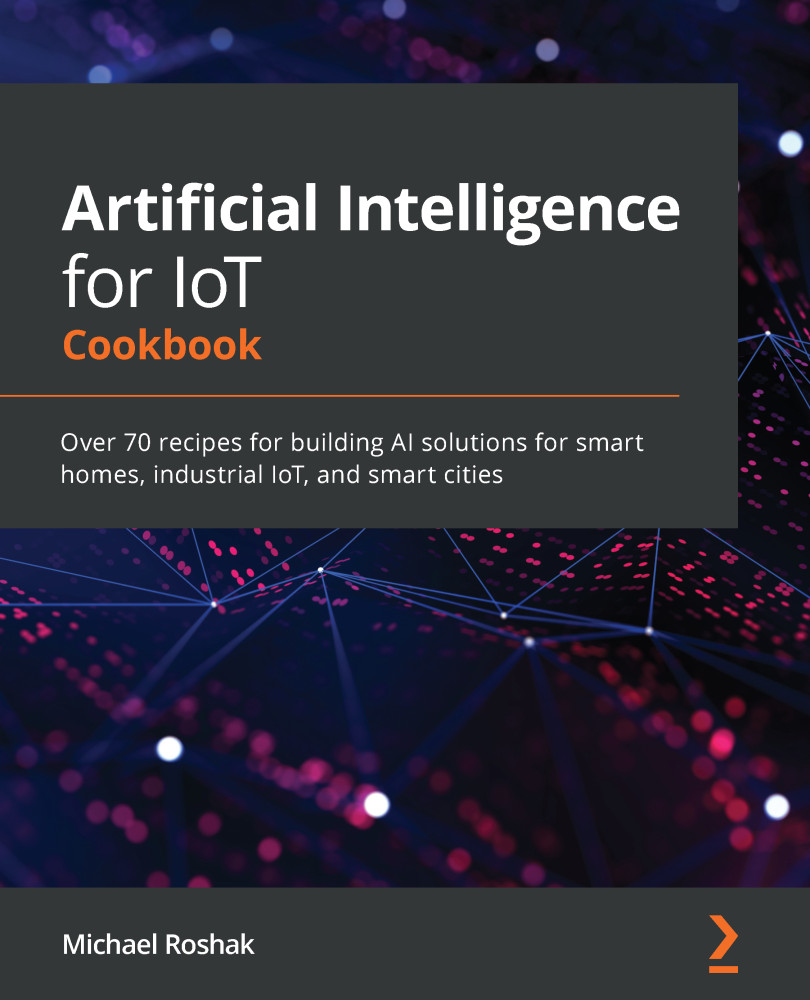
Artificial Intelligence for IoT Cookbook

Artificial Intelligence for IoT Cookbook

By : Roshak
4.9 (10)
close
close
Artificial Intelligence for IoT Cookbook

Artificial Intelligence for IoT Cookbook

4.9 (10)
By: Roshak

Overview of this book

Artificial intelligence (AI) is rapidly finding practical applications across a wide variety of industry verticals, and the Internet of Things (IoT) is one of them. Developers are looking for ways to make IoT devices smarter and to make users’ lives easier. With this AI cookbook, you’ll be able to implement smart analytics using IoT data to gain insights, predict outcomes, and make informed decisions, along with covering advanced AI techniques that facilitate analytics and learning in various IoT applications. Using a recipe-based approach, the book will take you through essential processes such as data collection, data analysis, modeling, statistics and monitoring, and deployment. You’ll use real-life datasets from smart homes, industrial IoT, and smart devices to train and evaluate simple to complex models and make predictions using trained models. Later chapters will take you through the key challenges faced while implementing machine learning, deep learning, and other AI techniques, such as natural language processing (NLP), computer vision, and embedded machine learning for building smart IoT systems. In addition to this, you’ll learn how to deploy models and improve their performance with ease. By the end of this book, you’ll be able to package and deploy end-to-end AI apps and apply best practice solutions to common IoT problems.
Table of Contents (11 chapters)
close
close

Getting ready

In this recipe, we are going to build off of the previous recipe. We are going to use an ESP32 and must have the Arduino IDE and VS Code installed. In VS Code, we are going to add the PlatformIO extension. Eventually, we are going to attach the ESP32 to the computer we are using via USB but until we attach the sensor, leave it unattached. For this recipe, you will need a DHT11 digital humidity and temperature sensor, jumper cables, a 10k ohm resistor, and a breadboard. You should be able to purchase all of these components for around $20.

From here, we will need to go into VS Code and, using the PlatformIO extension, create a new project. Then, you will need to install the DHT sensor library from the PlatformIO library manager. You will then need to download Fritzing. It is an open source program. You can contribute to the project on their website and receive a copy, but you can also go to GitHub and, under Releases, download and install the program. The ESP32 comes...

CONTINUE READING
83
Tech Concepts
36
Programming languages
73
Tech Tools
Icon Unlimited access to the largest independent learning library in tech of over 8,000 expert-authored tech books and videos.
Icon Innovative learning tools, including AI book assistants, code context explainers, and text-to-speech.
Icon 50+ new titles added per month and exclusive early access to books as they are being written.
Artificial Intelligence for IoT Cookbook
notes
bookmark Notes and Bookmarks search Search in title playlist Add to playlist download Download options font-size Font size

Change the font size

margin-width Margin width

Change margin width

day-mode Day/Sepia/Night Modes

Change background colour

Close icon Search
Country selected

Close icon Your notes and bookmarks

Confirmation

Modal Close icon
claim successful

Buy this book with your credits?

Modal Close icon
Are you sure you want to buy this book with one of your credits?
Close
YES, BUY

Submit Your Feedback

Modal Close icon
Modal Close icon
Modal Close icon