
Sign In Start Free Trial
Account

Add to playlist

Create a Playlist

Modal Close icon
You need to login to use this feature.
  • Book Overview & Buying Learn PostgreSQL
  • Table Of Contents Toc
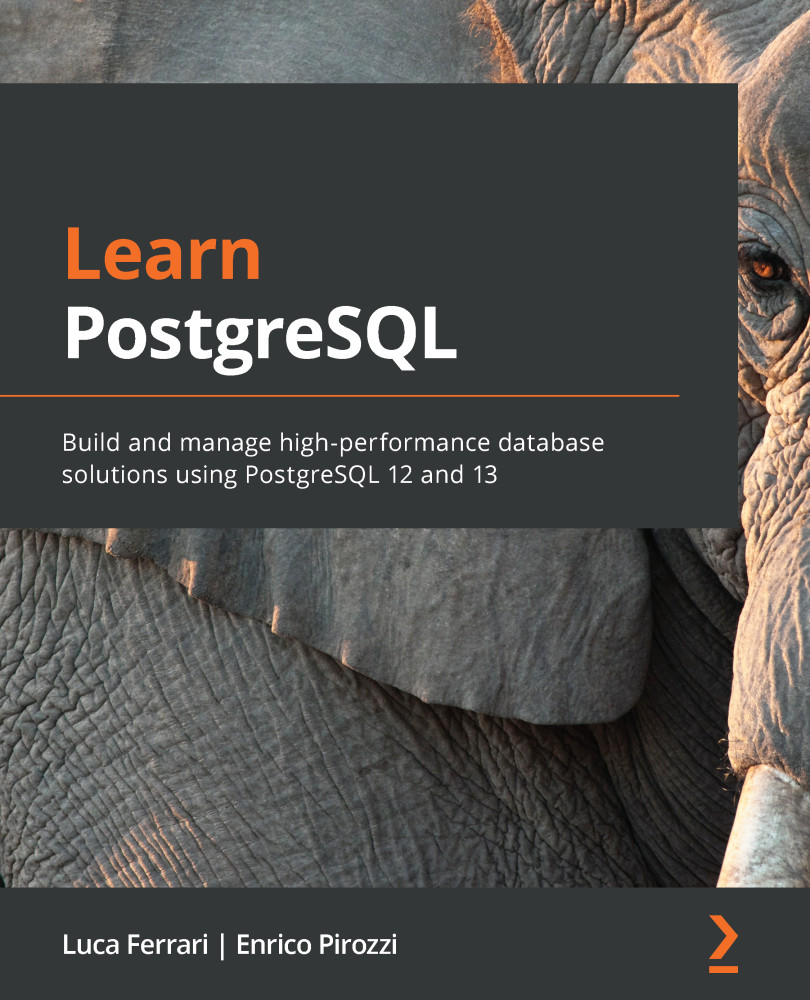
Learn PostgreSQL

Learn PostgreSQL

By : Luca Ferrari, Enrico Pirozzi
3.4 (5)
close
close
Learn PostgreSQL

Learn PostgreSQL

3.4 (5)
By: Luca Ferrari, Enrico Pirozzi

Overview of this book

PostgreSQL is one of the fastest-growing open source object-relational database management systems (DBMS) in the world. As well as being easy to use, it’s scalable and highly efficient. In this book, you’ll explore PostgreSQL 12 and 13 and learn how to build database solutions using it. Complete with hands-on tutorials, this guide will teach you how to achieve the right database design required for a reliable environment. You'll learn how to install and configure a PostgreSQL server and even manage users and connections. The book then progresses to key concepts of relational databases, before taking you through the Data Definition Language (DDL) and commonly used DDL commands. To build on your skills, you’ll understand how to interact with the live cluster, create database objects, and use tools to connect to the live cluster. You’ll then get to grips with creating tables, building indexes, and designing your database schema. Later, you'll explore the Data Manipulation Language (DML) and server-side programming capabilities of PostgreSQL using PL/pgSQL, before learning how to monitor, test, and troubleshoot your database application to ensure high-performance and reliability. By the end of this book, you'll be well-versed with the Postgres database and be able to set up your own PostgreSQL instance and use it to build robust solutions.
Table of Contents (27 chapters)
close
close
1
Section 1: Getting Started
5
Section 2: Interacting with the Database
12
Section 3: Administering the Cluster
20
Section 4: Replication
23
Section 5: The PostegreSQL Ecosystem
Introduction to PostgreSQL

PostgreSQL is a well-known open-source relational database, and its motto states what the project intends to be: the most advanced open-source database in the world.

The main qualities that attract masses of new users every year and keep current users enthusiastic about their projects are its rock-solid stability, scalability, and safeness, as well as the features that an enterprise-level database management system provides.

But PostgreSQL is not just a database; it has grown to be a whole ecosystem of extensions, tools, and languages tied together by communities spread around the world.

PostgreSQL is an open-source project and is fully developed in the open-source world. That means that there is no single entity in charge of the project and the result is that PostgreSQL is not a commercial product. In other words, PostgreSQL belongs to everyone, and anyone can contribute to it. Thanks to a very permissive BSD-style license, PostgreSQL can be used in any project or scenario, either open or closed source.

Of course, contributing to a project of that size requires experience in software development, database concepts, and, of course, a positive attitude to open source and collaborative efforts. But it does also mean that PostgreSQL will continue to live pretty much forever without the risk of a single company going out of business and sinking with the database.

PostgreSQL 12 is the latest release of this great database, and at the time of writing, efforts for PostgreSQL 13 have already begun. This book will focus on PostgreSQL, starting from the basics and moving toward the most exciting and complex tasks (such as replicating your datasets to prevent disasters). Of course, given that PostgreSQL is a project of this size with so many features, a single book cannot cover it all in detail, so our aim is to introduce the whole set of qualities PostgreSQL provides to you, giving practical use cases and examples, as well as external resources to help you learn more about particular aspects.

This book covers PostgreSQL 12 and 13, but the concepts explained in this book can apply also to later versions (as well as to previous ones when the same features are present). At the time of writing, PostgreSQL 12 is the stable release, while PostgreSQL 13 is in its second beta public release and is expected, therefore, to be stable enough for testing its features.

This chapter will introduce you to this great open source database starting from the project history and goals, which is very important to help you decide whether you want to use PostgreSQL in the first place. You will learn basic PostgreSQL terminology, which is very important to help you search the documentation and understand the main error messages, in case you need to. Finally, you will see how to install PostgreSQL in different ways so that you will get a basic knowledge of how to install it on different platforms and contexts.

The following topics are covered in this chapter:

  • PostgreSQL at a glance
  • Exploring PostgreSQL terminology
  • Installing PostgreSQL 12 or higher
CONTINUE READING
83
Tech Concepts
36
Programming languages
73
Tech Tools
Icon Unlimited access to the largest independent learning library in tech of over 8,000 expert-authored tech books and videos.
Icon Innovative learning tools, including AI book assistants, code context explainers, and text-to-speech.
Icon 50+ new titles added per month and exclusive early access to books as they are being written.
Learn PostgreSQL
notes
bookmark Notes and Bookmarks search Search in title playlist Add to playlist download Download options font-size Font size

Change the font size

margin-width Margin width

Change margin width

day-mode Day/Sepia/Night Modes

Change background colour

Close icon Search
Country selected

Close icon Your notes and bookmarks

Confirmation

Modal Close icon
claim successful

Buy this book with your credits?

Modal Close icon
Are you sure you want to buy this book with one of your credits?
Close
YES, BUY

Submit Your Feedback

Modal Close icon
Modal Close icon
Modal Close icon