Sign In Start Free Trial
Account

Add to playlist

Create a Playlist

Modal Close icon
You need to login to use this feature.
  • Book Overview & Buying gnuplot Cookbook
  • Table Of Contents Toc
  • Feedback & Rating feedback
gnuplot Cookbook

gnuplot Cookbook

By : Lee Phillips
3.8 (4)
close
close
gnuplot Cookbook

gnuplot Cookbook

3.8 (4)
By: Lee Phillips

Overview of this book

gnuplot is the world's finest technical plotting software, used by scientists, engineers, and others for many years. It is in constant development and runs on practically every operating system, and can produce output in almost any format. The quality of its 3d plots is unmatched and its ability to be incorporated into computer programs and document preparation systems is excellent. gnuplot Cookbook ñ it will help you master gnuplot. Start using gnuplot immediately to solve your problems in data analysis and presentation. Quickly find a visual example of the graph you want to make and see a complete, working script for producing it. Learn how to use the new features in gnuplot 4.4. Find clearly explained, working examples of using gnuplot with LaTeX and with your own computer programming language. You will master all the ins and outs of gnuplot through gnuplot Cookbook. You will learn to plot basic 2d to complex 3d plots, annotate from simple labels to equations, integrate from simple scripts to full documents and computer progams. You will be taught to annotate graphs with equations and symbols that match the style of the rest of your text, thus creating a seamless, professional document. You will be guided to create a web page with an interactive graph, and add graphical output to your simulation or numerical analysis program. Start using all of gnuplot's simple to complex features to suit your needs, without studying its 200 page manual through this Cookbook.
Table of Contents (18 chapters)
close
close
gnuplot Cookbook
Credits
About the Author
About the Reviewers
www.PacktPub.com
Preface
1
Finding Help and Information
2
Index

Making a statistical whisker plot


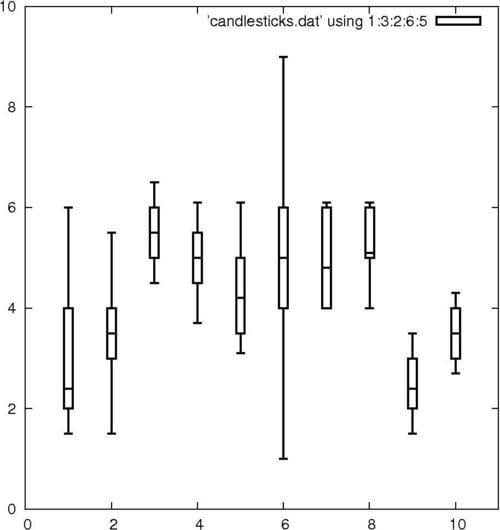
Also known in the statistics world as a "box and whisker plot" or simply as a boxplot, the statistical whisker plot is a series of symbols, each one showing the mean value of a set of measurements, the extent of the central part of the measurements' or population's distribution, and the extent of the remainder of the distribution excluding the "outliers" (the outliers themselves are sometimes shown as dots, but we won't use that style here). This type of plot is also sometimes used for financial price data rather than the finance plot that was the subject of the Handling financial data recipe in this chapter. We will avoid the specialized language of statistics and further discussion of the uses of these plots, but the statisticians among our readers know why they're here. The following figure shows the depiction of a statistical whisker plot using gnuplot:

In the previous plot, typically, the boxes show the range of the central part of the data distribution; the short horizontal line within the boxes shows the value of the mean; and the vertical lines extending above and below the boxes show the range of the bulk of the distribution excluding the outliers.

Getting ready

We've borrowed the demo file candlesticks.dat that comes with the gnuplot distribution; make sure it's in your current directory. If you want to use your own data instead, each line of the file must be in the following format:

x  whisker_min  box_min  mean  box_high   whisker_high

How to do it…

Feed the following script to gnuplot to get the whisker plot:

set xrange [0:11]
set yrange [0:10]
set boxwidth 0.2
plot 'candlesticks.dat' using 1:3:2:6:5 with candlesticks lt -1 lw 2 whiskerbars,\
    '' using 1:4:4:4:4 with candlesticks lt -1 lw 2 notitle

How it works…

The first two lines set the x and y ranges of the axes; they are set to give a little room around the data. The next line sets the boxwidth—the width of the rectangle showing the extent of the central part of the distribution (the default is very skinny). Next comes the plot command, split here over two lines. The order of the fields expected by the candlestick style is x box_min whisker_min whisker_high box_high, which is not in the same order as our datafile, so we need to use the using command to put the columns in the right order for plotting. The first plot command also specifies the line type lt to be -1 for solid black and a line width is set to 2; whiskerbars means put the little caps on the end of the whiskers. The second plot command—starting on the last line—plots from the same datafile, but employs a trick to use the 4th column—containing the mean value—repeatedly, effectively collapsing the box ends and whiskers down to the mean, all just to plot the little horizontal line in the middle of the boxes. This may seem like a convoluted method, but it ensures that the lines indicating the mean values are in the right places and have exactly the correct width to lie within the boxes.

There's more…

Some people prefer their whisker plot boxes to be filled in with a solid color or pattern. To get this, before issuing the plot command try the following command:

set style fill solid

or

set style fill pattern n
Visually different images
CONTINUE READING
83
Tech Concepts
36
Programming languages
73
Tech Tools
Icon Unlimited access to the largest independent learning library in tech of over 8,000 expert-authored tech books and videos.
Icon Innovative learning tools, including AI book assistants, code context explainers, and text-to-speech.
Icon 50+ new titles added per month and exclusive early access to books as they are being written.
gnuplot Cookbook
notes
bookmark Notes and Bookmarks search Search in title playlist Add to playlist font-size Font size

Change the font size

margin-width Margin width

Change margin width

day-mode Day/Sepia/Night Modes

Change background colour

Close icon Search
Country selected

Close icon Your notes and bookmarks

Confirmation

Modal Close icon
claim successful

Buy this book with your credits?

Modal Close icon
Are you sure you want to buy this book with one of your credits?
Close
YES, BUY

Submit Your Feedback

Modal Close icon
Modal Close icon
Modal Close icon