


-
Book Overview & Buying
-
Table Of Contents

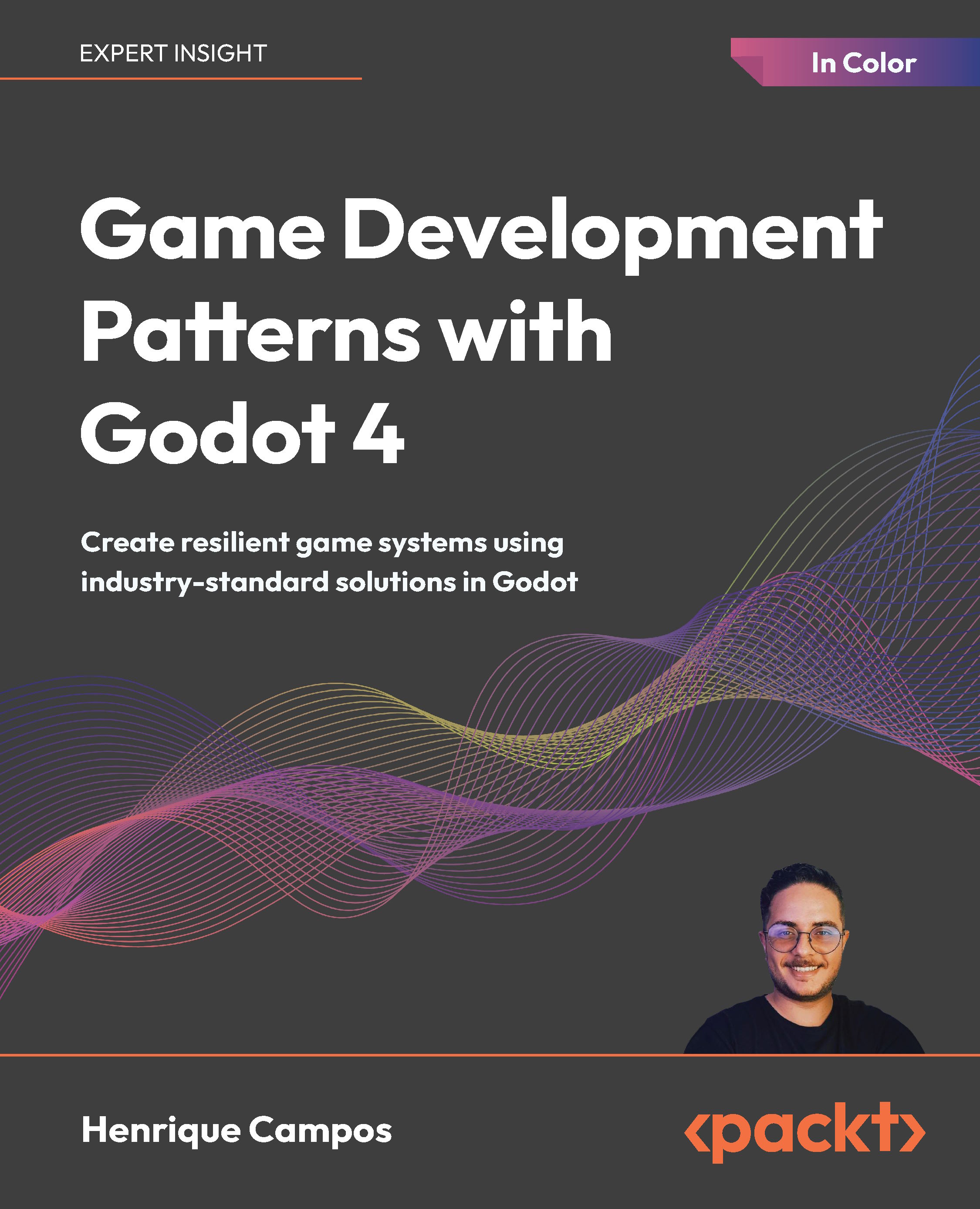
Game Development Patterns with Godot 4
By :


Game Development Patterns with Godot 4
By:
Overview of this book
Game development demands more than just creativity; it requires code that’s as dynamic and adaptable as the games you dream of creating. Seasoned Godot developer, educator and creator of popular resources like The Essential Guide to Creating Multiplayer Games with Godot 4.0, Henrique Campos introduces you to object-oriented programming design patterns, offering time-tested, reliable solutions to common coding issues. With these patterns, you’ll not only build scalable, maintainable architectures for your games but also gain the confidence to tackle real-world development challenges head-on with Godot's built-in features.
In this hands-on guide, you’ll step into the role of a game mechanics engineer tasked with implementing requests from a fictional game designer, simulating the collaborative nature of real-world game development. Using Godot 4.3, you’ll develop a complete platformer game featuring a playable character, enemies with advanced AI, interactive objects, multiple levels, music, and more. Along the way, you’ll master core programming concepts such as SOLID principles, favor composition over inheritance, and have a solid understanding of object-oriented programming along with the principles behind the design patterns.
By the end of the book, you’ll be able to diagnose and fix pathologies in your code with ease.
Table of Contents (19 chapters)
Preface


Chapter 1: Understanding Object-Oriented Design
Chapter 2: Learning the Four Fundamental Pillars
Chapter 3: Creating SOLID Design Solutions
Chapter 4: Favoring Composition Over Inheritance
Part 2: Basic Design Patterns

Chapter 5: Maintaining Global States with the Singleton Pattern
Chapter 6: Decoupling Objects with the Observer Pattern
Chapter 7: Spawning Game Objects with the Factory Pattern
Chapter 8: Changing Object Behavior with the State Pattern
Chapter 9: Designing Actors with the Command Pattern
Part 3: Advanced Design Patterns
Chapter 10: Implementing AI with the Strategy Pattern
Chapter 11: Creating a Power-Up System with the Decorator Pattern
Chapter 12: Cross-Fading Transitions with the Service Locator Pattern
Chapter 13: Improving Game Feel with the Event Queue Pattern
Index
Other Books You May Enjoy


