
Sign In Start Free Trial
Account

Add to playlist

Create a Playlist

Modal Close icon
You need to login to use this feature.
  • Book Overview & Buying Practical Python Programming for IoT
  • Table Of Contents Toc
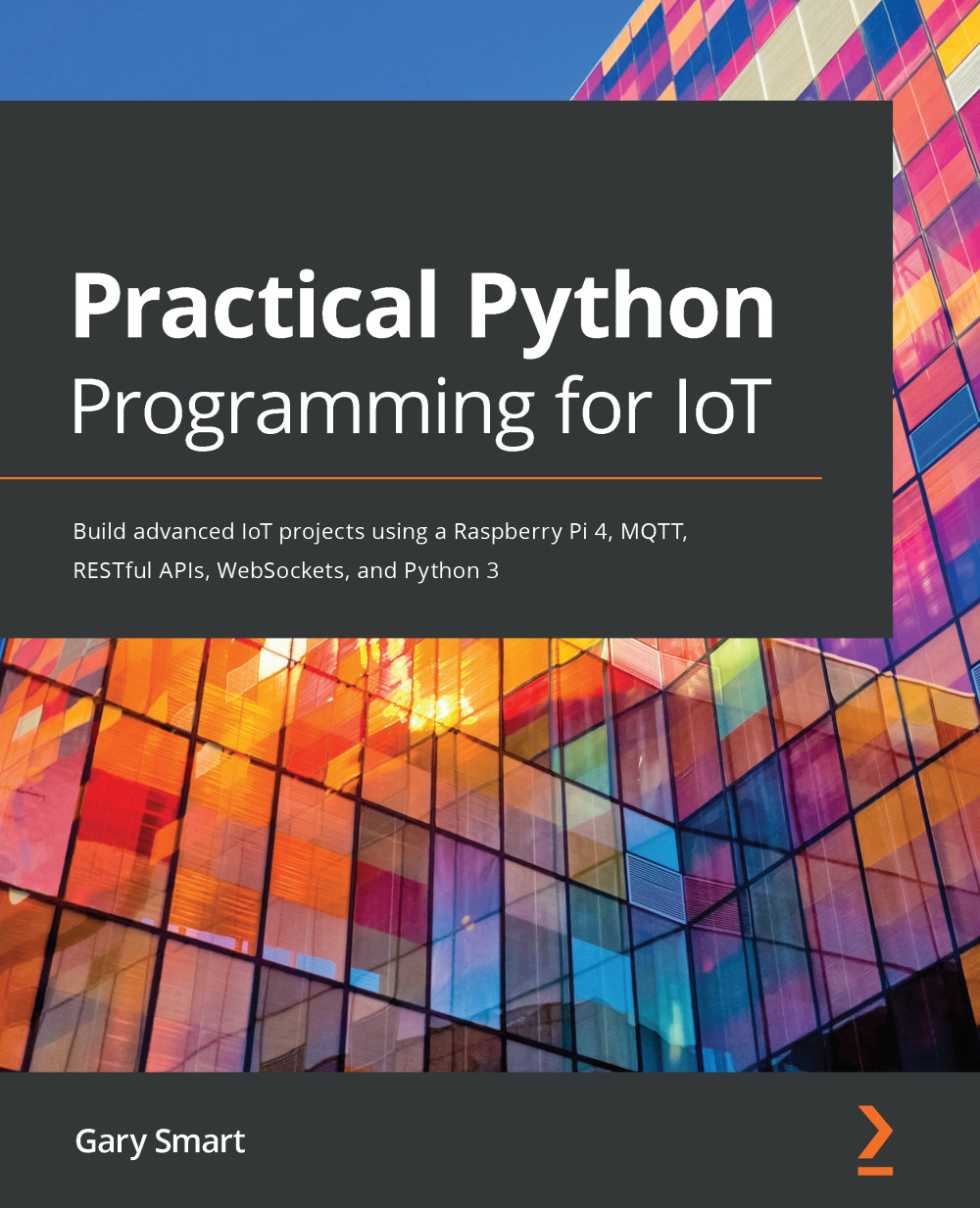
Practical Python Programming for IoT

Practical Python Programming for IoT

By : Gary Smart
5 (6)
close
close
Practical Python Programming for IoT

Practical Python Programming for IoT

5 (6)
By: Gary Smart

Overview of this book

The age of connected devices is here, be it fitness bands or smart homes. It's now more important than ever to understand how hardware components interact with the internet to collect and analyze user data. The Internet of Things (IoT), combined with the popular open source language Python, can be used to build powerful and intelligent IoT systems with intuitive interfaces. This book consists of three parts, with the first focusing on the "Internet" component of IoT. You'll get to grips with end-to-end IoT app development to control an LED over the internet, before learning how to build RESTful APIs, WebSocket APIs, and MQTT services in Python. The second part delves into the fundamentals behind electronics and GPIO interfacing. As you progress to the last part, you'll focus on the "Things" aspect of IoT, where you will learn how to connect and control a range of electronic sensors and actuators using Python. You'll also explore a variety of topics, such as motor control, ultrasonic sensors, and temperature measurement. Finally, you'll get up to speed with advanced IoT programming techniques in Python, integrate with IoT visualization and automation platforms, and build a comprehensive IoT project. By the end of this book, you'll be well-versed with IoT development and have the knowledge you need to build sophisticated IoT systems using Python.
Table of Contents (20 chapters)
close
close
1
Section 1: Programming with Python and the Raspberry Pi
6
Section 2: Practical Electronics for Interacting with the Physical World
9
Section 3: IoT Playground - Practical Examples to Interact with the Physical World

Alternative methods of executing a Python script

Let's briefly turn our attention to the alternative ways that we can execute a Python script. As we will learn, choosing the appropriate method is all based around how and from where you intend to start your script and whether your code requires elevated permissions.

The most common way of running a Python script is from within its virtual environment and with the permissions of the currently logged in user. However, there will be scenarios where we need to run a script as the root user or from outside an activated virtual environment.

Here are the ways we will explore:

  • Using sudo with virtual environments
  • Executing Python scripts outside of their virtual environments
  • Running a Python script at boot

Let's start by learning how to run a Python script with root user permissions.

Visually different images
CONTINUE READING
83
Tech Concepts
36
Programming languages
73
Tech Tools
Icon Unlimited access to the largest independent learning library in tech of over 8,000 expert-authored tech books and videos.
Icon Innovative learning tools, including AI book assistants, code context explainers, and text-to-speech.
Icon 50+ new titles added per month and exclusive early access to books as they are being written.
Practical Python Programming for IoT
notes
bookmark Notes and Bookmarks search Search in title playlist Add to playlist download Download options font-size Font size

Change the font size

margin-width Margin width

Change margin width

day-mode Day/Sepia/Night Modes

Change background colour

Close icon Search
Country selected

Close icon Your notes and bookmarks

Confirmation

Modal Close icon
claim successful

Buy this book with your credits?

Modal Close icon
Are you sure you want to buy this book with one of your credits?
Close
YES, BUY

Submit Your Feedback

Modal Close icon
Modal Close icon
Modal Close icon