Sign In Start Free Trial
Account

Add to playlist

Create a Playlist

Modal Close icon
You need to login to use this feature.
  • Book Overview & Buying Simplifying Android Development with Coroutines and Flows
  • Table Of Contents Toc
Simplifying Android Development with Coroutines and Flows

Simplifying Android Development with Coroutines and Flows

By : Tigcal
5 (2)
close
close
Simplifying Android Development with Coroutines and Flows

Simplifying Android Development with Coroutines and Flows

5 (2)
By: Tigcal

Overview of this book

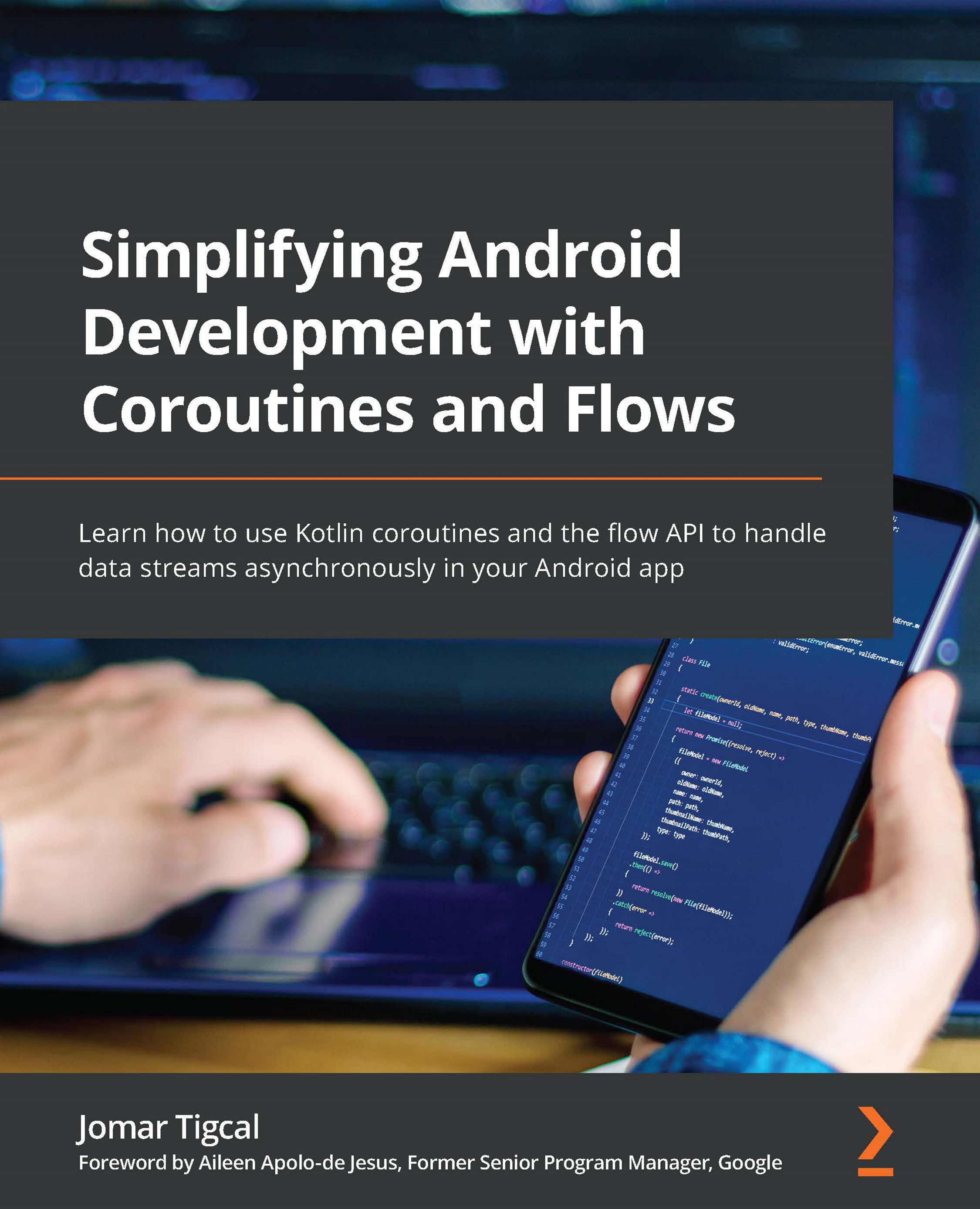
Coroutines and flows are the new recommended way for developers to carry out asynchronous programming in Android using simple, modern, and testable code. This book will teach you how coroutines and flows work and how to use them in building Android applications, along with helping you to develop modern Android applications with asynchronous programming using real data. The book begins by showing you how to create and handle Kotlin coroutines on Android. You’ll explore asynchronous programming in Kotlin, and understand how to test Kotlin coroutines. Next, you'll learn about Kotlin flows on Android, and have a closer look at using Kotlin flows by getting to grips with handling flow cancellations and exceptions and testing the flows. By the end of this book, you'll have the skills you need to build high-quality and maintainable Android applications using coroutines and flows.
Table of Contents (11 chapters)
close
close
1
Part 1 – Kotlin Coroutines on Android
6
Part 2 – Kotlin Flows on Android

Summary

In this chapter, you learned about coroutine cancelations. You can cancel coroutines by using the cancel or cancelAndJoin function from the coroutine job or the cancel function from the coroutine scope.

You learned that a coroutine cancelation needs to be cooperative. You also learned how you can change your code to make your coroutine cancelable by using isActive checks or by using suspending functions from the kotlinx.coroutines package.

Then, you learned about coroutine timeouts. You can set a timeout (in milliseconds or Duration) using withTimeout or withTimeoutOrNull.

You also learned about coroutine exceptions and how to catch them. try-catch blocks can be used to handle exceptions. You can also use CoroutineExceptionHandler in your coroutine scope to catch and handle exceptions in a single location.

Finally, you worked on an exercise to add cancelation to a coroutine and another exercise to update your code to handle coroutine exceptions.

In the next...

CONTINUE READING
83
Tech Concepts
36
Programming languages
73
Tech Tools
Icon Unlimited access to the largest independent learning library in tech of over 8,000 expert-authored tech books and videos.
Icon Innovative learning tools, including AI book assistants, code context explainers, and text-to-speech.
Icon 50+ new titles added per month and exclusive early access to books as they are being written.
Simplifying Android Development with Coroutines and Flows
notes
bookmark Notes and Bookmarks search Search in title playlist Add to playlist download Download options font-size Font size

Change the font size

margin-width Margin width

Change margin width

day-mode Day/Sepia/Night Modes

Change background colour

Close icon Search
Country selected

Close icon Your notes and bookmarks

Confirmation

Modal Close icon
claim successful

Buy this book with your credits?

Modal Close icon
Are you sure you want to buy this book with one of your credits?
Close
YES, BUY

Submit Your Feedback

Modal Close icon
Modal Close icon
Modal Close icon