Sign In Start Free Trial
Account

Add to playlist

Create a Playlist

Modal Close icon
You need to login to use this feature.
  • Book Overview & Buying Mastering Embedded Linux Programming
  • Table Of Contents Toc
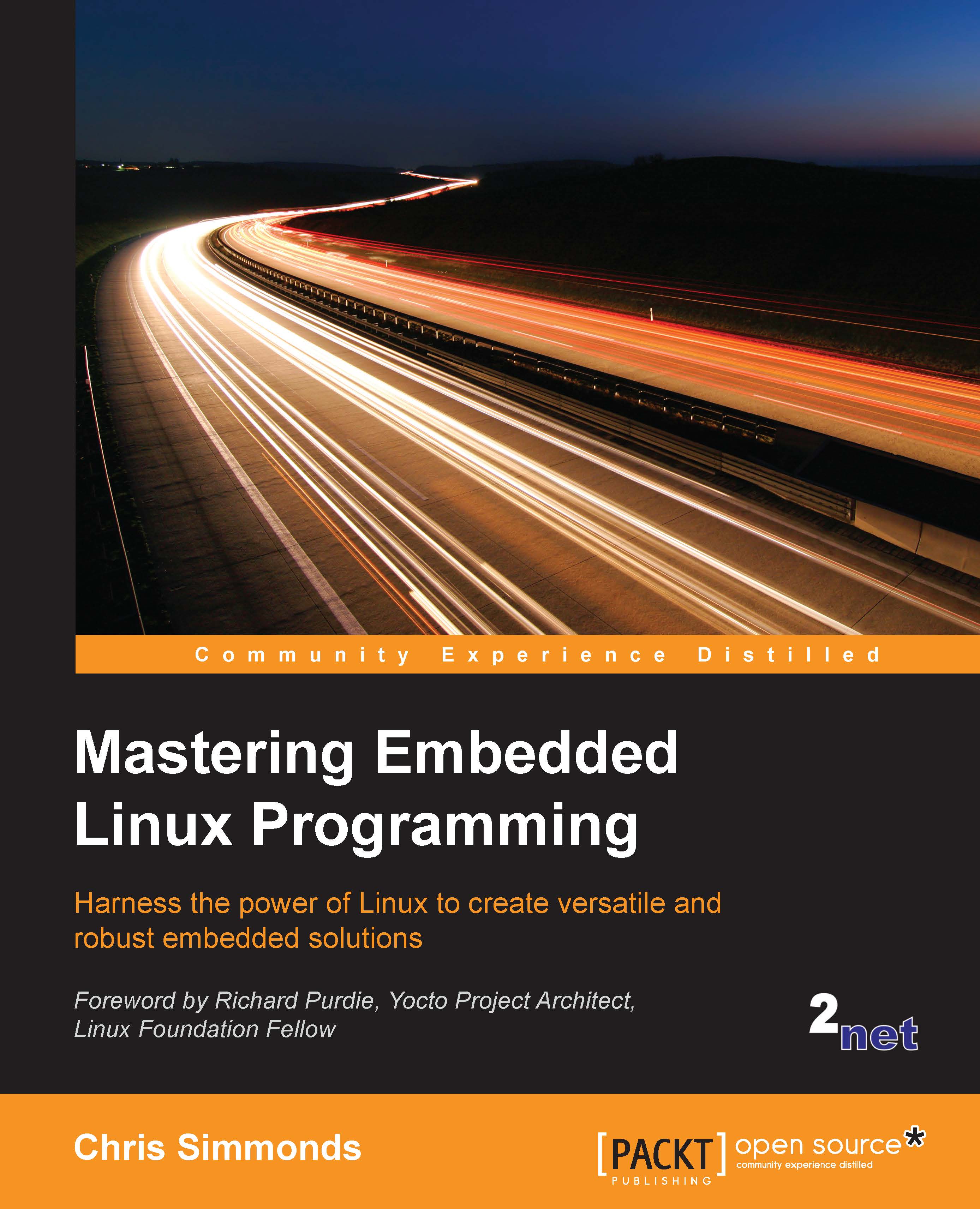
Mastering Embedded Linux Programming

Mastering Embedded Linux Programming

By : Chris Simmonds
4.8 (20)
close
close
Mastering Embedded Linux Programming

Mastering Embedded Linux Programming

4.8 (20)
By: Chris Simmonds

Overview of this book

Mastering Embedded Linux Programming takes you through the product cycle and gives you an in-depth description of the components and options that are available at each stage. You will begin by learning about toolchains, bootloaders, the Linux kernel, and how to configure a root filesystem to create a basic working device. You will then learn how to use the two most commonly used build systems, Buildroot and Yocto, to speed up and simplify the development process. Building on this solid base, the next section considers how to make best use of raw NAND/NOR flash memory and managed flash eMMC chips, including mechanisms for increasing the lifetime of the devices and to perform reliable in-field updates. Next, you need to consider what techniques are best suited to writing applications for your device. We will then see how functions are split between processes and the usage of POSIX threads, which have a big impact on the responsiveness and performance of the final device The closing sections look at the techniques available to developers for profiling and tracing applications and kernel code using perf and ftrace.
Table of Contents (16 chapters)
close
close
15
Index

A better way of managing device nodes


Creating device nodes statically with mknod is quite hard work and inflexible. There are other ways to create device nodes automatically on demand:

  • devtmpfs: This is a pseudo filesystem that you mount over /dev at boot time. The kernel populates it with device nodes for all the devices that the kernel currently knows about and creates nodes for new devices as they are detected at runtime. The nodes are owned by root and have default permissions of 0600. Some well-known device nodes, such as /dev/null and /dev/random, override the default to 0666 (see struct memdev in drivers/char/mem.c).

  • mdev: This is a BusyBox applet that is used to populate a directory with device nodes and to create new nodes as needed. There is a configuration file, /etc/mdev.conf, which contains rules for ownership and the mode of the nodes.

  • udev: This is now part of systemd and is the solution you will find on desktop Linux and some embedded devices. It is very flexible and a good...

Visually different images
CONTINUE READING
83
Tech Concepts
36
Programming languages
73
Tech Tools
Icon Unlimited access to the largest independent learning library in tech of over 8,000 expert-authored tech books and videos.
Icon Innovative learning tools, including AI book assistants, code context explainers, and text-to-speech.
Icon 50+ new titles added per month and exclusive early access to books as they are being written.
Mastering Embedded Linux Programming
notes
bookmark Notes and Bookmarks search Search in title playlist Add to playlist download Download options font-size Font size

Change the font size

margin-width Margin width

Change margin width

day-mode Day/Sepia/Night Modes

Change background colour

Close icon Search
Country selected

Close icon Your notes and bookmarks

Confirmation

Modal Close icon
claim successful

Buy this book with your credits?

Modal Close icon
Are you sure you want to buy this book with one of your credits?
Close
YES, BUY

Submit Your Feedback

Modal Close icon
Modal Close icon
Modal Close icon