Sign In Start Free Trial
Account

Add to playlist

Create a Playlist

Modal Close icon
You need to login to use this feature.
  • Book Overview & Buying Learning Python Design Patterns - Second Edition
  • Table Of Contents Toc
  • Feedback & Rating feedback
Learning Python Design Patterns - Second Edition

Learning Python Design Patterns - Second Edition - Second Edition

By : Giridhar, Zlobin
2.8 (13)
close
close
Learning Python Design Patterns - Second Edition

Learning Python Design Patterns - Second Edition

2.8 (13)
By: Giridhar, Zlobin

Overview of this book

With the increasing focus on optimized software architecture and design it is important that software architects think about optimizations in object creation, code structure, and interaction between objects at the architecture or design level. This makes sure that the cost of software maintenance is low and code can be easily reused or is adaptable to change. The key to this is reusability and low maintenance in design patterns. Building on the success of the previous edition, Learning Python Design Patterns, Second Edition will help you implement real-world scenarios with Python’s latest release, Python v3.5. We start by introducing design patterns from the Python perspective. As you progress through the book, you will learn about Singleton patterns, Factory patterns, and Façade patterns in detail. After this, we’ll look at how to control object access with proxy patterns. It also covers observer patterns, command patterns, and compound patterns. By the end of the book, you will have enhanced your professional abilities in software architecture, design, and development.
Table of Contents (13 chapters)
close
close
12
Index

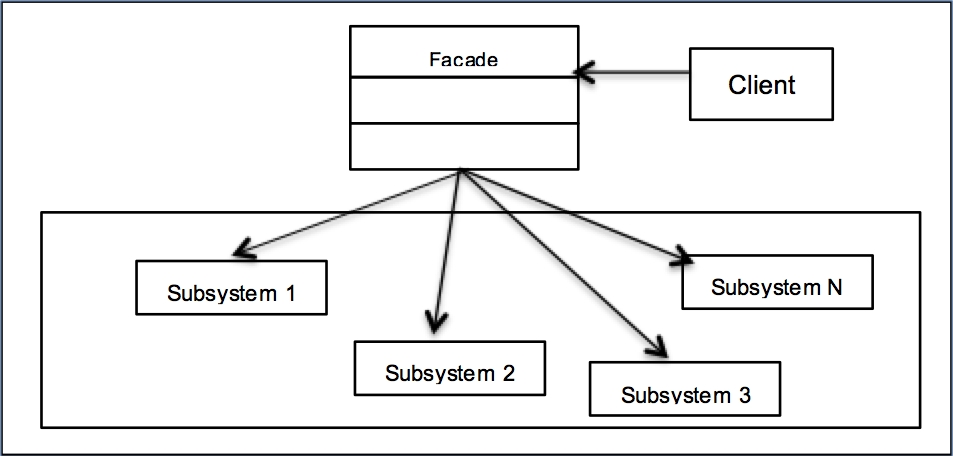
A UML class diagram


We will now discuss the Façade pattern with the help of the following UML diagram:

As we observe the UML diagram, you'll realize that there are three main participants in this pattern:

  • Façade: The main responsibility of a façade is to wrap up a complex group of subsystems so that it can provide a pleasing look to the outside world.

  • System: This represents a set of varied subsystems that make the whole system compound and difficult to view or work with.

  • Client: The client interacts with the Façade so that it can easily communicate with the subsystem and get the work completed. It doesn't have to bother about the complex nature of the system.

You will now learn a little more about the three main participants from the data structure's perspective.

Façade

The following points will give us a better idea of Façade:

  • It is an interface that knows which subsystems are responsible for a request

  • It delegates the client's requests to the appropriate subsystem objects using composition

For...

Visually different images
CONTINUE READING
83
Tech Concepts
36
Programming languages
73
Tech Tools
Icon Unlimited access to the largest independent learning library in tech of over 8,000 expert-authored tech books and videos.
Icon Innovative learning tools, including AI book assistants, code context explainers, and text-to-speech.
Icon 50+ new titles added per month and exclusive early access to books as they are being written.
Learning Python Design Patterns - Second Edition
notes
bookmark Notes and Bookmarks search Search in title playlist Add to playlist font-size Font size

Change the font size

margin-width Margin width

Change margin width

day-mode Day/Sepia/Night Modes

Change background colour

Close icon Search
Country selected

Close icon Your notes and bookmarks

Confirmation

Modal Close icon
claim successful

Buy this book with your credits?

Modal Close icon
Are you sure you want to buy this book with one of your credits?
Close
YES, BUY

Submit Your Feedback

Modal Close icon
Modal Close icon
Modal Close icon