Sign In Start Free Trial
Account

Add to playlist

Create a Playlist

Modal Close icon
You need to login to use this feature.
  • Book Overview & Buying Java 9 Data Structures and Algorithms
  • Table Of Contents Toc
Java 9 Data Structures and Algorithms

Java 9 Data Structures and Algorithms

By : Ray Chawdhuri
2.3 (3)
close
close
Java 9 Data Structures and Algorithms

Java 9 Data Structures and Algorithms

2.3 (3)
By: Ray Chawdhuri

Overview of this book

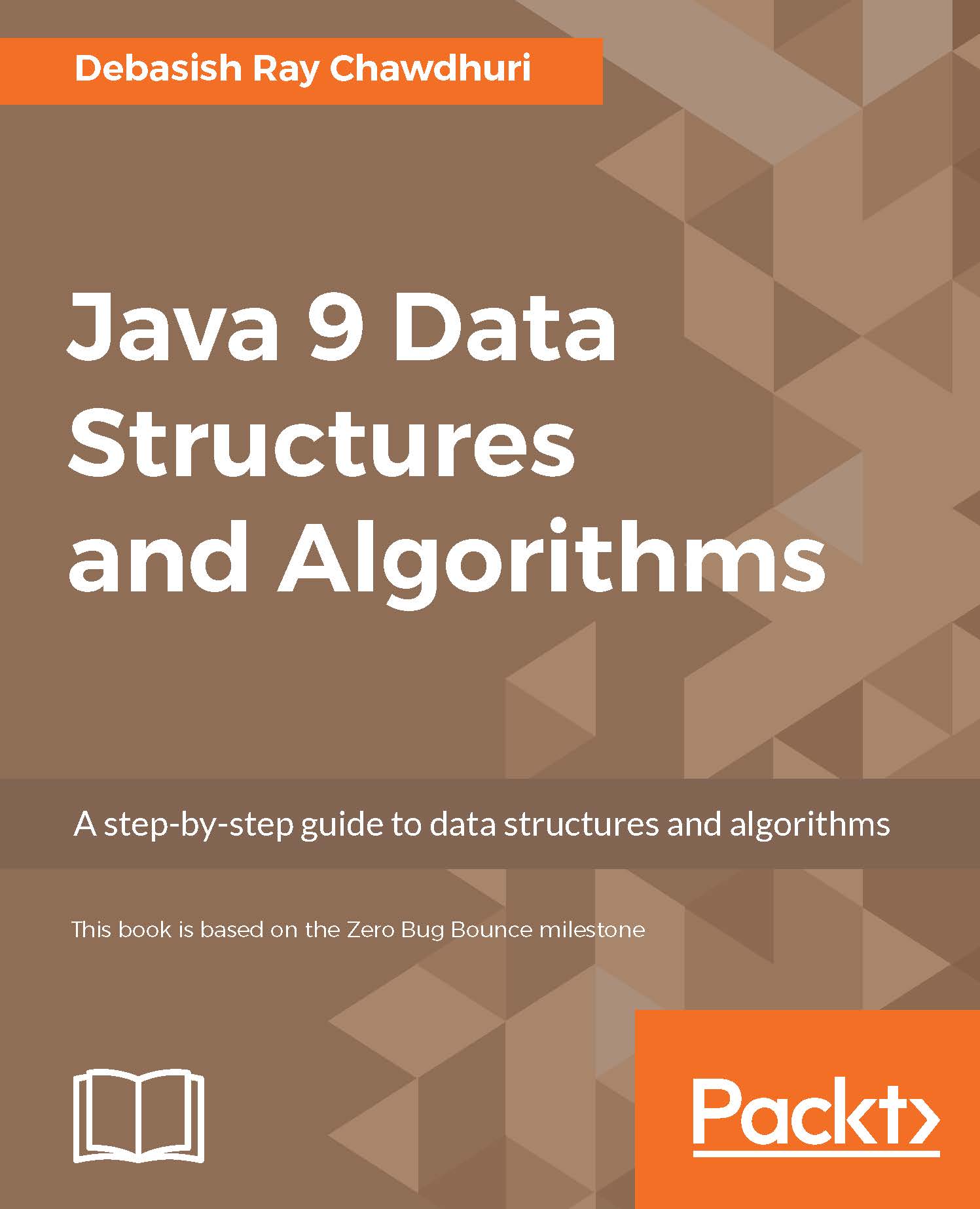
Java 9 Data Structures and Algorithms covers classical, functional, and reactive data structures, giving you the ability to understand computational complexity, solve problems, and write efficient code. This book is based on the Zero Bug Bounce milestone of Java 9. We start off with the basics of algorithms and data structures, helping you understand the fundamentals and measure complexity. From here, we introduce you to concepts such as arrays, linked lists, as well as abstract data types such as stacks and queues. Next, we’ll take you through the basics of functional programming while making sure you get used to thinking recursively. We provide plenty of examples along the way to help you understand each concept. You will also get a clear picture of reactive programming, binary searches, sorting, search trees, undirected graphs, and a whole lot more!
Table of Contents (13 chapters)
close
close
12
Index

Summary

In this chapter, you saw how we can think about measuring the running time of and the memory required by an algorithm in seconds and bytes, respectively. Since this depends on the particular implementation, the programming platform, and the hardware, we need a notion of talking about running time in an abstract way. Asymptotic complexity is a measure of the growth of a function when the input is very large. We can use it to abstract our discussion on running time. This is not to say that a programmer should not spend any time to make a run a program twice as fast, but that comes only after the program is already running at the minimum asymptotic complexity.

We also saw that the asymptotic complexity is not just a property of the problem at hand that we are trying to solve, but also a property of the particular way we are solving it, that is, the particular algorithm we are using. We also saw that two programs solving the same problem while running different algorithms with different asymptotic complexities can perform vastly differently for large inputs. This should be enough motivation to study algorithms explicitly.

In the following chapters, we will study the most used algorithmic tricks and concepts required in daily use. We will start from the very easy ones that are also the building blocks for the more advanced techniques. This book is, of course, by no means comprehensive; the objective is to provide enough background to make you comfortable with the basic concepts and then you can read on.

CONTINUE READING
83
Tech Concepts
36
Programming languages
73
Tech Tools
Icon Unlimited access to the largest independent learning library in tech of over 8,000 expert-authored tech books and videos.
Icon Innovative learning tools, including AI book assistants, code context explainers, and text-to-speech.
Icon 50+ new titles added per month and exclusive early access to books as they are being written.
Java 9 Data Structures and Algorithms
notes
bookmark Notes and Bookmarks search Search in title playlist Add to playlist download Download options font-size Font size

Change the font size

margin-width Margin width

Change margin width

day-mode Day/Sepia/Night Modes

Change background colour

Close icon Search
Country selected

Close icon Your notes and bookmarks

Confirmation

Modal Close icon
claim successful

Buy this book with your credits?

Modal Close icon
Are you sure you want to buy this book with one of your credits?
Close
YES, BUY

Submit Your Feedback

Modal Close icon
Modal Close icon
Modal Close icon