Sign In Start Free Trial
Account

Add to playlist

Create a Playlist

Modal Close icon
You need to login to use this feature.
  • Book Overview & Buying Java 9 Data Structures and Algorithms
  • Table Of Contents Toc
Java 9 Data Structures and Algorithms

Java 9 Data Structures and Algorithms

By : Ray Chawdhuri
2.3 (3)
close
close
Java 9 Data Structures and Algorithms

Java 9 Data Structures and Algorithms

2.3 (3)
By: Ray Chawdhuri

Overview of this book

Java 9 Data Structures and Algorithms covers classical, functional, and reactive data structures, giving you the ability to understand computational complexity, solve problems, and write efficient code. This book is based on the Zero Bug Bounce milestone of Java 9. We start off with the basics of algorithms and data structures, helping you understand the fundamentals and measure complexity. From here, we introduce you to concepts such as arrays, linked lists, as well as abstract data types such as stacks and queues. Next, we’ll take you through the basics of functional programming while making sure you get used to thinking recursively. We provide plenty of examples along the way to help you understand each concept. You will also get a clear picture of reactive programming, binary searches, sorting, search trees, undirected graphs, and a whole lot more!
Table of Contents (13 chapters)
close
close
12
Index

mergesort


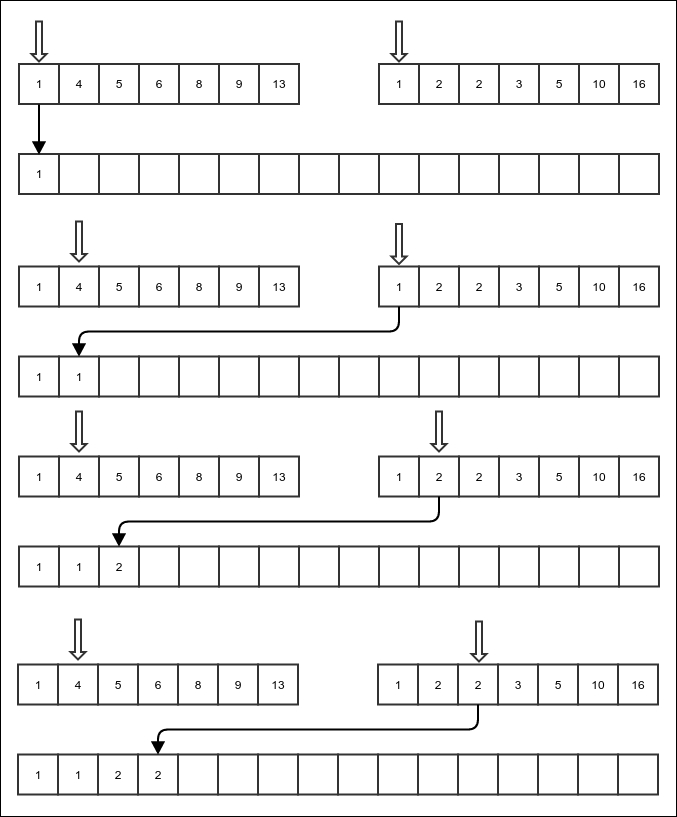
In the previous section, we tried to divide the array in such a way that when we sort each part, the entire array is sorted. We faced the problem that when we try to do that, the two parts are not equal in size causing the algorithm to sometimes take a quadratic amount of time. What if, instead of trying to divide the array in a way that sorting the parts would sort the whole, we just divide the array into two equal halves? Of course then, sorting the parts will not sort the entire array. However, if we have two array parts sorted on their own, can we merge them together to produce a sorted array as a whole? If we can do this efficiently enough, we would have an algorithm guaranteed to be efficient. As it turns out, it is possible. But we need to think about where the merged array will be stored. Since the values are being copied from the source array, the result needs to be stored in a separate place. So, we will need another storage of equal size for mergesort.

.

Merge of sorted...

Visually different images
CONTINUE READING
83
Tech Concepts
36
Programming languages
73
Tech Tools
Icon Unlimited access to the largest independent learning library in tech of over 8,000 expert-authored tech books and videos.
Icon Innovative learning tools, including AI book assistants, code context explainers, and text-to-speech.
Icon 50+ new titles added per month and exclusive early access to books as they are being written.
Java 9 Data Structures and Algorithms
notes
bookmark Notes and Bookmarks search Search in title playlist Add to playlist download Download options font-size Font size

Change the font size

margin-width Margin width

Change margin width

day-mode Day/Sepia/Night Modes

Change background colour

Close icon Search
Country selected

Close icon Your notes and bookmarks

Confirmation

Modal Close icon
claim successful

Buy this book with your credits?

Modal Close icon
Are you sure you want to buy this book with one of your credits?
Close
YES, BUY

Submit Your Feedback

Modal Close icon
Modal Close icon
Modal Close icon