Sign In Start Free Trial
Account

Add to playlist

Create a Playlist

Modal Close icon
You need to login to use this feature.
  • Book Overview & Buying Force.com Enterprise Architecture
  • Table Of Contents Toc
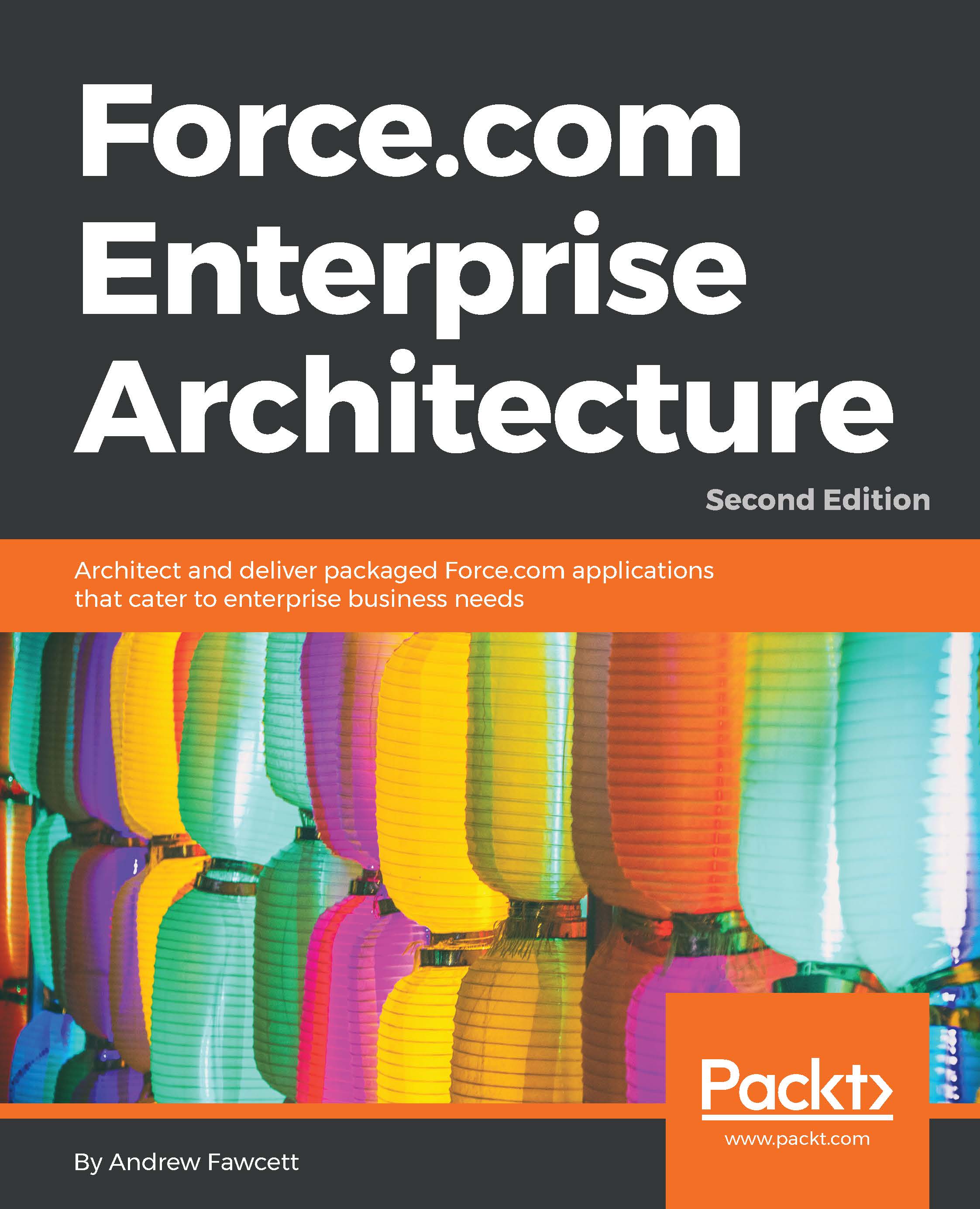
Force.com Enterprise Architecture

Force.com Enterprise Architecture - Second Edition

By : Andrew Fawcett
4.5 (6)
close
close
Force.com Enterprise Architecture

Force.com Enterprise Architecture

4.5 (6)
By: Andrew Fawcett

Overview of this book

Companies of all sizes have seen the need for Force.com's architectural strategy focused on enabling their business objectives. Successful enterprise applications require planning, commitment, and investment in the best tools, processes, and features available. This book will teach you how to architect and support enduring applications for enterprise clients with Salesforce by exploring how to identify architecture needs and design solutions based on industry standard patterns. There are several ways to build solutions on Force.com, and this book will guide you through a logical path and show you the steps and considerations required to build packaged solutions from start to finish. It covers all aspects, from engineering to getting your application into the hands of your customers, and ensuring that they get the best value possible from your Force.com application. You will get acquainted with extending tools such as Lightning App Builder, Process Builder, and Flow with your own application logic. In addition to building your own application API, you will learn the techniques required to leverage the latest Lightning technologies on desktop and mobile platforms.
Table of Contents (15 chapters)
close
close
14
Index

Separation of Concerns


As you can see there are a number of places Apex code is invoked by various platform features. Such places represent areas for valuable code to potentially hide. It is hidden because it is typically not easy or appropriate to reuse such logic as each of the areas mentioned in the previous table has its own subtle concerns with respect to security, state management, transactions, and other aspects such as error handling (for example, catching and communicating errors) as well as varying needs for bulkification.

Throughout the rest of this chapter, we will review these requirements and distill them into a Separation of Concerns that allows a demarcation of responsibilities between the Apex code used to integrate with these platform features versus the code implementing your application business logic, such that the code can be shared between platform features today and in the future more readily. Wikipedia describes the benefits of Separation of Concerns as the following...

Visually different images
CONTINUE READING
83
Tech Concepts
36
Programming languages
73
Tech Tools
Icon Unlimited access to the largest independent learning library in tech of over 8,000 expert-authored tech books and videos.
Icon Innovative learning tools, including AI book assistants, code context explainers, and text-to-speech.
Icon 50+ new titles added per month and exclusive early access to books as they are being written.
Force.com Enterprise Architecture
notes
bookmark Notes and Bookmarks search Search in title playlist Add to playlist font-size Font size

Change the font size

margin-width Margin width

Change margin width

day-mode Day/Sepia/Night Modes

Change background colour

Close icon Search
Country selected

Close icon Your notes and bookmarks

Confirmation

Modal Close icon
claim successful

Buy this book with your credits?

Modal Close icon
Are you sure you want to buy this book with one of your credits?
Close
YES, BUY

Submit Your Feedback

Modal Close icon
Modal Close icon
Modal Close icon