Sign In Start Free Trial
Account

Add to playlist

Create a Playlist

Modal Close icon
You need to login to use this feature.
  • Book Overview & Buying .NET Design Patterns
  • Table Of Contents Toc
.NET Design Patterns

.NET Design Patterns

By : Praseed Pai, Shine Xavier
3.6 (5)
close
close
.NET Design Patterns

.NET Design Patterns

3.6 (5)
By: Praseed Pai, Shine Xavier

Overview of this book

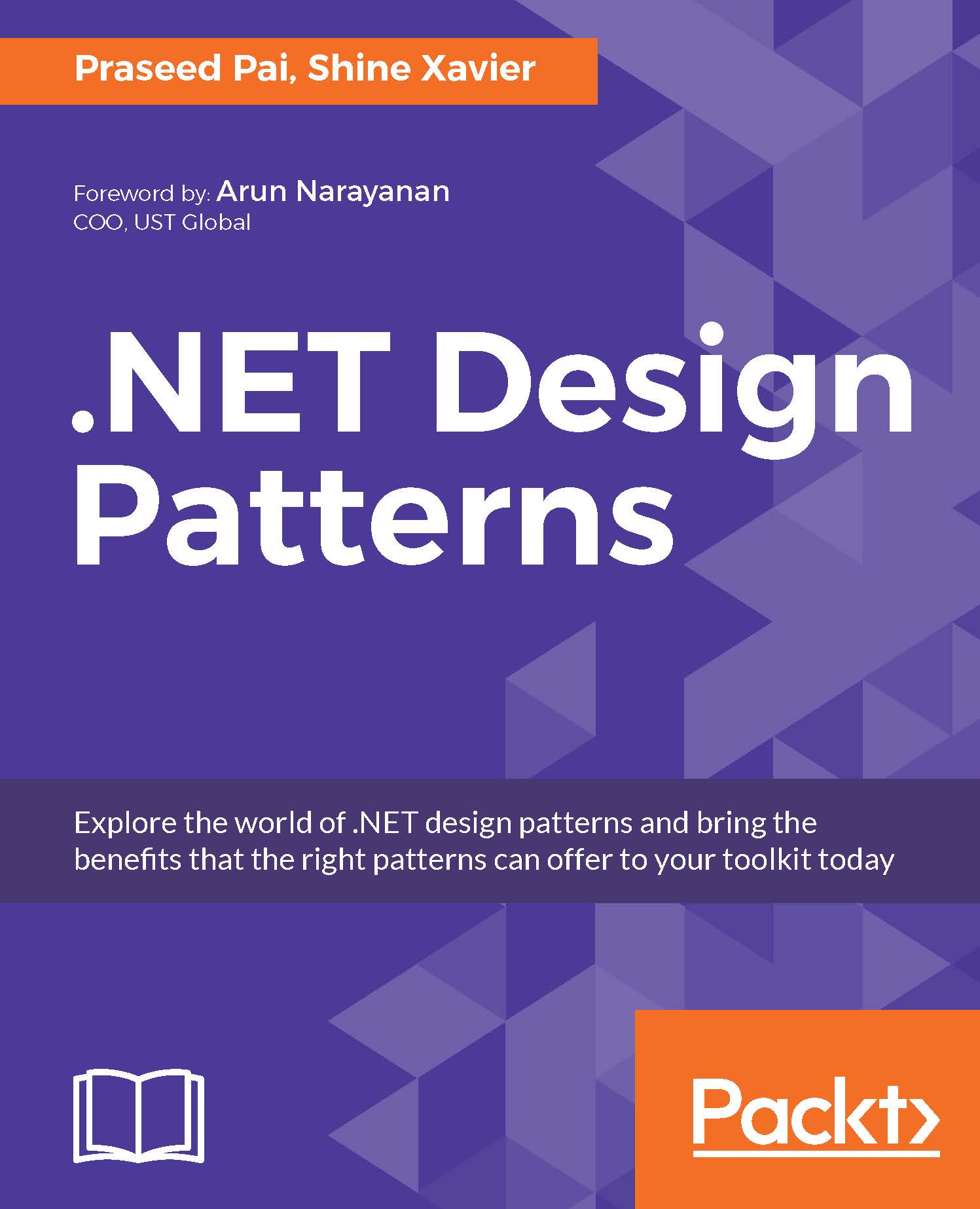
Knowing about design patterns enables developers to improve their code base, promoting code reuse and making their design more robust. This book focuses on the practical aspects of programming in .NET. You will learn about some of the relevant design patterns (and their application) that are most widely used. We start with classic object-oriented programming (OOP) techniques, evaluate parallel programming and concurrency models, enhance implementations by mixing OOP and functional programming, and finally to the reactive programming model where functional programming and OOP are used in synergy to write better code. Throughout this book, we’ll show you how to deal with architecture/design techniques, GoF patterns, relevant patterns from other catalogs, functional programming, and reactive programming techniques. After reading this book, you will be able to convincingly leverage these design patterns (factory pattern, builder pattern, prototype pattern, adapter pattern, facade pattern, decorator pattern, observer pattern and so on) for your programs. You will also be able to write fluid functional code in .NET that would leverage concurrency and parallelism!
Table of Contents (15 chapters)
close
close

Conventions

In this book, you will find a number of text styles that distinguish between different kinds of information. Here are some examples of these styles and an explanation of their meaning.

Code words in text, database table names, folder names, filenames, file extensions, pathnames, dummy URLs, user input, and Twitter handles are shown as follows: "An instance of this class needs to be passed to the Sort routine of the List<T> instance."

A block of code is set as follows:

    class Employee 
    { 
        public String name {get;set;} 
        public int age {get;set;} 
        public double salary { get; set; } 
    }

When we wish to draw your attention to a particular part of a code block, the relevant lines or items are set in bold:

    return function () { 
      try { 
        return fn.apply(null, args.slice(1)); 
      }

Any command-line input or output is written as follows:

npm install rx

New terms and important words are shown in bold. Words that you see on the screen, for example, in menus or dialog boxes, appear in the text like this: "You could simply do this in JSbin by using the Add library option shown in the web editor."

Note

Warnings or important notes appear in a box like this.

Tip

Tips and tricks appear like this.

CONTINUE READING
83
Tech Concepts
36
Programming languages
73
Tech Tools
Icon Unlimited access to the largest independent learning library in tech of over 8,000 expert-authored tech books and videos.
Icon Innovative learning tools, including AI book assistants, code context explainers, and text-to-speech.
Icon 50+ new titles added per month and exclusive early access to books as they are being written.
.NET Design Patterns
notes
bookmark Notes and Bookmarks search Search in title playlist Add to playlist download Download options font-size Font size

Change the font size

margin-width Margin width

Change margin width

day-mode Day/Sepia/Night Modes

Change background colour

Close icon Search
Country selected

Close icon Your notes and bookmarks

Confirmation

Modal Close icon
claim successful

Buy this book with your credits?

Modal Close icon
Are you sure you want to buy this book with one of your credits?
Close
YES, BUY

Submit Your Feedback

Modal Close icon
Modal Close icon
Modal Close icon