Sign In Start Free Trial
Account

Add to playlist

Create a Playlist

Modal Close icon
You need to login to use this feature.
  • Book Overview & Buying Go Design Patterns
  • Table Of Contents Toc
  • Feedback & Rating feedback
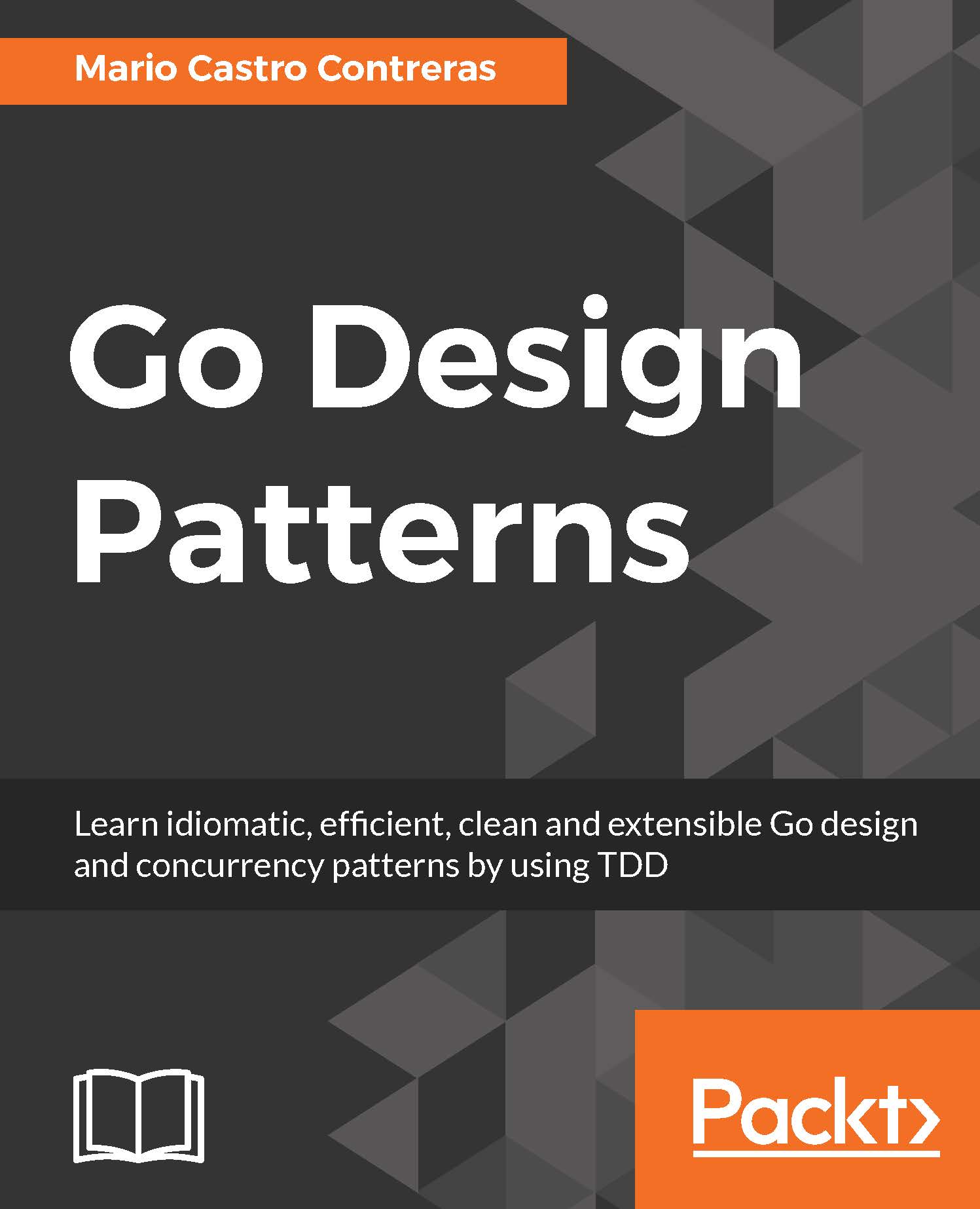
Go Design Patterns

Go Design Patterns

By : Castro Contreras
1.8 (6)
close
close
Go Design Patterns

Go Design Patterns

1.8 (6)
By: Castro Contreras

Overview of this book

Go is a multi-paradigm programming language that has built-in facilities to create concurrent applications. Design patterns allow developers to efficiently address common problems faced during developing applications. Go Design Patterns will provide readers with a reference point to software design patterns and CSP concurrency design patterns to help them build applications in a more idiomatic, robust, and convenient way in Go. The book starts with a brief introduction to Go programming essentials and quickly moves on to explain the idea behind the creation of design patterns and how they appeared in the 90’s as a common "language" between developers to solve common tasks in object-oriented programming languages. You will then learn how to apply the 23 Gang of Four (GoF) design patterns in Go and also learn about CSP concurrency patterns, the "killer feature" in Go that has helped Google develop software to maintain thousands of servers. With all of this the book will enable you to understand and apply design patterns in an idiomatic way that will produce concise, readable, and maintainable software.
Table of Contents (11 chapters)
close
close

Variables and constants

Variables are spaces in computer's memory to store values that can be modified during the execution of the program. Variables and constants have a type like the ones described in preceding text. Although, you don't need to explicitly write the type of them (although you can do it). This property to avoid explicit type declaration is what is called Inferred types. For example:

    //Explicitly declaring a "string" variable 
    var explicit string = "Hello, I'm a explicitly declared variable" 

Here we are declaring a variable (with the keyword var) called explicit of string type. At the same time, we are defining the value to Hello World!.

    //Implicitly declaring a "string". Type inferred 
inferred := ", I'm an inferred variable " 

But here we are doing exactly the same thing. We have avoided the var keyword and the string type declaration. Internally, Go's compiler will infer (guess) the type of the variable to a string type. This way you have to write much less code for each variable definition.

The following lines use the reflect package to gather information about a variable. We are using it to print the type of (the TypeOf variable in the code) of both variables:

    fmt.Println("Variable 'explicit' is of type:", 
        reflect.TypeOf(explicit)) 
    fmt.Println("Variable 'inferred' is of type:", 
        reflect.TypeOf(inferred)) 

When we run the program, the result is the following:

$ go run main.go
Hello, I'm a explicitly declared variable
Hello, I'm an inferred variable
Variable 'explicit' is of type: string
Variable 'inferred' is of type: string

As we expected, the compiler has inferred the type of the implicit variable to string too. Both have written the expected output to the console.

Visually different images
CONTINUE READING
83
Tech Concepts
36
Programming languages
73
Tech Tools
Icon Unlimited access to the largest independent learning library in tech of over 8,000 expert-authored tech books and videos.
Icon Innovative learning tools, including AI book assistants, code context explainers, and text-to-speech.
Icon 50+ new titles added per month and exclusive early access to books as they are being written.
Go Design Patterns
notes
bookmark Notes and Bookmarks search Search in title playlist Add to playlist download Download options font-size Font size

Change the font size

margin-width Margin width

Change margin width

day-mode Day/Sepia/Night Modes

Change background colour

Close icon Search
Country selected

Close icon Your notes and bookmarks

Confirmation

Modal Close icon
claim successful

Buy this book with your credits?

Modal Close icon
Are you sure you want to buy this book with one of your credits?
Close
YES, BUY

Submit Your Feedback

Modal Close icon
Modal Close icon
Modal Close icon