
Sign In Start Free Trial
Account

Add to playlist

Create a Playlist

Modal Close icon
You need to login to use this feature.
  • Book Overview & Buying Mastering Assembly Programming
  • Table Of Contents Toc
Mastering Assembly Programming

Mastering Assembly Programming

By : Alexey Lyashko
3 (0)
close
close
Mastering Assembly Programming

Mastering Assembly Programming

3 (0)
By: Alexey Lyashko

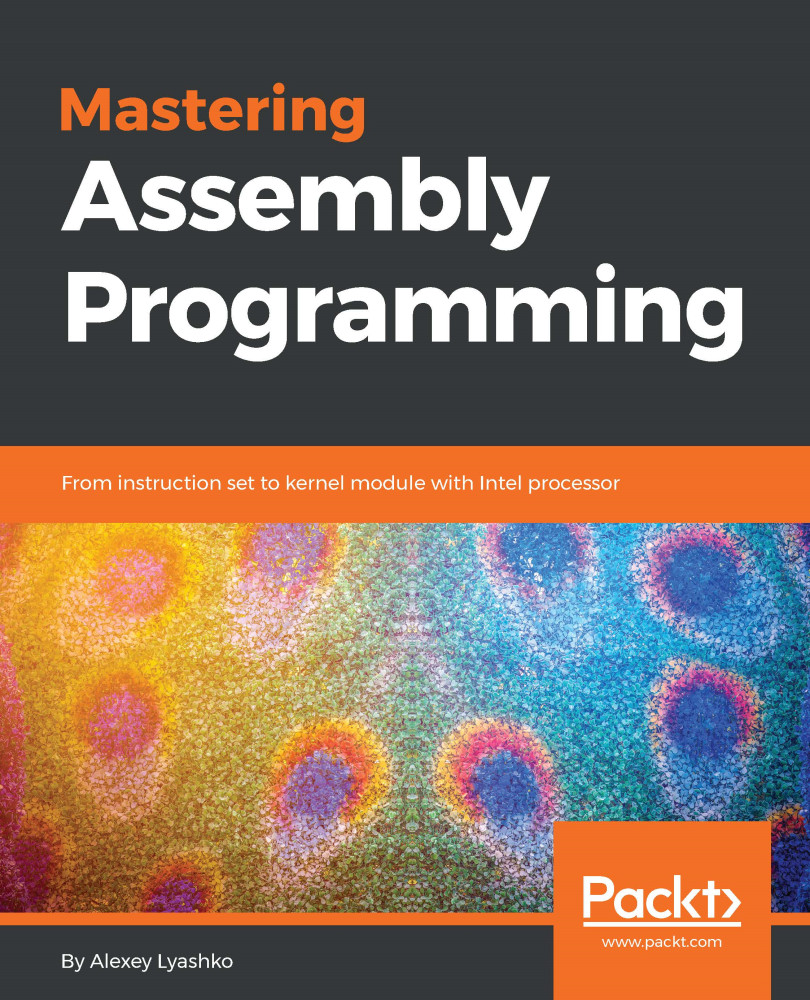
Overview of this book

The Assembly language is the lowest level human readable programming language on any platform. Knowing the way things are on the Assembly level will help developers design their code in a much more elegant and efficient way. It may be produced by compiling source code from a high-level programming language (such as C/C++) but can also be written from scratch. Assembly code can be converted to machine code using an assembler. The first section of the book starts with setting up the development environment on Windows and Linux, mentioning most common toolchains. The reader is led through the basic structure of CPU and memory, and is presented the most important Assembly instructions through examples for both Windows and Linux, 32 and 64 bits. Then the reader would understand how high level languages are translated into Assembly and then compiled into object code. Finally we will cover patching existing code, either legacy code without sources or a running code in same or remote process.
Table of Contents (12 chapters)
close
close
Lock Free Chapter
1
Intel Architecture

Summary

In this chapter, we have briefly covered several types of data structures (not to be confused with the Assembly struc[tures]) and reviewed a few of their possible applications. However, being very vast, the topic of data structures may require a separate chapter for each of the structures briefly described here, and their variations, which, unfortunately, falls out of the scope of this book.

Beginning with the next chapter (Chapter 8, Mixing Modules Written in Assembly and Those Written in High-Level Languages), we will approach more practical problems and will start applying the knowledge we have gathered thus far in an attempt to find an elegant solution.

In the next chapter, we will see how the Assembly code written for both 32-bit and 64-bit Windows and Linux operating systems may be linked with existing libraries written either in Assembly or in a high-level language...

CONTINUE READING
83
Tech Concepts
36
Programming languages
73
Tech Tools
Icon Unlimited access to the largest independent learning library in tech of over 8,000 expert-authored tech books and videos.
Icon Innovative learning tools, including AI book assistants, code context explainers, and text-to-speech.
Icon 50+ new titles added per month and exclusive early access to books as they are being written.
Mastering Assembly Programming
notes
bookmark Notes and Bookmarks search Search in title playlist Add to playlist download Download options font-size Font size

Change the font size

margin-width Margin width

Change margin width

day-mode Day/Sepia/Night Modes

Change background colour

Close icon Search
Country selected

Close icon Your notes and bookmarks

Confirmation

Modal Close icon
claim successful

Buy this book with your credits?

Modal Close icon
Are you sure you want to buy this book with one of your credits?
Close
YES, BUY

Submit Your Feedback

Modal Close icon
Modal Close icon
Modal Close icon