Sign In Start Free Trial
Account

Add to playlist

Create a Playlist

Modal Close icon
You need to login to use this feature.
  • Book Overview & Buying Learn Python in 7 Days
  • Table Of Contents Toc
Learn Python in 7 Days

Learn Python in 7 Days

By : Mohit Raj, Bhaskar N. Das
1.5 (2)
close
close
Learn Python in 7 Days

Learn Python in 7 Days

1.5 (2)
By: Mohit Raj, Bhaskar N. Das

Overview of this book

Python is a great language to get started in the world of programming and application development. This book will help you to take your skills to the next level having a good knowledge of the fundamentals of Python. We begin with the absolute foundation, covering the basic syntax, type variables and operators. We'll then move on to concepts like statements, arrays, operators, string processing and I/O handling. You’ll be able to learn how to operate tuples and understand the functions and methods of lists. We’ll help you develop a deep understanding of list and tuples and learn python dictionary. As you progress through the book, you’ll learn about function parameters and how to use control statements with the loop. You’ll further learn how to create modules and packages, storing of data as well as handling errors. We later dive into advanced level concepts such as Python collections and how to use class, methods, objects in python. By the end of this book, you will be able to take your skills to the next level having a good knowledge of the fundamentals of Python.
Table of Contents (12 chapters)
close
close
2
Type Variables and Operators

List comprehensions


List comprehension is a concise way of creating lists. In this section, we will use a list with the for loop. If you have not read about the for loop so far, you can skip this section and get back after learning about the for loop, covered in Chapter 6, Control Statements and Loops.

Let's take a list1 list as shown:

list1 = [2,3,4,5,6]

Now, our aim is to make a new list that contains the square of the elements of list1:

list1 = [2,3,4,5,6]

list2 = []

for each in list1:

            list2.append(each*each)

print list2

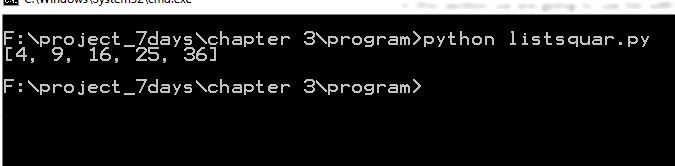
The output of the program is as follows:

Square of list

The preceding code took four lines to create the desired list. By using list comprehensions, we can do the preceding stuff in just one line:

>>> list1 = [2, 3, 4, 5, 6]

>>> [each*each for each in list1]

[4, 9, 16, 25, 36]

>>> 

Let's have a look at some more examples with the if statement.

 Create a new list that would contain the square of the even numbers of a given list:

list1...
CONTINUE READING
83
Tech Concepts
36
Programming languages
73
Tech Tools
Icon Unlimited access to the largest independent learning library in tech of over 8,000 expert-authored tech books and videos.
Icon Innovative learning tools, including AI book assistants, code context explainers, and text-to-speech.
Icon 50+ new titles added per month and exclusive early access to books as they are being written.
Learn Python in 7 Days
notes
bookmark Notes and Bookmarks search Search in title playlist Add to playlist download Download options font-size Font size

Change the font size

margin-width Margin width

Change margin width

day-mode Day/Sepia/Night Modes

Change background colour

Close icon Search
Country selected

Close icon Your notes and bookmarks

Confirmation

Modal Close icon
claim successful

Buy this book with your credits?

Modal Close icon
Are you sure you want to buy this book with one of your credits?
Close
YES, BUY

Submit Your Feedback

Modal Close icon
Modal Close icon
Modal Close icon