




In this section, we will discuss the advantages and disadvantages of having a serverless environment in your organization. As the name suggests, a serverless environment provides you with abstraction from operating systems, servers, and infrastructure. This comes with its own set of advantages and disadvantages. For example, if you are using Function as Service (FaaS) or an integration workflow, you only need to concern yourself with development implementation rather than with procurement of hardware and the building of infrastructure to run functions or integration workflows. This allows an organization to concentrate more on business requirements and innovation in the sector, rather than external factors such as infrastructure setup, firewalls, hardware procurement, and networking.
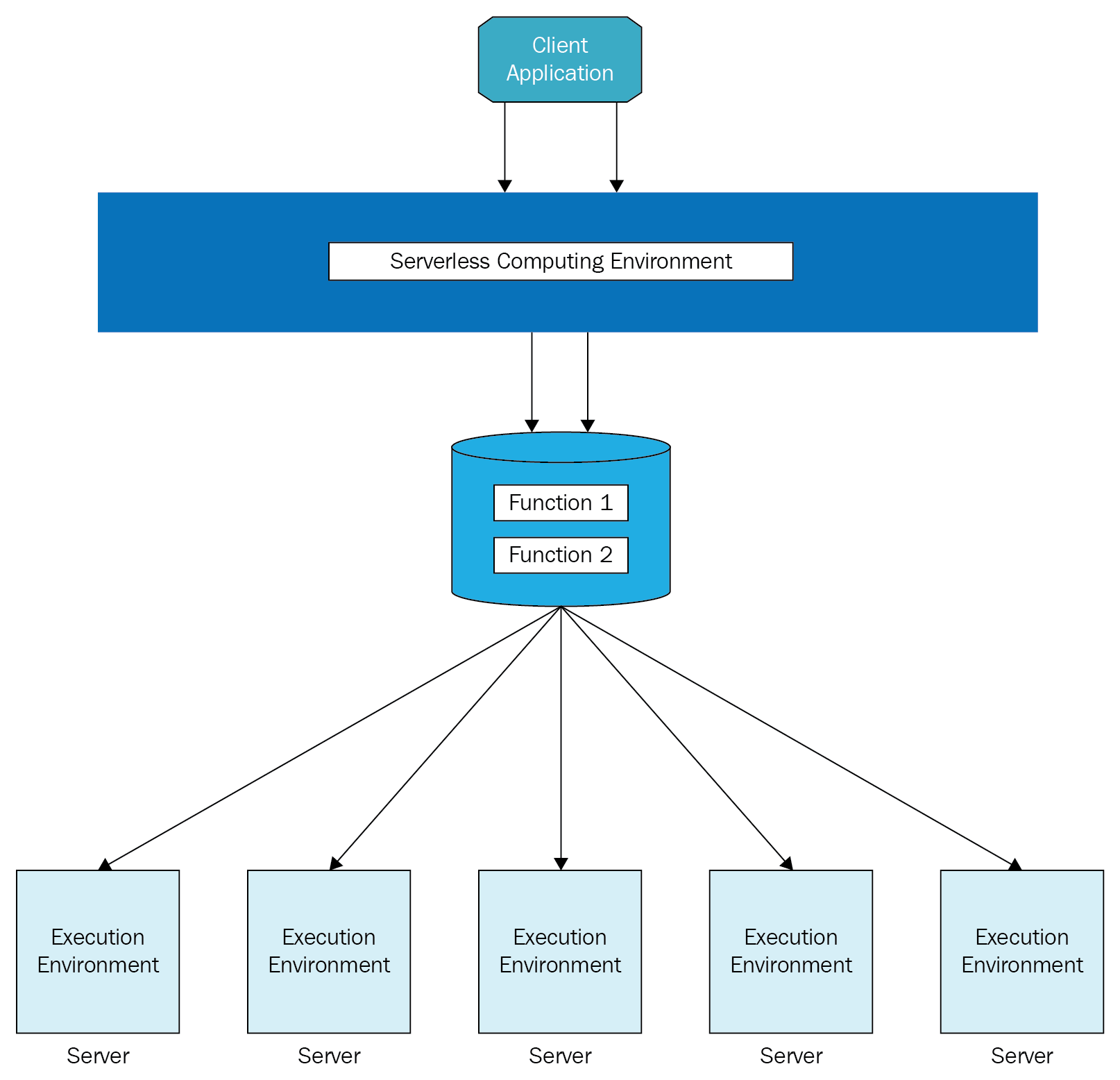
The following diagram is a representation of a serverless FaaS environment in the cloud, where auto scaling is catered for through multiple execution runtime environments:
As there are multiple layers to this discussion, let's discuss how you and your organization benefit from a serverless application architecture:
- Event-driven architecture: As we move closer to a serverless architecture, we also move closer to reactive asynchronous design patterns. For example, think of your application reacting to an event of your choice instead of polling for all events and then filtering for the required data. This has huge benefits for your organization in terms of the optimization of available resources and minimizing the overall application running cost in the cloud.
- Language of your choice: Organizations often struggle to find the right set of development resources that work for their business requirements. You might be a .NET developer or Node.js expert; these serverless platforms provide us with a platform in which language and framework are not constraints and you can write your own code with the language of your choice. This is one of the amazing benefits of utilizing serverless environments for your organization.
- Microbilling: A business cares about expenditure and innovation. When you think about a business owner's prospective costs, optimization is one of the biggest challenges in today's world. Most cloud vendors have worked through this challenge to provide better experiences to businesses by introducing a consumption-based pricing model. As more and more organizations are moving to the cloud, there has been a huge reduction in consumption across all cloud vendors. This helps cloud vendors to maximize their resource utilization.
- Scale on demand: Serverless environments are highly flexible in terms of scaling. As each serverless platform runs on a separate container, it is easy for cloud vendors to scale services as per demand. With auto scaling enabled, we need only worry about the best implementation of our applications and software, rather than about making applications to suit infrastructural requirements.
- Geolocation: Most serverless platforms can run across multiple regions. This is another key advantage when moving to the cloud. With geolocation features, businesses can meet customer requirements across different regions the world over without experiencing any latency or user experience problems.
- Better monitoring and priorities: With great monitoring capabilities in serverless environments, the DevOps team can now concentrate more on best practices for application development, deployment, and innovation, rather than spending endless nights supporting the infrastructure. This has benefited organizations in remaining competitive against market changes and innovation in their respective sectors.
We just covered some of the benefits of serverless environments – those were just a few of the many that there are. Now, let's discuss some disadvantages of serverless platforms:
- Vendor-specific resources: Most serverless platforms are managed and controlled by specified cloud vendors. This has potential drawbacks if you think of moving your resources to different hosting platforms or different cloud vendors. When using serverless platforms, you are locked into a specific implementation design that may not allow for your organization's flexibility requirements, and there may also be compatibility issues regarding business regions and changing pricing models.
- Governance: Most serverless platforms provide you with frameworks with easy startup, but there is a potential drawback to this. If you do not follow the right practices from the start, then you can put your business at risk. An example of this would be storing your database connection in your configuration file rather than using secure configuration storage or not implementing security for your outbound APIs. Though these are considered best practices, sometimes teams tend to move toward unsecured architecture patterns to meet business requirements.
- Monitoring across different cloud platforms: If your organization uses multiple cloud platforms, then each vendor will likely have a different set of monitoring implementations. This drawback means it can be harder for enterprises to maintain cross-cloud platform resources.
- Infrastructure insights: With serverless solution patterns, you can lose insights into the overall infrastructure setup. To gain maximum resource utilization, most cloud vendors share resources across multiple application implementations. This has the potential drawback of you not being aware of neighboring systems or encountering application noise, which might hinder the performance of your application.
So, we have given you a glimpse of the pros and cons of serverless environments. These are what you need to consider when you port your new services to serverless environments. In the following sections, we will concentrate on Microsoft's serverless offerings, discussing their concepts before moving on to their implementation logic.


