
Sign In Start Free Trial
Account

Add to playlist

Create a Playlist

Modal Close icon
You need to login to use this feature.
  • Book Overview & Buying Tkinter GUI Programming by Example
  • Table Of Contents Toc
Tkinter GUI Programming by Example

Tkinter GUI Programming by Example

By : David Love
1 (3)
close
close
Tkinter GUI Programming by Example

Tkinter GUI Programming by Example

1 (3)
By: David Love

Overview of this book

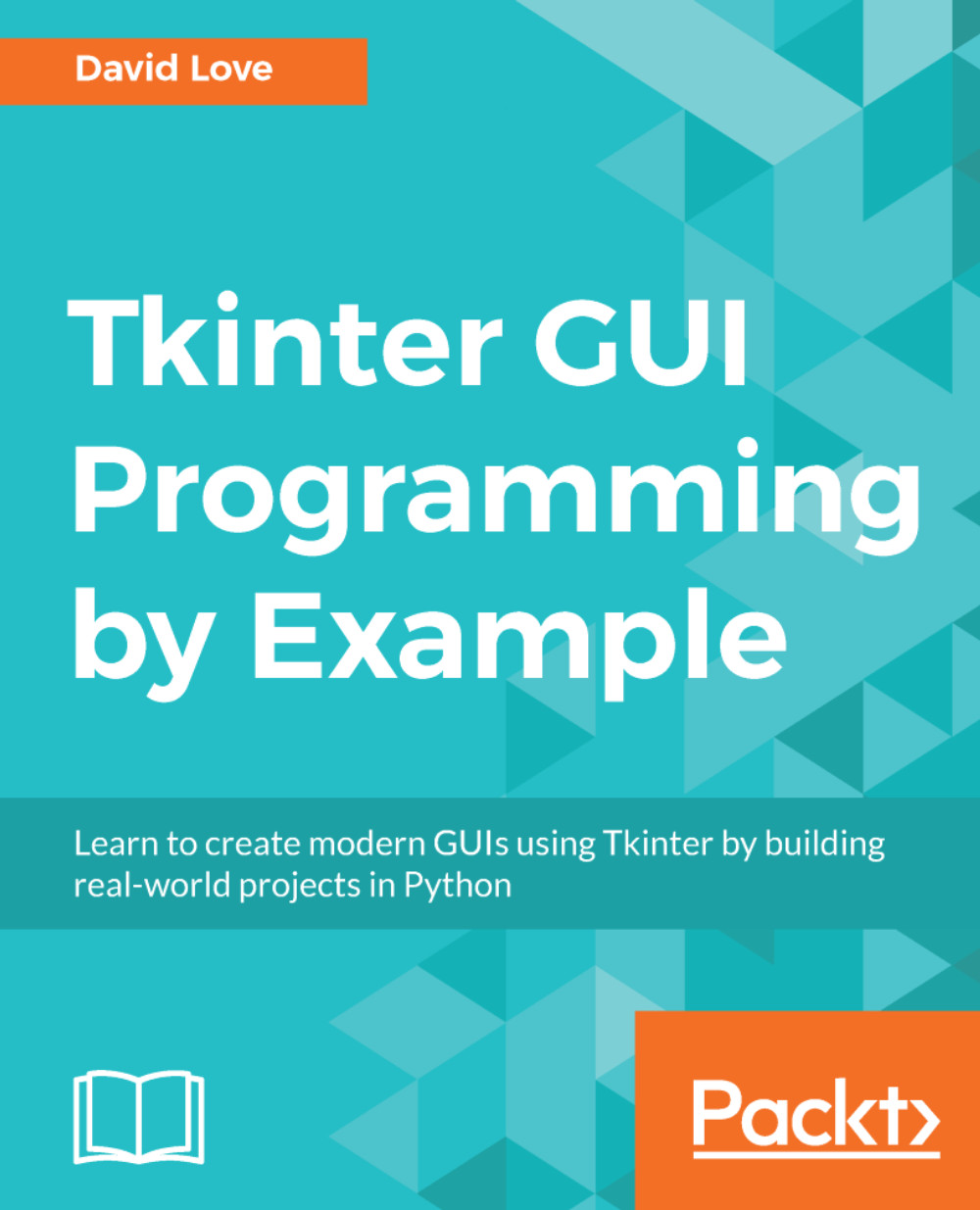
Tkinter is a modular, cross-platform application development toolkit for Python. When developing GUI-rich applications, the most important choices are which programming language(s) and which GUI framework to use. Python and Tkinter prove to be a great combination. This book will get you familiar with Tkinter by having you create fun and interactive projects. These projects have varying degrees of complexity. We'll start with a simple project, where you'll learn the fundamentals of GUI programming and the basics of working with a Tkinter application. After getting the basics right, we'll move on to creating a project of slightly increased complexity, such as a highly customizable Python editor. In the next project, we'll crank up the complexity level to create an instant messaging app. Toward the end, we'll discuss various ways of packaging our applications so that they can be shared and installed on other machines without the user having to learn how to install and run Python programs.
Table of Contents (13 chapters)
close
close

Summary

With this, our Hello World application has taught us all we should need to know with regard to basic GUI functionality. We have learned how to spawn a window containing various GUI elements by utilizing Tkinter's built-in widgets. We can place these widgets into the window using special functions called geometry managers, of which we have three to choose from.

The messagebox module allows us to easily convey information to the user without having to use any widgets within our main window, and can also be used to get feedback from a user and control how our window will behave.

We've added three simple, but effective widgets to our arsenal (not including the main window): the Label, for displaying static information; the Button, which allows a user to execute functions by clicking on it; and the Entry, which gathers textual information and allows for its use by our applications.

Next on our agenda is something a little different—a game of blackjack! By writing this game, we will also cover a very common starting point among programmers interested in GUI development: having a command-line application which could be improved by becoming a graphical one. In order to do this, we will briefly step back to the world of the CLI. 

CONTINUE READING
83
Tech Concepts
36
Programming languages
73
Tech Tools
Icon Unlimited access to the largest independent learning library in tech of over 8,000 expert-authored tech books and videos.
Icon Innovative learning tools, including AI book assistants, code context explainers, and text-to-speech.
Icon 50+ new titles added per month and exclusive early access to books as they are being written.
Tkinter GUI Programming by Example
notes
bookmark Notes and Bookmarks search Search in title playlist Add to playlist download Download options font-size Font size

Change the font size

margin-width Margin width

Change margin width

day-mode Day/Sepia/Night Modes

Change background colour

Close icon Search
Country selected

Close icon Your notes and bookmarks

Confirmation

Modal Close icon
claim successful

Buy this book with your credits?

Modal Close icon
Are you sure you want to buy this book with one of your credits?
Close
YES, BUY

Submit Your Feedback

Modal Close icon
Modal Close icon
Modal Close icon