
Sign In Start Free Trial
Account

Add to playlist

Create a Playlist

Modal Close icon
You need to login to use this feature.
  • Book Overview & Buying Hands-On Functional Programming with TypeScript
  • Table Of Contents Toc
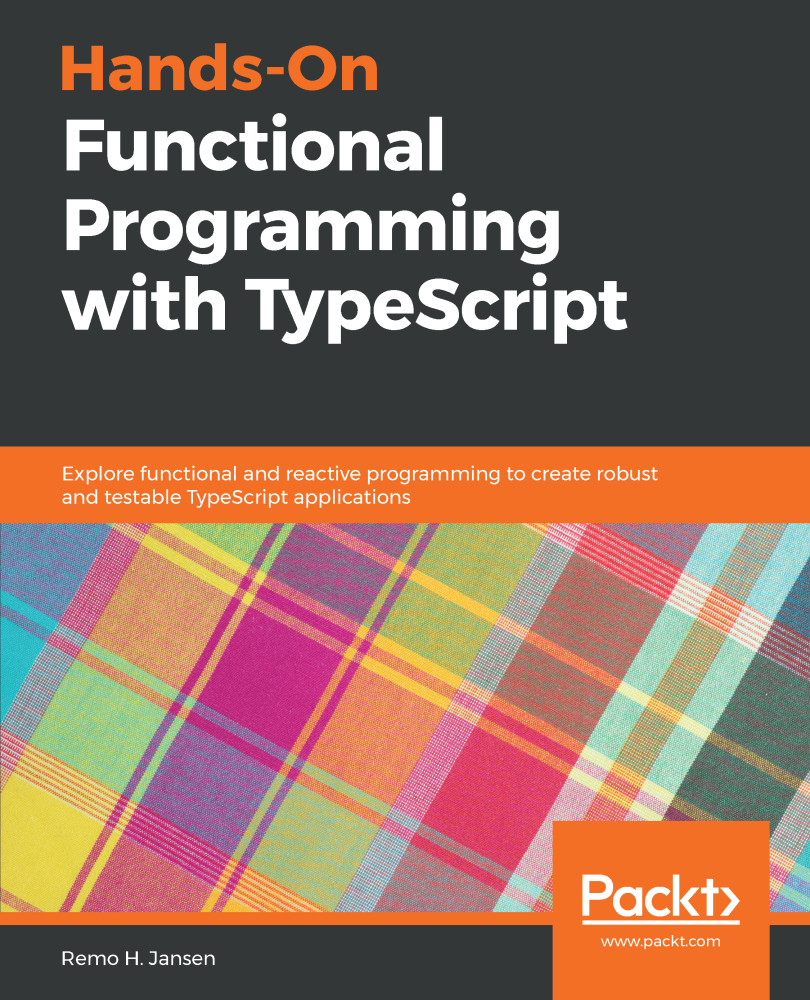
Hands-On Functional Programming with TypeScript

Hands-On Functional Programming with TypeScript

By : Remo H. Jansen
2 (2)
close
close
Hands-On Functional Programming with TypeScript

Hands-On Functional Programming with TypeScript

2 (2)
By: Remo H. Jansen

Overview of this book

Functional programming is a powerful programming paradigm that can help you to write better code. However, learning functional programming can be complicated, and the existing literature is often too complex for beginners. This book is an approachable introduction to functional programming and reactive programming with TypeScript for readers without previous experience in functional programming with JavaScript, TypeScript , or any other programming language. The book will help you understand the pros, cons, and core principles of functional programming in TypeScript. It will explain higher order functions, referential transparency, functional composition, and monads with the help of effective code examples. Using TypeScript as a functional programming language, you’ll also be able to brush up on your knowledge of applying functional programming techniques, including currying, laziness, and immutability, to real-world scenarios. By the end of this book, you will be confident when it comes to using core functional and reactive programming techniques to help you build effective applications with TypeScript.
Table of Contents (14 chapters)
close
close
5
The Runtime – Closures and Prototypes

Optics

Optics is a functional programming concept that can help us to reduce the amount of code that we need to write and make operations more readable. The benefits of using optics are particularly noticeable when we are working with immutable data structures. All optics are a way to get and set properties in an object. In fact, we can think about optics as an alternative to getters and setters in object-oriented programming.

Optics can be categorized into two main groups—lenses and prisms. As we learned in Chapter 7, Category Theory, algebraic data types can be defined in terms of sum and product types. A lens is used to work with product types (for example, tuples and objects) and a prism is used to work with sum types (for example, discriminated unions). During the remainder of this section, we are going to focus on the use of lenses.

...
CONTINUE READING
83
Tech Concepts
36
Programming languages
73
Tech Tools
Icon Unlimited access to the largest independent learning library in tech of over 8,000 expert-authored tech books and videos.
Icon Innovative learning tools, including AI book assistants, code context explainers, and text-to-speech.
Icon 50+ new titles added per month and exclusive early access to books as they are being written.
Hands-On Functional Programming with TypeScript
notes
bookmark Notes and Bookmarks search Search in title playlist Add to playlist download Download options font-size Font size

Change the font size

margin-width Margin width

Change margin width

day-mode Day/Sepia/Night Modes

Change background colour

Close icon Search
Country selected

Close icon Your notes and bookmarks

Confirmation

Modal Close icon
claim successful

Buy this book with your credits?

Modal Close icon
Are you sure you want to buy this book with one of your credits?
Close
YES, BUY

Submit Your Feedback

Modal Close icon
Modal Close icon
Modal Close icon