
Sign In Start Free Trial
Account

Add to playlist

Create a Playlist

Modal Close icon
You need to login to use this feature.
  • Book Overview & Buying Hands-On Design Patterns with Kotlin
  • Table Of Contents Toc
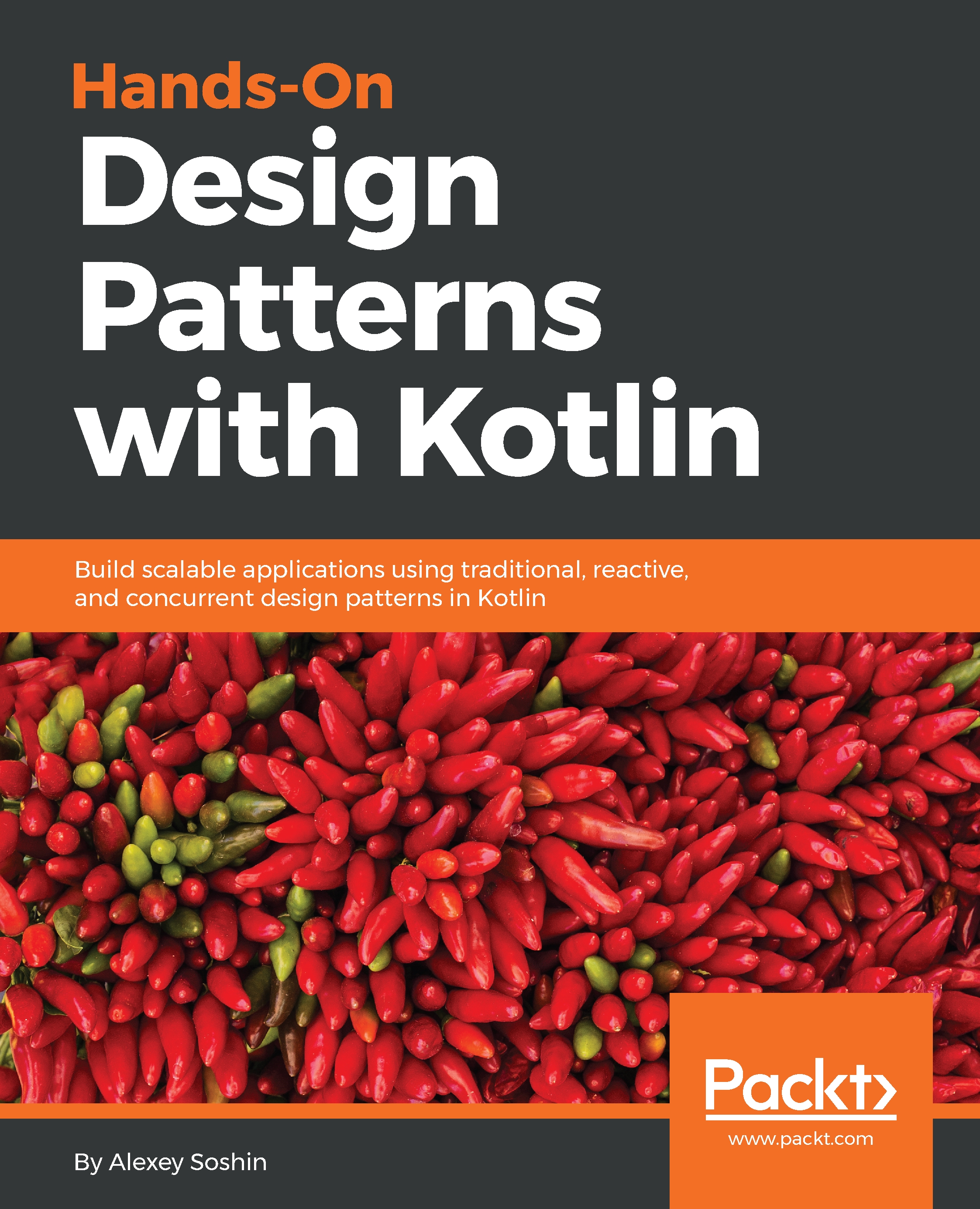
Hands-On Design Patterns with Kotlin

Hands-On Design Patterns with Kotlin

By : Alexey Soshin
4.1 (9)
close
close
Hands-On Design Patterns with Kotlin

Hands-On Design Patterns with Kotlin

4.1 (9)
By: Alexey Soshin

Overview of this book

Design patterns enable you as a developer to speed up the development process by providing you with proven development paradigms. Reusing design patterns helps prevent complex issues that can cause major problems, improves your code base, promotes code reuse, and makes an architecture more robust. The mission of this book is to ease the adoption of design patterns in Kotlin and provide good practices for programmers. The book begins by showing you the practical aspects of smarter coding in Kotlin, explaining the basic Kotlin syntax and the impact of design patterns. From there, the book provides an in-depth explanation of the classical design patterns of creational, structural, and behavioral families, before heading into functional programming. It then takes you through reactive and concurrent patterns, teaching you about using streams, threads, and coroutines to write better code along the way By the end of the book, you will be able to efficiently address common problems faced while developing applications and be comfortable working on scalable and maintainable projects of any size.
Table of Contents (13 chapters)
close
close

Streaming Your Data

In this chapter, we'll discuss higher-order functions for collections. For Java developers, they first appeared in Java 8 with the introduction of Stream API. But they were around for much longer in functional languages.

First, since we expect that many of our readers are familiar with Java 8, let's cover what Stream API is in Java briefly.

Streams from Java8 are not to be confused with some of the I/O classes with similar names, such as InputStream or OutputStream. While the latter represent data, the former are sequences of elements of the same type.

If those are sequences, and they all have the same type, how are they different from Lists? Well, streams can be infinite, unlike collections.

There is also a set of actions defined for Java streams. Not only are those actions the same for any kind of stream, they also have familiar names for those...

Visually different images
CONTINUE READING
83
Tech Concepts
36
Programming languages
73
Tech Tools
Icon Unlimited access to the largest independent learning library in tech of over 8,000 expert-authored tech books and videos.
Icon Innovative learning tools, including AI book assistants, code context explainers, and text-to-speech.
Icon 50+ new titles added per month and exclusive early access to books as they are being written.
Hands-On Design Patterns with Kotlin
notes
bookmark Notes and Bookmarks search Search in title playlist Add to playlist download Download options font-size Font size

Change the font size

margin-width Margin width

Change margin width

day-mode Day/Sepia/Night Modes

Change background colour

Close icon Search
Country selected

Close icon Your notes and bookmarks

Confirmation

Modal Close icon
claim successful

Buy this book with your credits?

Modal Close icon
Are you sure you want to buy this book with one of your credits?
Close
YES, BUY

Submit Your Feedback

Modal Close icon
Modal Close icon
Modal Close icon