Sign In Start Free Trial
Account

Add to playlist

Create a Playlist

Modal Close icon
You need to login to use this feature.
  • Book Overview & Buying Mastering SAS Programming for Data Warehousing
  • Table Of Contents Toc
Mastering SAS Programming for Data Warehousing

Mastering SAS Programming for Data Warehousing

By : Monika Wahi
4.4 (5)
close
close
Mastering SAS Programming for Data Warehousing

Mastering SAS Programming for Data Warehousing

4.4 (5)
By: Monika Wahi

Overview of this book

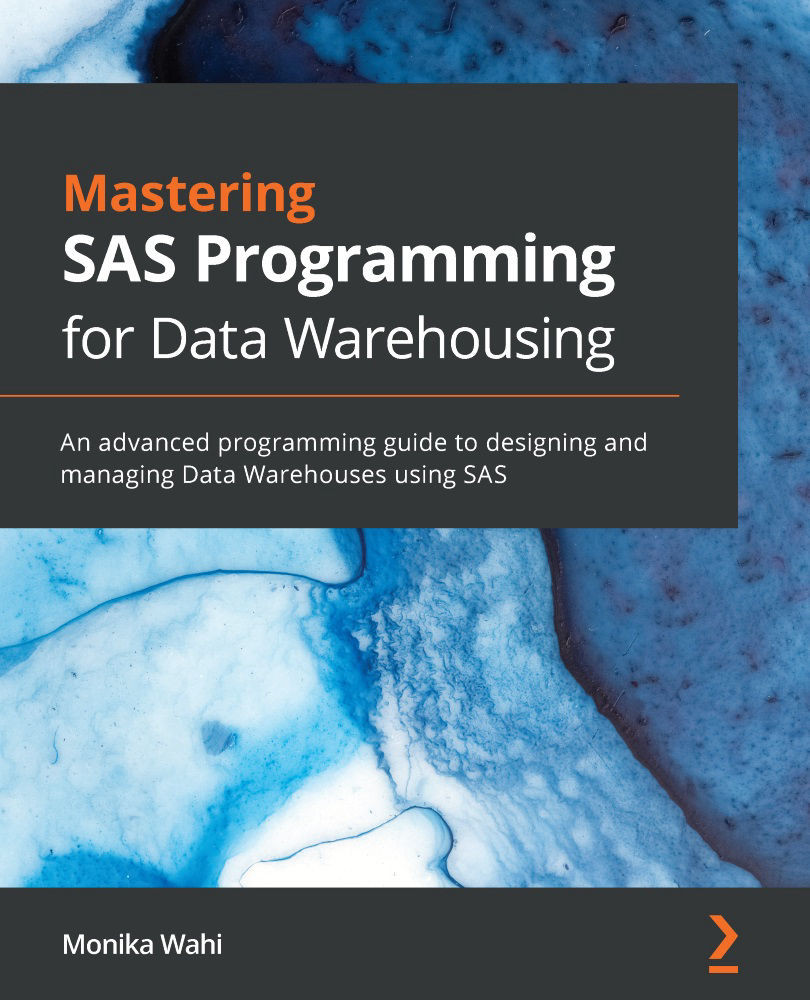
SAS is used for various functions in the development and maintenance of data warehouses, thanks to its reputation of being able to handle ’big data’. This book will help you learn the pros and cons of storing data in SAS. As you progress, you’ll understand how to document and design extract-transform-load (ETL) protocols for SAS processes. Later, you’ll focus on how the use of SAS arrays and macros can help standardize ETL. The book will also help you examine approaches for serving up data using SAS and explore how connecting SAS to other systems can enhance the data warehouse user’s experience. By the end of this data management book, you will have a fundamental understanding of the roles SAS can play in a warehouse environment, and be able to choose wisely when designing your data warehousing processes involving SAS.
Table of Contents (18 chapters)
close
close
1
Section 1: Managing Data in a SAS Data Warehouse
7
Section 2: Using SAS for Extract-Transform-Load (ETL) Protocols in a Data Warehouse
12
Section 3: Using SAS When Serving Warehouse Data to Users

Summary

This chapter provided a short history of SAS, focusing on how it has been used for data storage and analysis over the years. Initially, SAS data was stored on punch cards. Once data became electronic, the main challenge to SAS users working with big data was I/O. As SAS environments evolved from being on mainframes to being accessible by PCs, SAS developed new products and services to complement its core analytics and data management functions.

SAS data steps are procedural, and allow the programmer opportunities to greatly improve I/O through the use of certain commands, features, and approaches to programming. When SQL became popular, PROC SQL was invented. This allowed SAS users to choose between using data steps or SQL commands when managing data in SAS.

Today, SAS is still used in data warehousing, but there are new challenges with accessing data in the cloud. SAS data warehouses today can include predominantly SAS components, such as SAS VA and CAS. Or, SAS can be part of a warehouse system that includes other components and applications, such as cloud storage in Snowflake, and supplemental analytic functions provided by R.

Modern SAS data warehousing still seeks to improve I/O and to better serve warehouse users through the development of an efficient system that meets customer needs. Creativity is required in the design of modern SAS data warehouses so that the system can leverage the best SAS has to offer while avoiding its pitfalls.

Although this chapter covers the entire history of SAS for data storage, it is important for the new data scientist to understand this information because the way SAS runs today can often be explained by certain events in its history. Particular terminology and features that are unique to SAS arise from how it has evolved over time, and it is helpful to know this background when communicating with today's SAS data warehouse developers and data scientists.

The next chapter takes a sharp focus on the act of reading data into SAS and will close with strategies that can be used when importing difficult data into SAS.

Visually different images
CONTINUE READING
83
Tech Concepts
36
Programming languages
73
Tech Tools
Icon Unlimited access to the largest independent learning library in tech of over 8,000 expert-authored tech books and videos.
Icon Innovative learning tools, including AI book assistants, code context explainers, and text-to-speech.
Icon 50+ new titles added per month and exclusive early access to books as they are being written.
Mastering SAS Programming for Data Warehousing
notes
bookmark Notes and Bookmarks search Search in title playlist Add to playlist download Download options font-size Font size

Change the font size

margin-width Margin width

Change margin width

day-mode Day/Sepia/Night Modes

Change background colour

Close icon Search
Country selected

Close icon Your notes and bookmarks

Confirmation

Modal Close icon
claim successful

Buy this book with your credits?

Modal Close icon
Are you sure you want to buy this book with one of your credits?
Close
YES, BUY

Submit Your Feedback

Modal Close icon
Modal Close icon
Modal Close icon