
Sign In Start Free Trial
Account

Add to playlist

Create a Playlist

Modal Close icon
You need to login to use this feature.
  • Book Overview & Buying Learn Python by Building Data Science Applications
  • Table Of Contents Toc
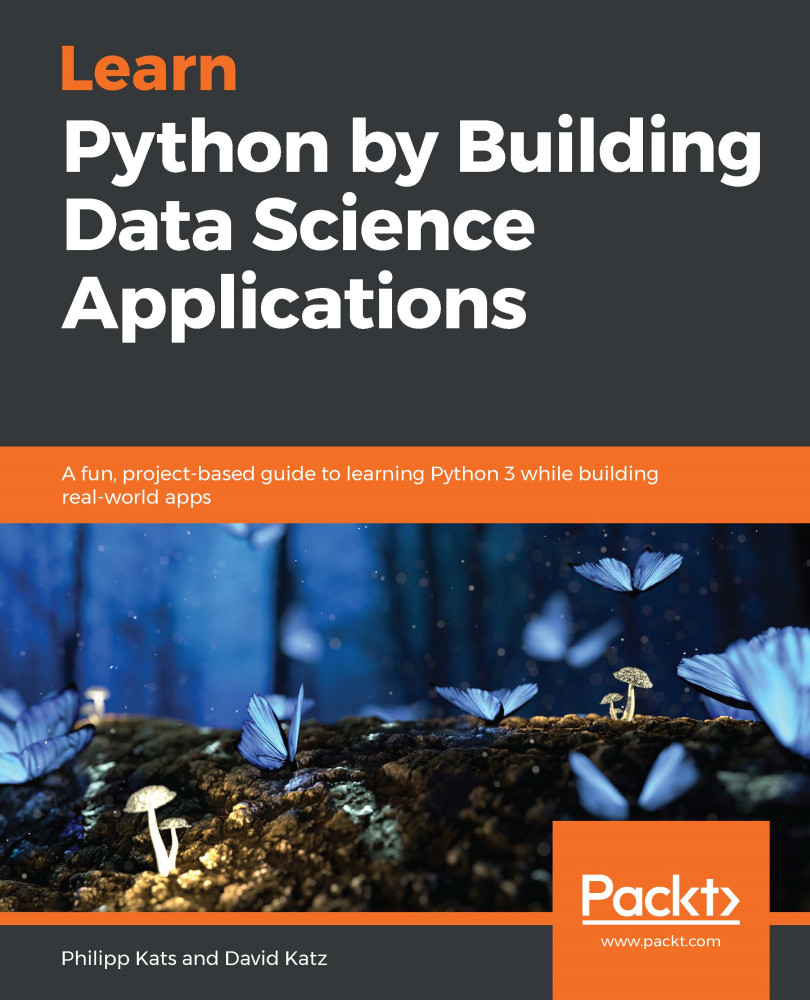
Learn Python by Building Data Science Applications

Learn Python by Building Data Science Applications

By : Kats, Katz
3 (3)
close
close
Learn Python by Building Data Science Applications

Learn Python by Building Data Science Applications

3 (3)
By: Kats, Katz

Overview of this book

Python is the most widely used programming language for building data science applications. Complete with step-by-step instructions, this book contains easy-to-follow tutorials to help you learn Python and develop real-world data science projects. The “secret sauce” of the book is its curated list of topics and solutions, put together using a range of real-world projects, covering initial data collection, data analysis, and production. This Python book starts by taking you through the basics of programming, right from variables and data types to classes and functions. You’ll learn how to write idiomatic code and test and debug it, and discover how you can create packages or use the range of built-in ones. You’ll also be introduced to the extensive ecosystem of Python data science packages, including NumPy, Pandas, scikit-learn, Altair, and Datashader. Furthermore, you’ll be able to perform data analysis, train models, and interpret and communicate the results. Finally, you’ll get to grips with structuring and scheduling scripts using Luigi and sharing your machine learning models with the world as a microservice. By the end of the book, you’ll have learned not only how to implement Python in data science projects, but also how to maintain and design them to meet high programming standards.
Table of Contents (26 chapters)
close
close
Lock Free Chapter
1
Section 1: Getting Started with Python
11
Section 2: Hands-On with Data
17
Section 3: Moving to Production

Summary

In this chapter, we learned how to form our code into production-level data pipelines that can be scheduled and re-run on demand. Building good pipelines is an important skill, as it enables you to have the data up to date and work on your business logic (for example, parsing the information), rather than running and re-running pipeline scripts or building your own bicycle solution. This reliable and robust solution is a good way to deploy and schedule your code as a deliverable. In the later part of this chapter, we learned about the different output formats and custom templates in luigi.

In the next chapter, we'll build on top of the pipeline we set up. We will use the data we collected to build a couple of interactive dashboards, allowing us to monitor the process and analyze ongoing trends in the data.

CONTINUE READING
83
Tech Concepts
36
Programming languages
73
Tech Tools
Icon Unlimited access to the largest independent learning library in tech of over 8,000 expert-authored tech books and videos.
Icon Innovative learning tools, including AI book assistants, code context explainers, and text-to-speech.
Icon 50+ new titles added per month and exclusive early access to books as they are being written.
Learn Python by Building Data Science Applications
notes
bookmark Notes and Bookmarks search Search in title playlist Add to playlist download Download options font-size Font size

Change the font size

margin-width Margin width

Change margin width

day-mode Day/Sepia/Night Modes

Change background colour

Close icon Search
Country selected

Close icon Your notes and bookmarks

Confirmation

Modal Close icon
claim successful

Buy this book with your credits?

Modal Close icon
Are you sure you want to buy this book with one of your credits?
Close
YES, BUY

Submit Your Feedback

Modal Close icon
Modal Close icon
Modal Close icon